TL;DR:
- Diamonds were first polished in India as octahedral crystals over 1,500 years ago. The development of tools like the scaif and bruting machine in Europe significantly improved cut quality and light performance. Today, advanced technology and scientific models produce the modern 58-facet round brilliant, which most influences a diamond’s beauty and value.
Diamond cutting evolved from simple polishing of natural crystal faces in ancient India into a mathematically engineered craft that produces the modern round brilliant, a 58-facet gem optimized to maximize light return. That shift, spanning roughly 1,500 years, is why cut is the single quality factor most responsible for a diamond’s visual impact and market value.
Key milestones at a glance:
- ~1375: The first European guild of diamond polishers formed in Nuremberg, Germany, establishing organized craft standards.
- 15th century: The scaif, a diamond-dusted polishing wheel, enabled matched facets and true symmetry for the first time.
- 1870s: Henry D. Morse and Charles M. Field introduced the bruting machine, prioritizing light performance over raw weight retention.
- 1919: Marcel Tolkowsky published the first mathematical model balancing brilliance and fire, laying the foundation for the modern round brilliant.
Table of Contents
- How diamond cutting began and why it matters
- From ancient India to medieval Europe
- Renaissance through the 19th century
- How major cuts evolved into the modern brilliant
- Key tools and inventions that changed cutting
- The science behind cut quality and proportions
- How diamond cutting works today
- Where diamond cutting happens around the world
- How cut affects value and what shoppers should know
- Timeline of key dates and figures
- Glossary of diamond cutting terms
- Sources and notes on contested attributions
- Key Takeaways
- Perspective
- Further reading
Table of Contents
- How did diamond cutting begin, and why does it matter? {#origins}
- From ancient India to medieval Europe {#ancient-to-medieval}
- Renaissance through the 19th century: tools, cuts, and industry centers {#renaissance-to-19c}
- How major cuts evolved into the modern brilliant {#evolution-of-cuts}
- Key tools and inventions that changed cutting capability {#technological-milestones}
- What is the science behind cut quality and proportions? {#science-of-cut}
- How does diamond cutting work today? {#modern-process}
- Where has diamond cutting happened throughout history? {#global-centers}
- How does cut affect market value and what should shoppers know? {#value-impact}
- Timeline of key dates and figures in diamond cutting {#timeline}
- Glossary of essential diamond cutting terms {#glossary}
- Sources and notes on contested attributions {#sources}
- Key Takeaways
- Why the history of diamond cutting matters more than most buyers realize {#perspective}
- Further reading: authoritative resources on diamond cutting history {#further-reading}
How did diamond cutting begin, and why does it matter? {#origins}
The history of diamond cutting explained in its simplest form is a story about human ingenuity applied to the hardest natural material on earth. Early cutters in India worked with what nature gave them: octahedral crystals with smooth, lustrous faces. Over centuries, trade routes carried both rough stones and polishing knowledge westward into the Islamic world and then into Europe, where guild craftsmen, Renaissance inventors, and eventually industrial engineers transformed a raw mineral into a precision optical instrument.
Why does this history matter to you as a buyer? Because every decision a cutter makes, from which facets to place to how much carat weight to sacrifice, directly affects the brilliance, fire, and price of the stone you see in a ring. Understanding the origin of diamond cutting helps you read a grading report intelligently, ask the right questions about proportions, and recognize why a well-cut one-carat stone can outsparkle a poorly cut stone of greater weight.
From ancient India to medieval Europe {#ancient-to-medieval}
The earliest evidence of diamond cutting
Diamond cutting was practiced on the Indian subcontinent as early as the 6th century AD. Ancient Sanskrit texts, including the Ratnapariksa and the Agastimata, describe diamonds and their qualities in detail, treating the natural octahedral crystal as the preferred form. Cutters of that era did not attempt to reshape the stone dramatically. Instead, they polished the existing crystal faces to enhance the stone’s natural adamantine luster, a quality prized for its hardness and surface sheen rather than for the internal light play we associate with diamonds today.
That context matters. The fire and brilliance we now consider essential to a diamond’s appeal are products of cutting geometry, not of the stone itself. A rough diamond looks more like a cloudy pebble than a sparkling gem. The entire history of gem cutting is, in a sense, the story of how craftsmen learned to unlock what was always inside the stone.
Trade routes and the spread of polishing knowledge
Islamic traders and scholars served as critical intermediaries, carrying both rough Indian diamonds and knowledge of polishing techniques into the Mediterranean world. By the time diamonds began appearing in European courts during the 13th and 14th centuries, basic polishing methods had already traveled a long way from their origins. European lapidaries initially worked with the same principle: follow the natural crystal shape, remove surface imperfections, and enhance the stone’s natural faces.
The Nuremberg polishers’ guild and the first European institution
European diamond cutting began in earnest in the mid-14th century. By approximately 1375, a guild of diamond polishers existed in Nuremberg, Germany, providing the first documented evidence of organized, institutionalized cutting in Europe. This was not a casual workshop arrangement. Guild membership meant standardized training, quality expectations, and trade protections, the same organizational logic that governed every skilled craft of the era. The Nuremberg guild marks the point at which diamond cutting shifted from an informal, individual skill into a recognized European profession.
Renaissance through the 19th century: tools, cuts, and industry centers {#renaissance-to-19c}
The period from roughly 1400 to 1900 produced most of the major technical breakthroughs in the evolution of diamond cutting methods. Each advance built on the last, and each was tied to a specific city, trade network, or individual innovator.
-
15th century: The scaif changes everything. The scaif, a diamond-dusted polishing wheel, was introduced in the 15th century and immediately transformed what was possible. Before the scaif, cutters could polish natural crystal faces but struggled to create new, precisely angled flat surfaces. The scaif allowed craftsmen to grind and polish any face at any angle with enough control to achieve matched, symmetrical facets. Venice and Bruges were early centers of this innovation, and the technique spread quickly through the Low Countries.
-
Late 15th–16th century: The table cut and rose cut emerge. The table cut, which flattened the top of an octahedral crystal to create a large flat facet, was the first major departure from the natural crystal form. The rose cut followed, featuring a flat base and a domed top covered with triangular facets, typically 6, 12, or 24 depending on the variant. Rose cuts became popular across Europe from the 16th through the 18th century, particularly in Amsterdam and Antwerp, which had grown into the dominant cutting centers of the era.
-
17th century: The Mazarin and Peruzzi cuts. Cardinal Mazarin of France is credited with commissioning or popularizing the Mazarin cut, a double-cut brilliant with approximately 17 crown facets that represented a significant leap in symmetry and light return. The Peruzzi cut, attributed to a Venetian polisher whose historical existence is debated (see Sources section), pushed the facet count further, with roughly 33 crown facets. These cuts introduced the concept of triangular and kite-shaped facets on both the crown and pavilion, the structural logic that underlies every brilliant cut since.
-
18th century: Old mine and old European cuts. The old mine cut, associated with Brazilian diamond production that began in the early 1700s, featured a cushion-shaped girdle, a high crown, a small table, and a large culet. The old European cut, developed by around 1750, used early bruting techniques to round the girdle and produced a more circular outline. Both cuts retained significant carat weight but sacrificed some optical efficiency by modern standards.
-
1870s: Mechanization and the bruting machine. The bruting machine, introduced in the late 19th century, enabled cutters to create perfectly circular girdles consistently and at scale. Henry D. Morse, a Boston-based diamond merchant, and his foreman Charles M. Field were central figures in this shift. Rather than maximizing carat weight from each rough stone, Morse and Field emphasized light performance, accepting greater material loss to achieve better optical results. That philosophy was genuinely radical for its time and directly anticipated the mathematical approach Tolkowsky would formalize decades later.
-
Early 20th century: Motorized saws. Motorized diamond saws, arriving around 1900, allowed cutters to divide rough stones with far greater precision than hand cleaving. Combined with the bruting machine, motorized saws made it practical to produce round brilliants in volume, setting the stage for the modern cutting industry.
How major cuts evolved into the modern brilliant {#evolution-of-cuts}
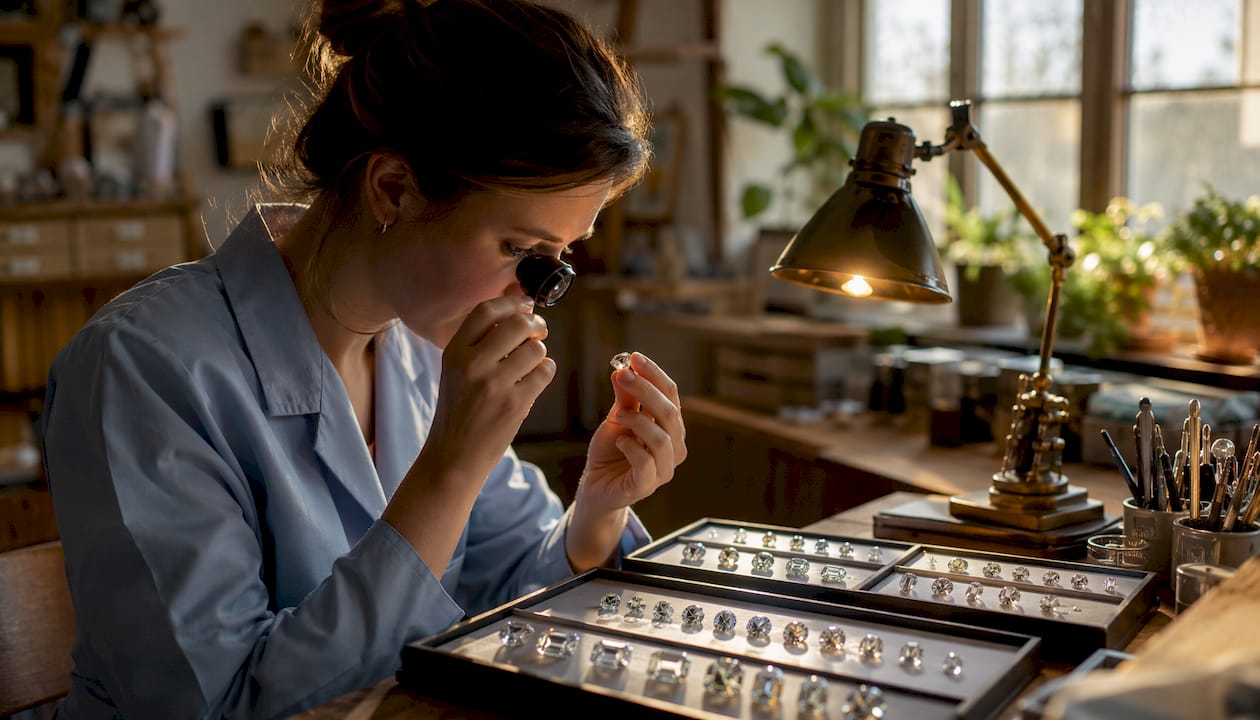
The progression from the point cut to the modern round brilliant is not a straight line. Each generation of cutters was working within the constraints of available tools, prevailing aesthetic tastes, and the economics of rough stone supply. The table below summarizes the major cuts, their approximate facet counts, and the functional advance each one represented.
Major diamond cuts: facets and key advances
| Cut | Approximate era | Crown facets | Total facets | Key advance |
|---|---|---|---|---|
| Point cut | 14th century | 0 (natural faces) | 8 | Polished natural octahedron; minimal waste |
| Table cut | Late 14th–15th c. | 9 | ~18 | First deliberate reshaping; flat table facet added |
| Rose cut | 16th–18th c. | 6–24 | 6–24 | Domed crown; flat base; early fire |
| Mazarin cut | 17th century | ~17 | ~34 | Double brilliant; matched crown and pavilion facets |
| Peruzzi cut | Late 17th c. | ~33 | ~57 | Triple-cut brilliant; near-modern facet count |
| Old mine cut | 18th century | 33 | 58 | Cushion girdle; high crown; large culet |
| Old European cut | ~1750–1880s | 33 | 58 | Round girdle via bruting; precursor to modern brilliant |
| Modern round brilliant | 1919–present | 33 | 58 | Mathematically optimized proportions (Tolkowsky) |
Each step in this sequence solved a specific optical problem. The table cut created a window into the stone but produced little fire. The rose cut added a domed crown that scattered light more attractively, though the flat base meant significant light leaked through the bottom. The Mazarin and Peruzzi cuts introduced pavilion facets that began to reflect light back upward through the crown, the fundamental mechanism of brilliance. The old European cut got the geometry close to right but lacked the precise angle calculations that Tolkowsky would later supply.
The 58-facet modern round brilliant) evolved from these 17th- and 18th-century experiments and was mathematically refined by Marcel Tolkowsky in 1919, producing a cut whose proportions are still the global benchmark.
Key tools and inventions that changed cutting capability {#technological-milestones}
The diamond cutting techniques history is inseparable from the history of the tools that made each technique possible. Here are the major breakthroughs and what each one actually enabled:
-
Scaif (15th century): A cast-iron wheel charged with a mixture of diamond dust and oil. Before the scaif, cutters could only polish existing crystal faces. With it, they could grind new facets at precise angles, enabling the symmetrical, multi-faceted cuts that define the brilliant family. The scaif remains in use today in modified form.
-
Bruting machine (1870s): Two diamonds mounted on opposing spindles, spun against each other to grind the girdle into a perfect circle. Before mechanical bruting, round girdles were approximated by hand, with obvious inconsistencies. The machine made circular girdles reproducible and set the stage for standardized proportions.
-
Motorized diamond saws (~1900): Thin phosphor-bronze blades charged with diamond dust, driven by electric motors. These replaced hand cleaving for most separations, reducing the risk of catastrophic splits along unintended cleavage planes and enabling more precise initial shaping.
-
Laser cutting (late 20th century): Lasers replaced saws for many initial cuts, offering even finer kerf widths and the ability to cut along lines that do not follow natural cleavage planes. Laser planning also allows cutters to map inclusions precisely before committing to a cut path.
-
CAD/CAM and 3D scanning (modern era): Scanning devices create a 3-dimensional computer model of the rough stone, mapping inclusions and surface features. Software then calculates the optimal cut plan to maximize the value of finished diamonds, balancing yield, shape, and optical performance. This is where the shift from craft-based intuition to science-guided design becomes most visible.
What is the science behind cut quality and proportions? {#science-of-cut}
Tolkowsky’s 1919 contribution
Marcel Tolkowsky’s 1919 analysis provided the first widespread mathematical model for balancing brilliance and fire in a round brilliant diamond. Working from geometric optics, Tolkowsky calculated the crown and pavilion angles that would allow light entering the table to reflect internally off both pavilion facets before exiting through the crown, rather than leaking out the bottom or sides. His ideal proportions specified a table of 53% of the girdle diameter, a pavilion depth of 43.1%, and a crown height of 16.2%.
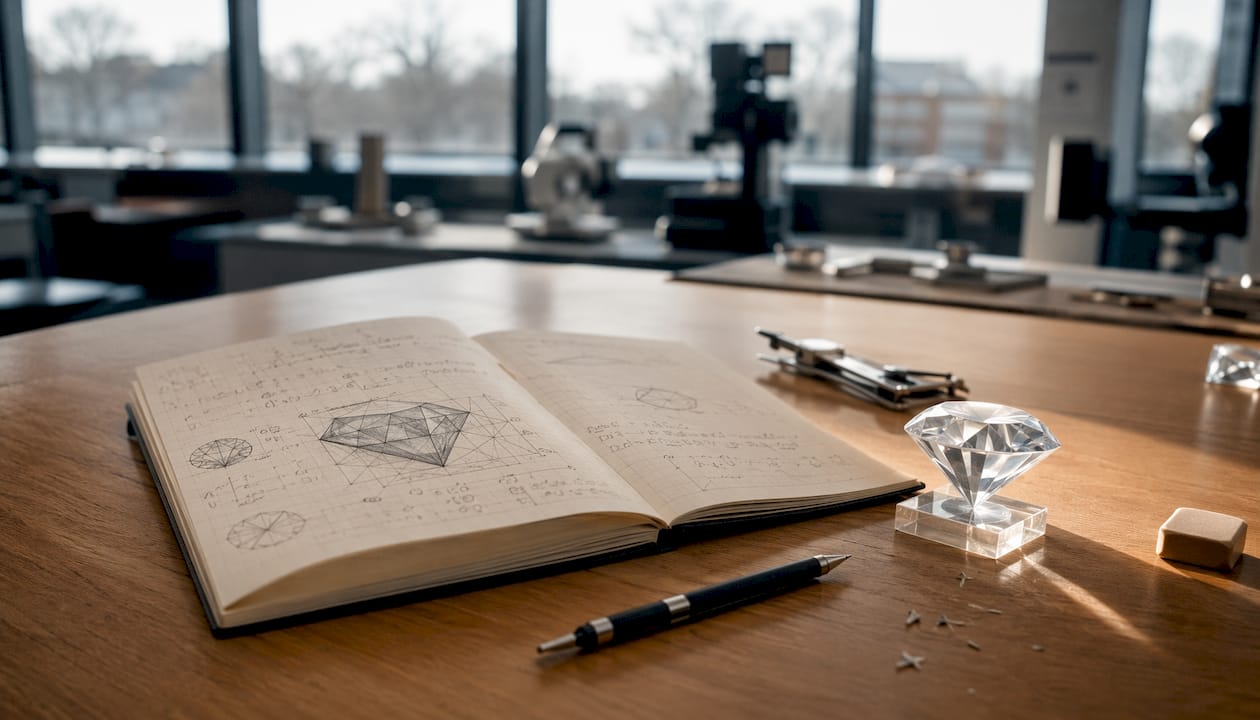
Tolkowsky’s model was not the final word. Researchers have since shown that his analysis tracked only two-reflection light paths, while a diamond’s actual appearance involves many more. Still, his framework became the basis for every subsequent ideal-cut standard, including the American Gem Society’s grading system and the GIA’s cut grade, which the GIA began applying to every grading report in 2006.
Crown, pavilion, table, girdle, and culet
Each structural element of a faceted diamond has a specific optical job:
- Table: The large flat facet on top. A table that is too large reduces fire; too small reduces brilliance.
- Crown: The upper portion above the girdle. Crown angle controls how light exits the stone and contributes to fire (dispersed colored light).
- Pavilion: The lower cone-shaped portion below the girdle. Pavilion angle is the most critical variable for brilliance; too shallow and light leaks through the bottom, too steep and it reflects back at the wrong angle.
- Girdle: The narrow band separating crown and pavilion. Girdle thickness affects weight without contributing to optical performance.
- Culet: A small facet at the very bottom tip. A large culet appears as a dark circle when viewed from above; modern cuts typically have no culet or a very small one.
Statistic callout: The modern round brilliant’s 58 facets) (33 on the crown, 25 on the pavilion) are the result of nearly three centuries of incremental refinement, from the Mazarin’s 34 to the Peruzzi’s 57 to Tolkowsky’s mathematically validated standard.
Polish and symmetry compound the effect of proportions. Poor polish leaves microscopic scratches that scatter light before it can reflect cleanly. Misaligned facets misdirect light paths, reducing both brilliance and fire. For buyers, these are the reasons a GIA or AGS cut grade matters as much as the carat weight printed on a certificate. You can explore how cut shapes brilliance in more detail if you want to go deeper on the optics.
How does diamond cutting work today? {#modern-process}
The modern cutting process is both an engineering workflow and a skilled craft. Here is how it unfolds from rough stone to polished gem:
-
Planning. A scanner creates a 3D model of the rough stone. Software maps inclusions, surface irregularities, and cleavage planes, then calculates the cut plan that maximizes the value of the finished stone. This is where the carat-vs-brilliance tradeoff is decided: a cutter may choose to sacrifice 10–15% more weight than strictly necessary to achieve better symmetry and light return, because a well-cut smaller stone often commands a higher price per carat than a heavier but poorly proportioned one.
-
Cleaving or sawing. The rough stone is divided along planned lines. Cleaving follows natural crystal planes and requires a precisely placed groove and a controlled tap with a steel blade. Sawing or laser cutting handles divisions that do not follow cleavage planes.
-
Bruting (rounding). Two diamonds are spun against each other, or a diamond is ground against a rotating diamond-charged disk, to shape the girdle into a perfect circle. Modern software measures roundness to within a tenth of a millimeter for stones targeting an excellent cut grade.
-
Blocking (crossworking). A diamond crossworker places the main facets, the table, culet, and the eight main crown and pavilion facets. This stage establishes the fundamental geometry and locks in the proportions.
-
Brillianteering. A brillianteer adds the remaining facets: star facets, upper and lower girdle facets (also called half facets). These are the facets that create the scintillation pattern, the flashes of light and dark that make a diamond look alive under movement.
-
Inspection and certification. The finished stone is measured, graded for polish and symmetry, and submitted for certification. Labs like the GIA assess cut on a five-point scale from Excellent to Poor.
Pro Tip: If you are considering a recut on an antique stone, ask the cutter for a before-and-after light performance estimate. Recutting an old European cut to modern brilliant proportions typically improves brilliance noticeably but reduces carat weight by 5–15%. Whether that trade is worth it depends on the stone’s original weight and your priorities.
Where has diamond cutting happened throughout history? {#global-centers}
The geography of diamond cutting has shifted dramatically over the centuries, driven by trade routes, raw material supply, labor economics, and political upheaval.
-
Venice and Italian centers (14th–15th century): Early European cutting concentrated in Venice and other Italian trading cities, which had direct access to Indian diamonds through Levantine trade networks.
-
Bruges and Antwerp (15th–16th century): As the Low Countries became the commercial heart of Europe, cutting expertise migrated north. Antwerp became the dominant center by the late 15th century, a position it held for over a century.
-
Amsterdam (17th century onward): Political disruptions in Antwerp during the late 16th century pushed many craftsmen to Amsterdam, which became the world’s leading cutting center through the 17th and 18th centuries. The city’s reputation for precision cutting persisted well into the 20th century.
-
Brazil and South Africa (18th–19th century): New diamond discoveries in Brazil (1720s) and South Africa (1860s) shifted the supply side of the industry dramatically. South African production in particular created the scale that made industrial cutting centers economically viable.
-
Post-WWII diaspora and Israeli cutting: Jewish diamond craftsmen displaced by World War II established a significant cutting industry in Israel, particularly in Tel Aviv and Ramat Gan, which became known for high-quality smaller stones.
-
Surat, India (modern era): The geographic shift to India accelerated through the late 20th century. Surat now processes the vast majority of the world’s finished diamonds by volume, driven by lower labor costs, a large skilled workforce, and significant investment in modern cutting technology. The city handles an estimated share of global diamond cutting output that makes it the undisputed center of the modern industry.
The economic logic is straightforward: cutting is labor-intensive, and regions with lower labor costs and strong training infrastructure can process high volumes of smaller stones profitably. Antwerp and New York retain importance for high-value, large stones where individual expertise commands a premium.
How does cut affect market value and what should shoppers know? {#value-impact}
Cut is the one quality factor that human skill controls entirely. Carat weight, color, and clarity are properties of the rough stone; cut is a choice. That distinction has direct consequences for buyers.
The carat-vs-brilliance tradeoff:
- A diamond cut to maximize carat weight from the rough may have a thick girdle, an oversized table, or pavilion angles that cause light to leak. It weighs more on paper but looks duller in person.
- A diamond cut to ideal proportions sacrifices some weight but returns more light through the crown, appearing larger and more brilliant than its carat weight alone would suggest.
- Two one-carat diamonds with identical color and clarity grades can look dramatically different if one carries a GIA Excellent cut grade and the other a Fair grade. The price difference between those two stones can be substantial, and the visual difference is immediately apparent.
Practical guidance for shoppers:
- Prioritize cut grade over carat weight when budget is limited. A 0.90-carat Excellent-cut stone will typically outsparkle a 1.00-carat Good-cut stone of the same color and clarity.
- For antique cuts (old European, old mine, rose), understand that their optical performance differs from modern brilliants by design, not by defect. Many buyers prefer their softer, warmer light pattern.
- Recutting an antique stone to modern proportions improves light performance but permanently reduces carat weight and may affect the stone’s historical character and collector value.
- When comparing stones online, always check the role of cut in diamond quality alongside the certificate numbers.
The insight Henry Morse applied in the 1870s, that beauty justifies sacrificing some weight, is the same calculation every informed buyer should make today.
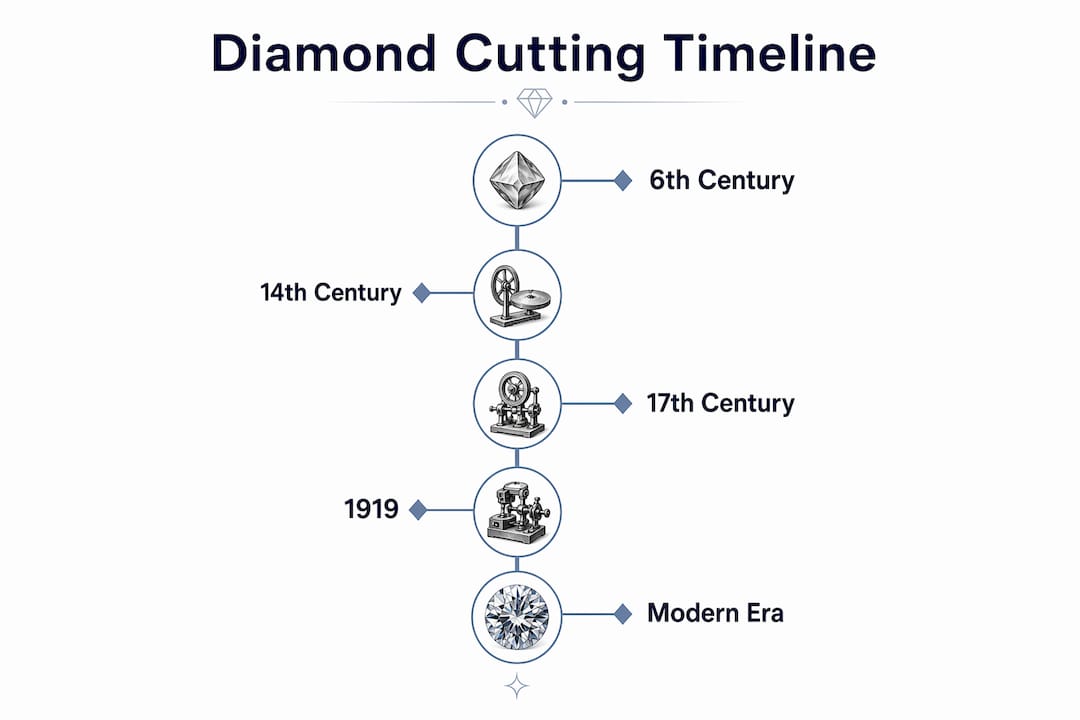
Timeline of key dates and figures in diamond cutting {#timeline}
| Date | Milestone | Key figure(s) | Notes |
|---|---|---|---|
| 6th century AD | Earliest written references to diamond cutting | Indian lapidaries | Ratnapariksa, Agastimata describe polishing octahedral crystals |
| ~1375 | First European diamond polishers’ guild | Nuremberg craftsmen | Documented institutional cutting in Germany |
| 15th century | Invention of the scaif | Flemish/Italian craftsmen | Diamond-dusted wheel enables matched facets and symmetry |
| Late 15th–16th c. | Table cut and rose cut developed | Venice, Bruges, Antwerp | First major departures from natural crystal form |
| 17th century | Mazarin and Peruzzi cuts | Cardinal Mazarin; “Peruzzi” (attribution debated) | Double and triple brilliant cuts; ~34 and ~57 facets respectively |
| ~1750 | Old European cut developed | Amsterdam craftsmen | Round girdle via early bruting; 58 facets |
| 1720s–1860s | Brazilian and South African diamond discoveries | Various | New supply scales the industry; industrial cutting becomes viable |
| 1870s | Bruting machine introduced | Henry D. Morse, Charles M. Field | Circular girdles at scale; light performance prioritized over weight |
| ~1900 | Motorized diamond saws | Industrial manufacturers | Precise initial shaping; reduced cleaving risk |
| 1919 | Mathematical model for the round brilliant | Marcel Tolkowsky | Diamond Design published; ideal proportions defined |
| 2006 | GIA begins cut grading on all reports | GIA | Standardized five-point cut scale (Excellent to Poor) |
| Late 20th c.–present | Laser cutting and CAD/CAM planning | Industry-wide | 3D scanning, computer-optimized yield, laser precision |
Glossary of essential diamond cutting terms {#glossary}
- Bruting: The process of rounding a diamond’s girdle by spinning two diamonds against each other or against a diamond-charged disk. Historically done by hand; mechanized in the 1870s.
- Brillianteer: The specialist who adds the final facets (star facets, upper and lower girdle facets) to a diamond after the crossworker has placed the main facets.
- Crown: The upper portion of a faceted diamond, above the girdle. Crown angle and height directly affect fire (dispersed colored light).
- Crossworker: The cutter who places the main facets on a diamond during the blocking stage, establishing the fundamental geometry.
- Culet: A small facet at the very bottom tip of the pavilion. A large culet appears as a dark circle when viewed face-up; modern stones typically have none or a very small one.
- Facet: Any flat, polished surface on a cut gemstone. The modern round brilliant has 58 facets (or 57 if no culet).
- Fire: The dispersion of white light into spectral colors (rainbow flashes) as it exits a diamond. Controlled primarily by crown angle.
- Girdle: The narrow band around the widest part of a diamond, separating the crown from the pavilion. Girdle thickness affects weight without contributing to optical performance.
- Old European cut: A precursor to the modern brilliant, developed around 1750, featuring a round girdle, high crown, small table, and large culet. Produces a softer, warmer light pattern than modern cuts.
- Old mine cut: An 18th-century cut with a cushion-shaped (square with rounded corners) girdle, high crown, and large culet. Associated with Brazilian diamond production.
- Pavilion: The lower, cone-shaped portion of a faceted diamond, below the girdle. Pavilion angle is the most critical variable for brilliance.
- Point cut: The earliest European cut, simply polishing the natural faces of an octahedral crystal. No new facets added.
- Polish: The smoothness of a diamond’s facet surfaces. Poor polish scatters light before it can reflect cleanly.
- Rose cut: A cut featuring a flat base and a domed crown covered with triangular facets (6, 12, or 24). Popular from the 16th through 18th centuries; produces little brilliance but a distinctive antique appearance.
- Scaif: A cast-iron polishing wheel charged with diamond dust and oil, introduced in the 15th century. Enabled the creation of precisely angled, matched facets.
- Scintillation: The pattern of light and dark flashes visible when a diamond or the light source moves. Produced by the upper and lower girdle facets added during brillianteering.
- Symmetry: The alignment and balance of a diamond’s facets. Poor symmetry misdirects light paths, reducing both brilliance and fire.
- Table: The large flat facet on the top of a diamond. Table percentage (table width divided by girdle diameter) is a key proportion metric.
Sources and notes on contested attributions {#sources}
This article draws on a combination of primary historical scholarship, institutional museum resources, and peer-reviewed academic work. A few important caveats:
- Dates for early Indian cutting (6th century AD) come from Sanskrit gemological texts and are treated as approximate by most historians. The Ratnapariksa and Agastimata are real texts, but their precise dating and the exact cutting practices they describe remain subjects of scholarly discussion.
- The Nuremberg guild date of ~1375 is well-documented in European guild records and is consistently cited by institutional sources including the GIA and the Cape Town Diamond Museum.
- “Vincenzo Peruzzi” is a contested attribution. As historians caution, some named historic cutters may be legendary labels applied to a workshop tradition rather than verifiable individuals. The Peruzzi cut is real; whether a single person named Vincenzo Peruzzi invented it is not established. Writers and educators should treat this attribution with appropriate caution.
- Marcel Tolkowsky’s 1919 work (Diamond Design) is a primary source, available in a web edition edited by Jasper Paulsen. His mathematical model has been critiqued and extended by subsequent researchers, but its foundational role is not disputed.
- Geographic shift data (Surat’s modern dominance) draws on academic work published through KNAW (the Royal Netherlands Academy of Arts and Sciences), which examined the circulation of knowledge and technique across cutting centers.
Primary sources consulted:
- GIA (Gemological Institute of America): gia.edu
- Wikipedia: “Diamond cut” and “Brilliant (gemstone cut)” articles, used for documented facts and cross-checked against institutional sources
- Cape Town Diamond Museum: history of diamond cutting educational pages
- KNAW accepted manuscript: Knowledge, Technique and Taste in Transit (Hofmeester)
- NaturalDiamonds.com: historical overview of diamond cutting evolution
- The Plumb Club: history of gem cutting, including notes on attribution ambiguity
Key Takeaways
Diamond cutting advanced from polishing natural crystal faces in ancient India to a mathematically engineered process that produces the modern 58-facet round brilliant, with cut quality directly determining a stone’s brilliance, fire, and market value.
| Point | Details |
|---|---|
| Origins in ancient India | Diamond polishing dates to at least the 6th century AD, with natural octahedral crystals as the starting point. |
| First European institution | The Nuremberg polishers’ guild (~1375) established organized, standardized cutting in Europe. |
| Tolkowsky’s 1919 model | Marcel Tolkowsky’s mathematical analysis defined the ideal proportions still used as the benchmark for the modern round brilliant. |
| Cut beats carat for sparkle | A 0.90-carat Excellent-cut stone typically outsparkles a 1.00-carat Good-cut stone of equal color and clarity. |
| Modern technology | CAD/CAM scanning and laser cutting allow today’s cutters to optimize yield and light performance simultaneously. |
Why the history of diamond cutting matters more than most buyers realize {#perspective}
Most people shopping for a diamond focus on the four Cs as a checklist. Cut gets a grade, they note it, and they move on to carat weight. That’s understandable, but it misses something the history makes clear: cut is the only C that is entirely a human decision. Color and clarity are accidents of geology. Cut is craft, and increasingly, engineering.
What strikes me about this history is how long it took for the industry to accept that sacrificing carat weight could actually increase a stone’s value. Henry Morse understood it in the 1870s, and the trade largely ignored him for decades. Tolkowsky formalized the mathematics in 1919, and it still took most of the 20th century for ideal-cut standards to become mainstream. The GIA didn’t add cut grades to standard reports until 2006. That’s nearly 90 years between Tolkowsky’s proof and universal adoption.
For buyers, that history has a practical implication. When you see an antique stone, an old European cut or an old mine cut, you are looking at a gem that was optimized for different priorities: weight retention, the tools available at the time, and aesthetic tastes that valued a softer, candlelit glow over the sharp brilliance modern cuts produce. Neither is wrong. But knowing the difference lets you choose deliberately rather than by accident.
The deeper lesson is that understanding the evolution of diamond cutting methods gives you a framework for evaluating any stone, not just round brilliants. It helps you ask why a stone was cut the way it was, what that means for its light performance, and whether a recut makes sense for your situation. That’s the kind of knowledge that turns a purchase into an informed decision. If you’re ready to apply it, Superjeweler’s engagement ring collection spans cuts from classic round brilliants to fancy shapes, all with the grading information you need to compare intelligently.
Further reading: authoritative resources on diamond cutting history {#further-reading}
For readers who want to go deeper, these are the most authoritative and accessible resources available:
-
Marcel Tolkowsky, Diamond Design (1919): The foundational text. A web edition edited by Jasper Paulsen is freely available online and is essential reading for anyone serious about cut proportions. Tolkowsky’s geometric diagrams remain remarkably clear.
-
GIA (gia.edu): The Gemological Institute of America publishes educational articles on diamond cut history, grading standards, and optical performance. Their cut grading research, including the study of 20,000 proportion combinations, is the most comprehensive in the industry.
-
Cape Town Diamond Museum: The museum’s educational pages on the history of diamond cutting provide a well-organized chronological overview with good coverage of the South African industry’s role in scaling production.
-
KNAW: Knowledge, Technique and Taste in Transit (Hofmeester): An academic paper examining how cutting knowledge and skilled labor moved between geographic centers over centuries. Particularly valuable for understanding the Antwerp-to-Amsterdam shift and the later rise of Indian cutting hubs.
-
The Plumb Club: “The History of Gem Cutting”: A practitioner-oriented overview that includes useful notes on attribution ambiguity, including the Peruzzi question. Good for readers who want a trade perspective alongside the academic one.
-
Wikipedia: “Diamond cut” and “Brilliant (gemstone cut)”: Both articles are well-sourced and regularly updated. Use them as a starting point for specific claims, but cross-check dates and attributions against the institutional sources above.
-
Antique Jewelry University: Covers historical cuts in detail, with photographs of actual antique stones that illustrate the visual differences between rose, old mine, old European, and modern brilliant cuts better than any diagram.
For shoppers wanting to connect this history to a purchase decision, Superjeweler’s guide to understanding gemstone cuts covers the practical retail implications of cut choice, and the lab-grown diamond collection showcases how modern cutting technology applies to stones that are chemically identical to mined diamonds.
{
  "@context": "https://schema.org",
  "@type": "Article",
  "headline": "History of Diamond Cutting Explained: Timeline & Techniques",
  "description": "A comprehensive chronological history of diamond cutting from ancient India to the modern round brilliant, covering key inventions, named figures, and buyer implications.",
  "author": {
    "@type": "Person",
    "name": "Andrew"
  },
  "publisher": {
    "@type": "Organization",
    "name": "Superjeweler",
    "url": "https://www.superjeweler.com"
  },
  "mainEntityOfPage": {
    "@type": "WebPage",
    "@id": "https://www.superjeweler.com"
  }
}
Recommended
- Diamond Cut in Engagement Rings: Maximizing Sparkle
- Role of cut in diamond quality: maximize sparkle in 2026
- How to verify diamond quality: a step-by-step guide 2026
- Unlock Maximum Sparkle: How Gemstone Cut Shapes Brilliance
