Yes, lab grown colored diamonds are real diamonds, chemically and optically identical to their mined counterparts, and they come in hues from soft champagne to deep ocean blue. Before you buy one, check three things: the color intensity grade, an independent lab report from GIA or IGI, and full disclosure of any post-growth treatment. Get those right and everything else, cut, carat, setting, falls into place around them.
TL;DR:
- Yellow and brown lab grown diamonds are the most common and affordable, while blue and pink tend to command higher prices due to their rarity and precise growth control.
- A reputable lab report from GIA or IGI should include the growth method, color grade, treatment disclosures, and be laser-inscribed on the girdle for traceability.
- Post-growth treatments like irradiation and HPHT enhancement are common, and buyers should verify treatment details before purchasing.
- Choosing a cut that complements color and setting that enhances hue can significantly influence the visual appeal and perceived value of the stone.
- Lab grown colored diamonds generally cost more than colorless ones of similar size but are typically more affordable than natural fancy color diamonds of comparable quality.
Table of Contents
- What Colors Come in Lab Grown Colored Diamonds and How Is Color Described
- How Colored Lab Grown Diamonds Are Made: HPHT and CVD
- Certification: What a GIA, IGI, or EGL Report Actually Tells You
- Choosing a Colored Lab Grown Diamond for Rings, Earrings, or Pendants
- What Drives the Price of Lab Grown Colored Diamonds
- Verifying Disclosure and Caring for a Colored Lab Grown Diamond
- Where to Buy: What a Trustworthy Listing Looks Like
- An Editorial Take on Where This Market Is Headed
- Start Browsing Lab Grown Colored Diamonds at Superjeweler
- Sources
- FAQ
What Colors Come in Lab Grown Colored Diamonds and How Is Color Described
Pink, yellow, blue, green, orange, brown, and even black and gray all show up in lab grown colored diamonds, though not with equal frequency. Yellow is the easiest to produce and the most common on the market. Blue and pink take more precise control of growth conditions, which is part of why they tend to sit at higher price points even within the lab grown category.
Every colored diamond, natural or lab grown, gets described through three properties: hue (the actual color, like blue or pink), tone (how light or dark it appears), and saturation (how intense or muted the color is). Grading labs combine those into a single scale running from Fancy Light through Fancy, Fancy Intense, and up to Fancy Vivid, the top of the range and the most sought-after grade for hues like pink and blue.
A few things worth knowing as you compare listings:
- Yellow and brown lab grown diamonds are the most widely available and generally the most affordable.
- Blue, pink, and green stones are rarer in lab grown production and carry a price premium relative to yellow.
- Color distribution matters as much as intensity. Graders note whether color sits evenly across the stone or pools unevenly near the corners, and even distribution is almost always the more desirable and more valuable outcome.
- Two stones with the same color name can look noticeably different once tone and saturation are factored in, which is exactly why the Fancy scale exists.
How Colored Lab Grown Diamonds Are Made: HPHT and CVD
Two methods produce nearly all gem-quality lab grown diamonds: HPHT (high pressure, high temperature) and CVD (chemical vapor deposition). HPHT mimics the intense heat and pressure found deep in the earth, and it can generate or intensify color relatively fast, often within days to a few weeks. CVD builds a diamond layer by layer inside a gas chamber over a period of weeks, and it frequently starts out colorless or lightly tinted, requiring an additional HPHT treatment step afterward to reach a vivid, marketable hue.
That second step is why treatment disclosure matters so much in this category. Reputable sellers and labs are expected to note any irradiation, heat treatment, or HPHT color enhancement applied after initial growth, since these treatments are common tools for pushing a pale stone toward a deeper, more valuable color.
- HPHT growth: fast, high pressure and heat, can produce strong color directly.
- CVD growth: slower, layer-by-layer, often needs post-growth HPHT treatment for vivid color.
- Common treatments: irradiation, heat treatment, and HPHT color enhancement.
- Gem labs detect treatment history through internal growth patterns and spectroscopic testing that reveal how a stone’s color actually formed.
Pro Tip: If a listing doesn’t mention growth method or treatment status at all, ask directly before you buy. A seller with nothing to hide will have that information ready.
Certification: What a GIA, IGI, or EGL Report Actually Tells You
A lab report is the single most useful document in this entire purchase, and it’s worth understanding what’s actually printed on one before you rely on it.
A GIA Laboratory-Grown Colored Diamond Report covers the full 4Cs, plus color identification, color distribution, growth-type assessment, and disclosure of any post-growth treatment. GIA also laser-inscribes the girdle with the words “Laboratory-Grown” alongside the report number, a practice designed to make traceability permanent rather than something that can be lost with paperwork.
IGI takes a similar approach with its Fancy Colored Diamond Report, screening for growth origin and noting any permanent treatments. Lab grown stones graded by IGI receive an “LG” inscription ahead of the report number on the girdle, and fancy colored reports typically ship with a distinct cover to separate them visually from standard grading paperwork.
Before you commit to a stone, verify these items on its report:
- Report number, and confirm it matches what’s laser-inscribed on the stone itself.
- A reference image or diagram showing the stone’s proportions and any plotted clarity characteristics.
- Growth method disclosure (HPHT or CVD).
- Color grade and description (hue, tone, saturation, and Fancy scale position).
- Any treatment disclosure, including irradiation or heat enhancement.
Certification checkpoint: GIA requires laser inscription of “Laboratory-Grown” plus the report number on qualifying stones, giving buyers a permanent, physical link between the stone and its paper trail that survives resizing, cleaning, or resale.
Choosing a Colored Lab Grown Diamond for Rings, Earrings, or Pendants
Shape changes how color reads to the eye, sometimes dramatically. Emerald and other step cuts show off large, even color fields because their broad, open facets let light travel through more of the stone at once. Brilliant cuts like round or cushion break light into more sparkle but can mask lighter or uneven color behind that extra fire, which is worth knowing if you’re choosing between two stones with similar grades.
When you’re weighing options, work through priorities in this order:
- Color intensity and hue first. This drives both beauty and value more than any other factor.
- Cut, chosen to flatter that specific hue rather than for sparkle alone.
- Clarity, which matters less for color visibility but still affects durability and light performance.
- Carat and budget last, since a smaller stone with excellent color usually outshines a larger one with weak saturation.
Setting choices can genuinely shift how a color appears. White metals like platinum or white gold tend to make cool colors like blue and green pop, while yellow or rose gold warms up pink, champagne, and yellow stones. A halo setting in a contrasting metal or diamond accent can intensify a light or medium-toned center stone, while a solitaire lets a Fancy Vivid stone speak for itself without competition.
Pro Tip: If you’re set on a colored center stone for an engagement ring, ask to see it under two lighting types, warm indoor light and daylight, since fancy colors can shift noticeably between the two.
What Drives the Price of Lab Grown Colored Diamonds
Price in this category comes down to a handful of factors stacked on top of each other: color intensity and saturation, hue rarity, carat weight, cut quality, clarity, and whether the report clearly discloses lab origin and any treatment. A Fancy Vivid blue will always cost more than a Fancy Light version of the same size, and rarer hues like blue or green generally command more than common ones like yellow or brown.
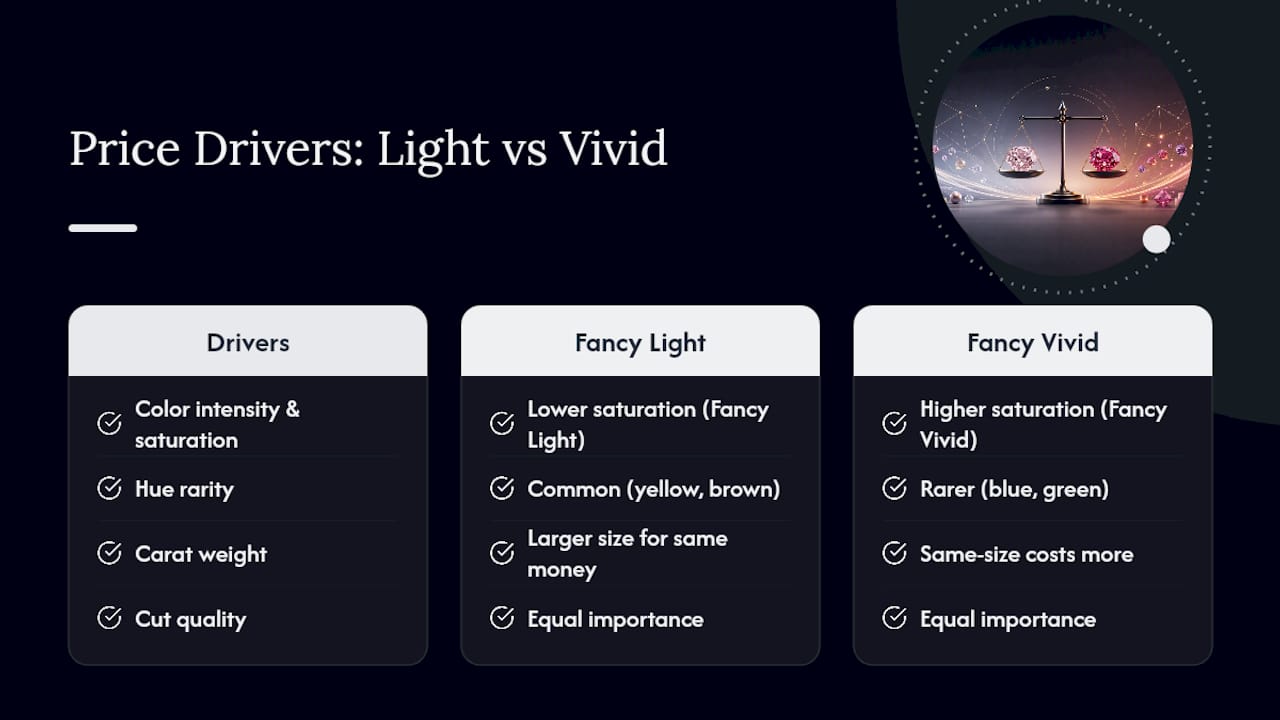
Lab grown colored diamonds are generally more affordable than equivalent natural fancy colored stones, though pricing patterns vary by hue and intensity and shouldn’t be treated as a fixed discount. That gap is exactly why lab grown color has opened up options, like a Fancy Vivid pink center stone, that would sit far outside most budgets in a natural stone.
If your priority is a bold, statement look, put your budget toward saturation over size. If you want a larger stone for the same money, a Fancy Light or Fancy grade in a popular hue stretches further without sacrificing character. Browsing lab-grown engagement ring options side by side makes this trade-off easier to see in practice.
Verifying Disclosure and Caring for a Colored Lab Grown Diamond
Ask a seller these questions before you buy: Can I see the full lab report, not just a summary? Is the girdle laser-inscribed, and can you show me a magnified photo of it? Has this stone been treated after growth, and is that noted on the report? What’s the return policy and warranty if something doesn’t match the description?
For verification, confirm the report number directly against the issuing lab’s own records rather than trusting a printed copy alone, and for a high-value purchase, consider an independent re-assessment before finalizing.
- Clean with mild soap, warm water, and a soft brush; avoid ultrasonic cleaners on treated stones.
- Keep treated colored diamonds away from prolonged high heat, which can occasionally affect color stability over time.
- Store separately from harder-wearing jewelry to avoid surface scratches on facet edges.
Where to Buy: What a Trustworthy Listing Looks Like
A listing worth trusting shows its work. Look for a linked or attached lab report (not just a claim of “certified”), a specific note about laser inscription, a color description that names hue, tone, and saturation rather than a vague marketing term, and high-resolution photos taken under consistent lighting.
- Report linked or downloadable as a PDF, not just referenced in text.
- Laser inscription explicitly mentioned, ideally with a photo.
- Clear color grade language (hue, tone, saturation, Fancy scale position).
- High-resolution photos from multiple angles.
- Stated return policy and warranty terms.
Shopping online works well when that documentation is upfront, though an in-person inspection at a jeweler still has value for anyone buying their first colored stone. Superjeweler’s lab grown diamonds category lists growth method and grading details alongside each stone, and the broader rings selection shows how colored centers pair with different settings.
An Editorial Take on Where This Market Is Headed
More color options, faster grading turnaround, and clearer lab documentation have made this a genuinely better time to buy colored diamonds than it was even a few years ago. The old skepticism about lab grown stones missed how much certification has caught up: a GIA or IGI report on a colored lab grown diamond today carries the same rigor as one on a natural fancy color stone, just with different origin language. Read the report, match the color grade to what you’re actually seeing, and you’re shopping with real confidence instead of a guess.
— Andrew
Start Browsing Lab Grown Colored Diamonds at Superjeweler
This retailer offers lab grown colored diamonds with a lifetime guarantee, free worldwide shipping, and a 60-day money-back guarantee on every piece.

That directness matters most with colored stones, where hue and treatment disclosure make or break a purchase. Every stone in the lab grown diamonds collection comes with the grading detail this guide walks through, so you’re never guessing at color intensity or growth method. Pair a colored center stone with a setting from the rings category, or explore custom design options if you have a specific hue and shape in mind. Start by browsing the current lab grown diamonds selection and filter by color to see what’s available at your budget today.
Sources
For deeper reading, consult GIA’s fancy color grading guidance, IGI’s fancy colored diamond report page, and EGL USA’s lab-grown reporting documentation for additional grading references.
FAQ
Do Colored Lab-Grown Diamonds Exist?
Yes, colored lab grown diamonds are real and widely available, produced through HPHT or CVD growth methods and sometimes finished with additional treatment to reach a specific hue. They’re graded on the same Fancy Light to Fancy Vivid scale used for natural fancy colored diamonds.
Are Colored Lab Diamonds More Expensive Than Colorless Ones?
Generally, yes. Colored lab grown diamonds usually cost more than colorless lab grown diamonds of similar carat weight because achieving strong, even color is harder to control during growth. Compared to natural fancy colored diamonds of similar grade, though, lab grown versions are typically the more affordable choice.
Why Do Some Jewelers Avoid Recommending Lab-Grown Diamonds?
Some traditional jewelers favor natural stones due to established sourcing relationships and higher margins on mined diamonds, not because of any quality gap. Lab grown diamonds, including colored ones, carry the same chemical composition and can hold equally rigorous GIA or IGI certification as natural stones.
What Color Lab-Grown Diamond Is Considered Best?
There’s no single “best” color since it depends on personal taste and budget, but Fancy Vivid grades in blue, pink, or green tend to be the most sought-after and carry the highest value due to their rarity in lab grown production. Yellow and brown remain popular for buyers who want strong color at a more accessible price point.
What Should I Check Before Buying a Colored Lab-Grown Diamond?
Confirm the stone comes with an independent lab report from GIA or IGI that states the growth method, color grade, and any treatment history. Also check for a laser inscription on the girdle matching the report number, since that’s your permanent link between the physical stone and its paperwork.
