Choosing an engagement ring can feel complicated when you want something beautiful, ethical, and affordable. For eco-conscious couples, the search for a meaningful alternative often points to lab-grown diamonds. These gems are not only real diamonds but are also crafted using advanced scientific methods that produce the same brilliance and durability as mined stones. By embracing this innovative option, you gain insight into ethical diamond creation while reducing environmental impact and making your love story truly unique.
Table of Contents
- What Is A Lab-Grown Diamond?
- How Lab-Grown Diamonds Are Created
- Lab-Grown Vs. Mined Diamonds Compared
- Environmental And Ethical Benefits Explained
- Cost, Value, And Common Misconceptions
Key Takeaways
| Point | Details |
|---|---|
| Lab-Grown Diamonds vs. Mined Diamonds | Lab-grown diamonds are created in weeks using advanced technologies, while mined diamonds take millions of years. Both types have identical properties, but lab-grown options are more ethical and environmentally friendly. |
| Cost Benefits | Lab-grown diamonds can cost 30-80% less than their mined counterparts, allowing buyers to afford larger or higher-quality stones. |
| Environmental Impact | Lab-grown diamonds minimize land disruption and water use, and they can reduce carbon emissions significantly when produced using renewable energy sources. |
| Authenticity and Value | Lab-grown diamonds are genuine diamonds; however, they usually have lower resale values compared to mined diamonds. Always obtain a gemological certificate to confirm their characteristics. |
What Is a Lab-Grown Diamond?
A lab-grown diamond is a technologically crafted gemstone produced through advanced scientific methods that replicate the natural diamond formation process. Unlike traditional mined diamonds that take millions of years to develop, these diamonds are created in controlled laboratory environments within weeks using sophisticated techniques like High Pressure High Temperature and Chemical Vapor Deposition (CVD).
These diamonds are not synthetic imitations but genuine diamonds with identical chemical, physical, and optical properties to natural stones. Scientists precisely engineer these gems by recreating the extreme conditions necessary for diamond crystallization. The result is a real diamond that is chemically, structurally, and visually indistinguishable from mined diamonds – just created through a more efficient and environmentally conscious process.
The production of lab-grown diamonds involves two primary methods. The High Pressure High Temperature (HPHT) method mimics the natural diamond formation by subjecting carbon to extremely high temperatures and pressures, while the Chemical Vapor Deposition (CVD) method involves breaking down carbon-containing gases and depositing pure carbon atoms layer by layer to create a diamond crystal. Both techniques produce diamonds with the same hardness, brilliance, and molecular structure as naturally occurring stones.
Pro tip: When shopping for lab-grown diamonds, always request a professional gemological certification to verify the diamond’s authenticity and quality characteristics.
How Lab-Grown Diamonds Are Created
Lab-grown diamonds are produced through two primary scientific methods that meticulously recreate the natural diamond formation process: High Pressure High Temperature (HPHT) and Chemical Vapor Deposition (CVD). Diamond creation techniques involve complex technological processes that transform carbon into stunning, gem-quality stones within weeks instead of millions of years.
The High Pressure High Temperature (HPHT) method mimics Earth’s natural diamond-forming conditions by subjecting carbon to extreme pressures and temperatures inside a specialized chamber. Technicians start with a small diamond seed and apply intense heat and pressure, allowing carbon atoms to crystallize and grow around the seed. This process carefully controls temperature, pressure, and chemical environment to ensure the diamond develops with the precise structural characteristics of natural stones.

Chemical Vapor Deposition (CVD) represents a more modern approach to diamond creation. In this method, scientists place a diamond seed in a sealed chamber and introduce carbon-rich gases. Using microwave energy, these gases are heated and broken down, causing pure carbon atoms to gradually deposit and build the diamond layer by layer. The CVD technique allows for more precise control over the diamond’s growth, enabling manufacturers to create stones with exceptional clarity and minimal imperfections.
Pro tip: When exploring lab-grown diamonds, ask about the specific creation method used, as each technique can subtly influence the diamond’s final characteristics and appearance.
Lab-Grown vs. Mined Diamonds Compared
The key distinction between lab-grown and mined diamonds lies fundamentally in their origin and creation process. Diamond origin differences reveal that while natural diamonds form over billions of years deep within the Earth’s crust, lab-grown diamonds are precisely engineered in controlled laboratory environments within weeks. Despite this critical difference, both types of diamonds share identical chemical compositions, crystal structures, and optical properties.
From a physical perspective, lab-grown and mined diamonds are virtually indistinguishable to the naked eye. Gemological experts require specialized equipment to determine a diamond’s origin, as both types exhibit the same hardness, brilliance, and light refraction characteristics. The primary differences emerge in their environmental and ethical footprints. Mined diamonds involve extensive earth excavation, potential ecosystem disruption, and complex supply chain challenges, whereas lab-grown diamonds dramatically reduce environmental impact by eliminating traditional mining processes.
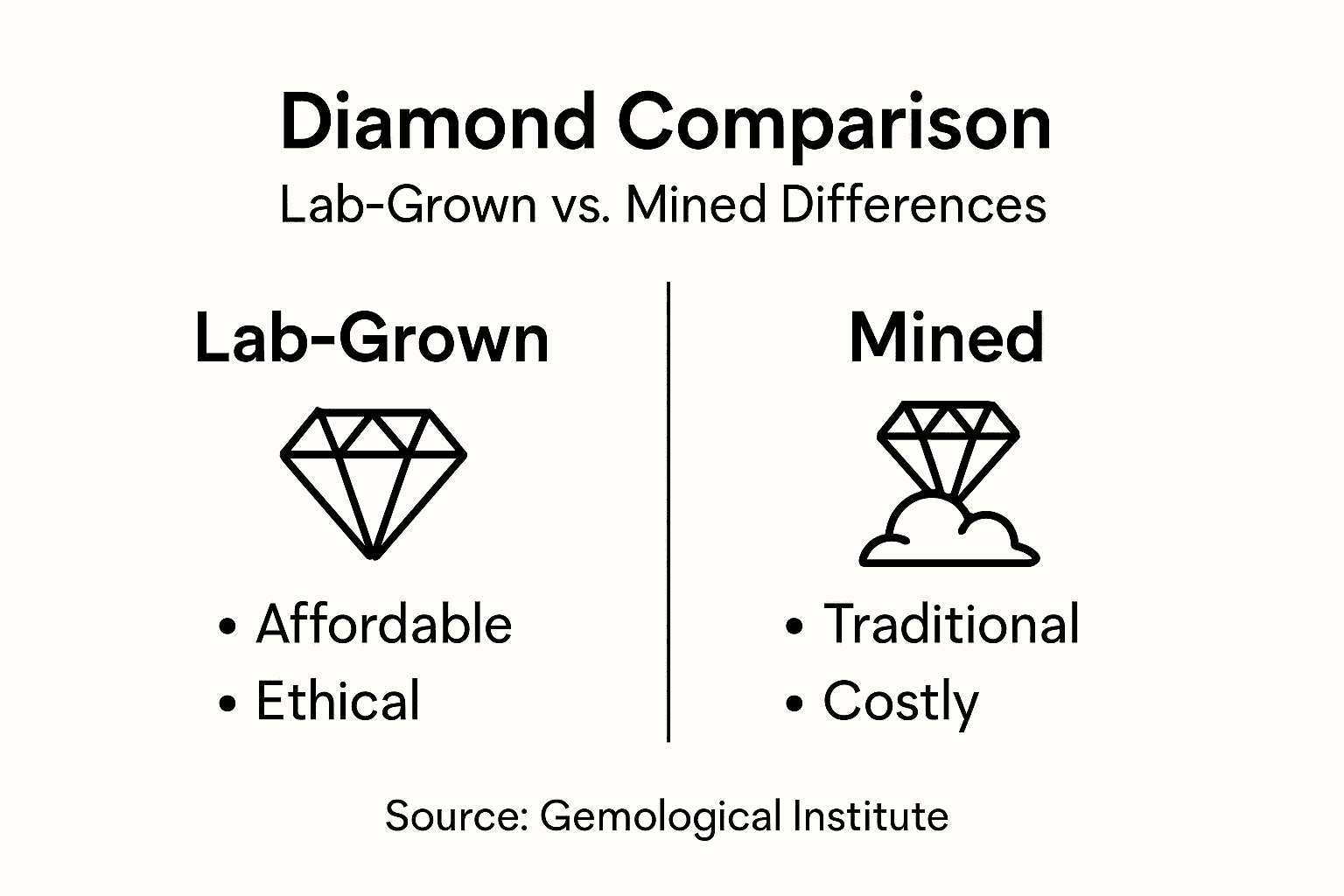
Economically, lab-grown diamonds offer significant advantages for consumers. These scientifically created gems typically cost 30-50% less than comparable mined diamonds while maintaining identical quality standards. The pricing difference stems from the more efficient production process, which eliminates extensive mining, transportation, and complex global logistics associated with natural diamond extraction. This cost efficiency allows buyers to secure larger or higher-quality stones within the same budget, making lab-grown diamonds an increasingly attractive option for engagement rings and fine jewelry.
Pro tip: Request a detailed gemological certification when purchasing lab-grown diamonds to ensure you understand the specific characteristics and origin of your stone.
Here’s a side-by-side comparison of key attributes for lab-grown and mined diamonds:
| Attribute | Lab-Grown Diamond | Mined Diamond |
|---|---|---|
| Formation Time | Weeks | Millions to billions of years |
| Production Location | Laboratory environments | Deep within Earth’s crust |
| Environmental Impact | Minimal, reduced energy and waste | High, due to land and water use |
| Ethical Considerations | Conflict-free, fully traceable | May involve ethical sourcing issues |
| Price Range (per carat) | 30-80% less than mined equivalents | Premium pricing |
| Resale Value | Generally lower | Typically higher |
Environmental and Ethical Benefits Explained
Lab-grown diamonds represent a transformative approach to sustainable jewelry production, offering significant environmental advantages over traditional mining practices. Sustainable diamond production demonstrates how technological innovation can dramatically reduce the ecological footprint associated with diamond acquisition. Unlike mining operations that require extensive land excavation, water consumption, and potential ecosystem destruction, lab-created diamonds minimize environmental disruption by producing gems in controlled laboratory settings.
The ethical implications of lab-grown diamonds extend far beyond environmental considerations. Traditional diamond mining has long been associated with complex humanitarian challenges, including potential labor exploitation, community displacement, and funding of regional conflicts. Lab-grown diamonds completely eliminate these ethical concerns by providing a transparent, traceable production process that guarantees conflict-free sourcing. Each lab-created stone can be tracked from its precise point of origin, offering consumers unprecedented transparency about the gem’s complete manufacturing journey.
Energy consumption remains an important consideration in lab-grown diamond production. While these diamonds do require electricity for creation, manufacturers are increasingly adopting renewable energy sources to further reduce their carbon footprint. Advanced facilities now utilize solar, wind, and other sustainable energy technologies to power diamond synthesis processes. Comparative studies suggest that lab-grown diamonds can generate significantly lower carbon emissions compared to mined diamonds, with some production methods reducing environmental impact by up to 70% when powered by clean energy sources.
Pro tip: Request specific environmental impact documentation when purchasing lab-grown diamonds to understand the exact sustainability metrics of your chosen stone.
The following table summarizes the environmental improvements associated with lab-grown diamonds:
| Sustainability Factor | Lab-Grown Diamonds | Mined Diamonds |
|---|---|---|
| Land Disruption | None | Significant land excavation |
| Water Usage | Low | High |
| Carbon Emissions | Reduced with renewables | High due to fuel-intensive mining |
| Traceability | Full manufacturing transparency | Often complex and opaque supply chain |
| Conflict Risk | Eliminated | Can be significant |
Cost, Value, and Common Misconceptions
Lab-grown diamonds present a compelling economic alternative to traditional mined stones, with significant price advantages that make luxury more accessible. Diamond pricing dynamics reveal that lab-created diamonds can cost 60-80% less than comparable natural diamonds, enabling consumers to purchase larger or higher-quality stones within the same budget. This dramatic price difference stems from streamlined production processes that eliminate the complex global mining supply chain.
Common misconceptions about lab diamonds frequently mislead potential buyers about their authenticity and value. Contrary to popular belief, lab-grown diamonds are genuine diamonds with identical chemical, physical, and optical properties to mined stones. Gemological experts require specialized equipment to distinguish between lab-created and natural diamonds, confirming their absolute authenticity. The primary difference lies not in the diamond’s quality, but in its origin and production method.
Resale value represents another critical consideration for potential buyers. While lab-grown diamonds typically have lower resale prices compared to natural diamonds, their initial cost savings can offset this concern. The diamond market continues to evolve, with increasing acceptance and demand for lab-created stones. Buyers should view lab-grown diamonds as a smart investment that provides exceptional value, allowing them to maximize quality and size while maintaining a more budget-friendly approach to fine jewelry.
Pro tip: Always request a detailed gemological certificate when purchasing a lab-grown diamond to ensure you understand its precise characteristics and origin.
Discover Authentic Lab-Grown Diamonds at SuperJeweler
If you are searching for a real diamond that is affordable, ethical, and stunning, lab-grown diamonds are the perfect choice. This article highlights how these diamonds match mined stones in quality while offering significant savings and a smaller environmental impact. You deserve jewelry that aligns with your values and budget without compromise.

Explore the beautiful collection of lab-grown diamonds at SuperJeweler where you can customize your ring, necklace, or bracelet with stones crafted using cutting-edge technology. Benefit from free worldwide shipping, warranty options, and a simple return policy. Start your journey to owning exquisite, conflict-free diamonds today by visiting SuperJeweler and discover how accessible luxury can be.
Frequently Asked Questions
What is a lab-grown diamond?
A lab-grown diamond is a genuine diamond created in controlled laboratory environments using advanced scientific methods that replicate the natural diamond formation process.
How are lab-grown diamonds made?
Lab-grown diamonds are produced primarily using two methods: High Pressure High Temperature (HPHT), which mimics natural diamond formation, and Chemical Vapor Deposition (CVD), which builds diamonds layer by layer from carbon-rich gases.
What are the main differences between lab-grown diamonds and mined diamonds?
The main distinctions include their origin, formation time, environmental impact, and price. Lab-grown diamonds are created in weeks with minimal environmental disruption, while mined diamonds take millions of years and have higher ecological costs. Additionally, lab-grown diamonds are typically 30-50% less expensive.
Are lab-grown diamonds ethically sourced?
Yes, lab-grown diamonds are conflict-free and fully traceable, eliminating the ethical concerns associated with traditional diamond mining, such as labor exploitation and funding regional conflicts.
Recommended
- Lab-Grown Diamonds: Affordable Luxury With Ethics
- Why Choose Lab Diamonds: Sustainable Luxury Explained
- Step-by-Step Guide to Buying Lab-Grown Diamonds Online
- 7 Key Benefits of Lab-Grown Diamonds for Engagement Rings
