A diamond accent stone is a small, genuine diamond set alongside a larger center stone to enhance its visual impact. Accent diamonds are real diamonds, either natural or lab-grown, and they typically weigh between 0.01 and 0.25 carats per stone. Their job is not to compete with the center stone but to frame it, multiply its sparkle, and define the overall style of the piece.
Three quick facts worth knowing before you shop:
- Accent stones appear in halos, pavé bands, channel settings, and side-stone arrangements.
- They are priced and sold differently than center stones, often by total carat weight (TCW) rather than individually.
- Visual matching to the center stone matters more than individual grades for small accents.
Table of Contents
- What counts as an accent diamond, and where do you find them? {#what-counts}
- Are accent diamonds real, and do they hold value? {#real-value}
- Common shapes, cuts, and sizes used as accent stones {#shapes-sizes}
- Settings and styles that use accent stones {#settings}
- How accent stones are graded and priced {#grading-pricing}
- How to choose accent stones for a ring or piece {#how-to-choose}
- Care and maintenance for jewelry with many small stones {#care}
- Lab-grown vs. natural accent diamonds: what actually matters {#lab-vs-natural}
- Key Takeaways {#takeaways}
- Why matching matters more than you might think {#perspective}
- Superjeweler has the accent diamond options you are looking for {#promo}
- Useful sources {#sources}
Table of Contents
- What counts as an accent diamond?
- Are accent diamonds real, and do they hold value?
- Common shapes, cuts, and sizes
- Settings and styles that use accent stones
- How accent stones are graded and priced
- How to choose accent stones
- Care and maintenance
- Lab-grown vs. natural accent diamonds
- Key Takeaways
- Perspective
- Shop accent diamond jewelry at Superjeweler
- Useful sources
What counts as an accent diamond, and where do you find them? {#what-counts}
The distinction is simple: the center stone is the focal point; accent stones are everything else. Size and placement define the role. A diamond under roughly a quarter carat set around or beside a larger stone is almost always functioning as an accent, regardless of its shape or quality.
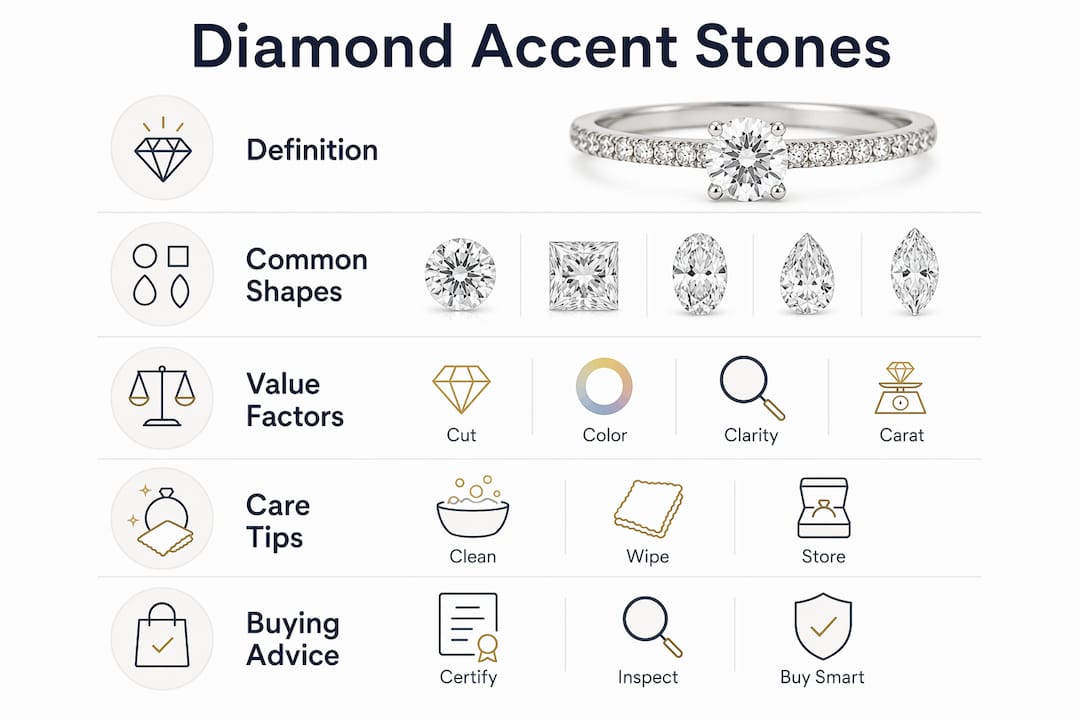
In practice, accents are selected based on shape, size, color, and quality to either elevate or frame the center stone. A halo ring surrounds the center stone with a ring of small rounds, making the center appear larger. Pavé bands stud the band itself with tiny diamonds set so close together the metal nearly disappears. Channel settings line the band with a row of matched stones tucked between two metal rails, while side-stone settings place one or two larger accent diamonds flanking the center.
Cluster pieces use many small stones arranged to mimic a single large stone. Earring surrounds and pendant halos follow the same logic: small diamonds amplifying a central gem. Once you know what to look for, you will spot accent stones in nearly every category of fine jewelry.
Are accent diamonds real, and do they hold value? {#real-value}
Yes, accent diamonds are real diamonds. Whether natural or lab-grown, they share the same physical and optical properties as any other diamond: carbon crystal structure, hardness of 10 on the Mohs scale, and the same light-refracting brilliance. A small stone is not a simulant like cubic zirconia or moissanite unless the retailer explicitly says so.
Value, though, works differently at small sizes. Per-stone resale value is low because individual accent diamonds are difficult to sell separately. What matters for the overall piece is the total carat weight. A pavé engagement ring with 0.50 carats TCW in accents carries real diamond weight, and that contributes to the ring’s appraised value even if no single accent stone would fetch much on its own.
Pro Tip: Secure the best center stone your budget allows first. Then match accents to that stone’s color and clarity. Spending heavily on many small accents while compromising on the center stone is the most common budget mistake in engagement ring shopping.
When matching goes wrong, the result is visible: a warm-tinted accent next to a near-colorless center stone creates an obvious mismatch. Mismatched brilliance, where some accents look glassy or flat, is equally distracting. Ask your jeweler specifically how accents were selected relative to the center.
Common shapes, cuts, and sizes used as accent stones {#shapes-sizes}
Any diamond shape can serve as an accent, but certain shapes dominate because of how they behave at small sizes. Round brilliants are the most common, delivering maximum sparkle even at 1–2mm. Baguettes bring a clean, linear quality that suits Art Deco and modern minimalist designs. Trillions (triangular cuts) add geometric drama as side stones flanking a center. Princess cuts offer a square silhouette with strong brilliance. Marquise and pear shapes appear as side stones in vintage and nature-inspired styles, where their pointed ends create elegant elongation.
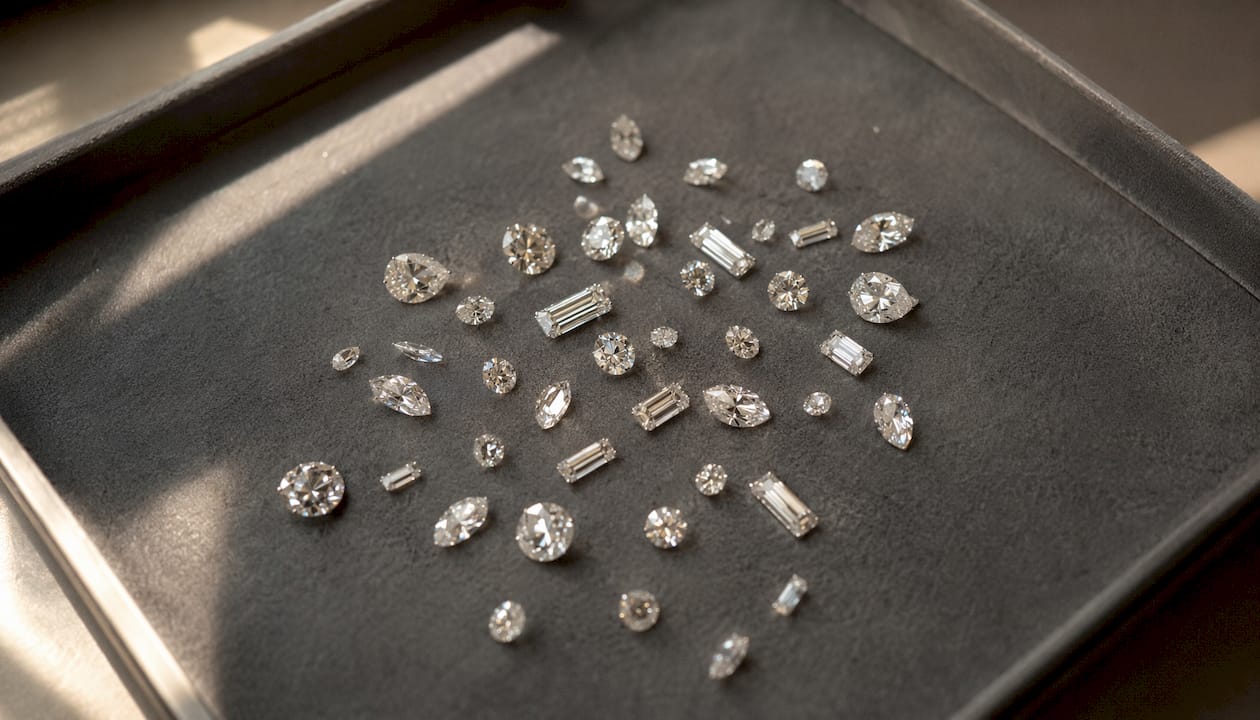
A quick note on units: jewelers measure small diamonds in points, where 100 points equal one carat. A 10-point stone is 0.10 carats; a 5-point stone is 0.05 carats. Total carat weight (TCW) adds all stones in a piece together.
| Shape | Typical size range | Visual effect |
|---|---|---|
| Round brilliant | 1–20 points (0.01–0.20 ct) | Maximum sparkle; most versatile |
| Baguette | 5–20 points (0.05–0.20 ct) | Linear, step-cut detail; sleek look |
| Princess | 5–20 points (0.05–0.20 ct) | Square brilliance; modern feel |
| Trillion | 10–20 points (0.10–0.20 ct) | Geometric drama; often used as side stones |
| Marquise | 10–20 points (0.10–0.20 ct) | Elongating; vintage and nature-inspired styles |
| Emerald | 5–20 points (0.05–0.20 ct) | Step-cut elegance; pairs well with emerald centers |
Settings and styles that use accent stones {#settings}
The setting determines how accent stones look, how durable they are, and how much maintenance they will need over time.
- Halo: A ring of small rounds encircles the center stone. Visually expands the center and adds significant sparkle. Prongs holding each small stone require periodic inspection.
- Pavé: Tiny diamonds set flush with the band surface, held by small beads of metal. Delivers a continuous glitter effect. Thin pavé bands are more vulnerable to bending and stone loss than thicker ones.
- Channel: Stones sit in a groove between two parallel metal rails with no individual prongs. More protected than pavé; a good choice for people with active hands.
- Bead-set: Each stone is held by small raised beads of metal. Similar durability profile to pavé.
- Bar-set: Metal bars separate each stone rather than prongs. Exposes more of each stone’s surface for light entry while offering moderate protection.
- Side-stone: One or two larger accent diamonds flank the center, often in their own prong settings. These accents are larger than pavé stones and easier to inspect individually.
- Cluster: Multiple small stones grouped to create the impression of a single larger stone. Requires careful inspection of every setting point.
- Three-stone: A center stone flanked by two accent stones of matched size and shape, symbolizing past, present, and future.
Diamond wedding bands illustrate pavé and channel settings well, and vintage-style engagement rings show how halo and cluster arrangements use accents to create intricate, layered designs.
How accent stones are graded and priced {#grading-pricing}
Grading small diamonds works differently than grading a center stone. The GIA and AGS set the standards for diamond grading, but individual full reports for accent-sized stones are rare. At 0.01–0.10 carats, the cost of issuing a per-stone certificate would exceed the stone’s value. Instead, jewelers source accents in wholesale parcels priced by total carat weight and grouped into tight color and clarity bands.
What this means for you: you will not receive a GIA report for each accent stone. What you should ask for is the supplier’s quality band (e.g., G–H color, SI1–SI2 clarity) and confirmation that the jeweler matched the parcel to the center stone’s grade. Documented supplier standards and a clear warranty policy are the practical trust signals here.
Pricing for small stones does not scale linearly with center-stone pricing. A 0.10-carat accent is not one-tenth the price of a 1-carat center stone of the same grade. Rarity premiums, cut complexity, and market demand all push center-stone prices disproportionately higher.
| Size | Carat equivalent | Typical role |
|---|---|---|
| 1 point | 0.01 ct | Micro-pavé; smallest common accent |
| 5 points | 0.05 ct | Standard pavé or halo fill |
| 10 points | 0.10 ct | Halo stones; small side accents |
| 20 points | 0.25 ct | Larger side stones; three-stone accents |
For identifying quality diamonds and understanding how the 4Cs apply at different sizes, Superjeweler’s buying guides cover the practical details shoppers need.
How to choose accent stones for a ring or piece {#how-to-choose}
A short, practical checklist keeps the decision clear:
- Lock in the center stone first. Color, clarity, and cut of the center stone set the benchmark. Everything else matches to it.
- Match color and clarity bands. Ask the jeweler which color and clarity range the accents fall in and confirm it aligns with the center stone. A G-color center paired with K-color accents will look warm and mismatched.
- Choose the setting for your lifestyle. Pavé is beautiful but demands more care. Channel and bezel settings protect stones better for active wearers.
- Confirm TCW and how it is calculated. Total carat weight should include all stones. Ask whether the stated TCW covers only the center or the full piece.
- Ask about origin: natural or lab-grown? Both are real diamonds, but disclosure matters. A ring mixing natural and lab-grown stones without disclosure is a red flag.
- Request warranty and repair terms. Small stones do get lost. Know the policy before you buy.
Questions worth asking your jeweler directly: How were the accents matched to the center stone? What supplier standards do you follow? What does the warranty cover for lost accent stones?
Red flags: accents with a noticeably different tint than the center, unusually low pricing with no quality disclosure, and vague or evasive answers about stone origin.
Care and maintenance for jewelry with many small stones {#care}
Multiple small stones mean multiple setting points, and each one is a potential failure point over time. The good news is that a simple routine keeps most problems from developing.
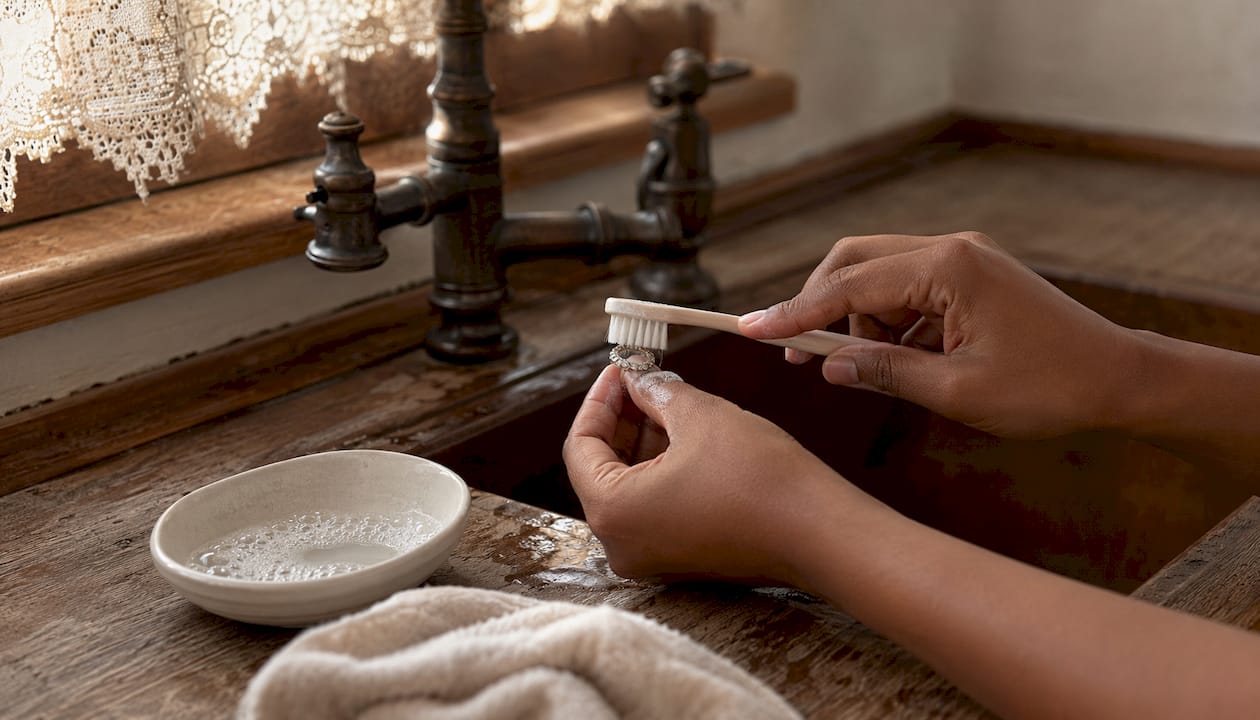
For home cleaning, warm water with a drop of mild dish soap and a soft toothbrush works well for most settings. Scrub gently around each stone and rinse thoroughly. Avoid ultrasonic cleaners at home for pavé or bead-set pieces; the vibration can loosen stones that are already slightly worn. Professional ultrasonic and steam cleaning at a jeweler’s bench is safer because a trained eye inspects the settings before and after.
Inspection every 6–12 months is the standard recommendation. Ask the jeweler to check prong tips, bead integrity, and channel rails. A prong that has worn flat or a bead that has shifted can release a stone without warning. Catching it early costs far less than replacing a lost diamond.
Everyday habits matter too. Remove rings before heavy lifting, gardening, or any task involving gloves that grip tightly. Rubber gloves can catch on prongs and pull them out of position. For more detailed guidance, Superjeweler’s jewelry care tips cover inspection schedules and safe cleaning methods for a range of settings.
Lab-grown vs. natural accent diamonds: what actually matters {#lab-vs-natural}
Both lab-grown and natural diamonds are used as accent stones, and at sizes below 0.25 carats the visual difference between them is essentially zero. The same cut quality, the same color and clarity band, the same sparkle. What changes is price and disclosure.
Lab-grown accents generally cost less per carat than natural accents of equivalent grade. For a ring with significant pavé coverage, that difference adds up. Some shoppers choose lab-grown diamond options specifically to allocate more budget to a larger or higher-quality center stone.
Pro Tip: Ask your jeweler to match origin consistently. Lab-grown accents paired with a lab-grown center, or natural accents with a natural center. Mixing origins is not a quality problem, but it can become a disclosure issue and may affect resale conversations later.
The most important thing is that the retailer discloses origin clearly. Superjeweler offers both natural and lab-grown diamond jewelry with transparent descriptions, so shoppers can make an informed choice rather than guessing after the fact.
Key Takeaways {#takeaways}
Accent diamonds are real diamonds whose value to a piece lies in their collective sparkle and total carat weight, not in individual per-stone grades.
| Point | Details |
|---|---|
| Accents are real diamonds | Confirm natural or lab-grown origin and ask for supplier quality standards, not just a price. |
| Center stone comes first | Lock in the center stone’s color and clarity, then match accents to it to avoid visible tint mismatches. |
| Setting affects durability | Channel and bezel settings protect accents better than pavé for everyday wear; inspect settings every 6–12 months. |
| TCW and origin disclosure matter | Ask how total carat weight is calculated and whether accents are natural or lab-grown before purchase. |
| Superjeweler offers both options | Superjeweler carries natural and lab-grown accent jewelry with clear disclosure and warranty coverage. |
Why matching matters more than you might think {#perspective}
Most buying guides spend their energy on the center stone, and for good reason. But the accents are where a ring can quietly fall apart, visually and literally.
The tint mismatch problem is more common than retailers like to admit. A center stone graded G or H in color looks noticeably different next to accents sourced from a parcel graded J or K. At small sizes, the difference in sparkle is subtle, but the color difference is not. You will see it in photographs, and you will definitely see it in sunlight. A jeweler who cannot tell you the color band of the accent parcel used in your ring is not a jeweler you should trust with a significant purchase.
The durability question is equally underappreciated. Pavé looks extraordinary, but it demands more from the wearer than most people expect. A thin pavé band on an engagement ring worn daily will need professional inspection at least once a year. That is not a flaw; it is just the physics of many small stones held by tiny beads of metal. Knowing this going in means you budget for maintenance and do not end up surprised when a stone goes missing two years after the wedding.
The lab-grown question, finally, is not really about quality. It is about consistency and disclosure. A ring where the center is natural and the accents are lab-grown is not a lesser ring, but the buyer deserves to know. Ask the question directly. A good retailer answers it without hesitation.
Superjeweler has the accent diamond options you are looking for {#promo}
Finding a ring where the accents are properly matched to the center stone, clearly disclosed as natural or lab-grown, and backed by a real warranty is harder than it should be. Superjeweler makes that part straightforward.

The selection covers engagement rings in halo, pavé, channel, and side-stone styles, plus a full range of lab-grown diamond deals for shoppers who want more visual impact at a lower price point. Every piece ships free, comes with warranty coverage, and can be returned if it does not meet expectations. If you are working with a tighter budget and want accent-heavy styles that maximize sparkle, the affordable engagement ring category is a good starting point. Browse by style, shape, or stone type, and contact customer service with specific questions about accent matching or origin disclosure.
Useful sources {#sources}
- Diamonds.pro — Diamond Accents: What You Need To Know: Covers accent definition, size ranges, and how accents are selected relative to center stones.
- Beyond4Cs — What Are Accent Diamonds?: Explains common accent shapes and their visual roles in different settings.
- Lepdo Diamonds — Diamond Parcel Sizes: Wholesale Buyers Guide: Details how small diamonds are sourced, grouped, and priced in wholesale parcels.
- Superjeweler — How to Identify Quality Diamonds: Practical 4Cs guidance for matching accents and center stones.
- Superjeweler — Jewelry Care Tips: Cleaning and inspection guidance for jewelry with multiple small stones.
- Superjeweler.com: Full catalog of natural and lab-grown diamond jewelry with warranty and return policy details.
{
  "@context": "https://schema.org",
  "@type": "Article",
  "headline": "What Is a Diamond Accent Stone? A Buyer's Guide",
  "description": "A clear, practical explanation of what a diamond accent stone is, how accent diamonds are graded and priced, common shapes and settings, and how to choose and care for accent diamond jewelry.",
  "author": {
    "@type": "Person",
    "name": "Andrew"
  },
  "publisher": {
    "@type": "Organization",
    "name": "Superjeweler",
    "url": "https://www.superjeweler.com"
  },
  "mainEntityOfPage": {
    "@type": "WebPage",
    "@id": "https://www.superjeweler.com"
  }
}
Recommended
- Diamond shape impact: choosing the ideal engagement ring
- What is diamond fluorescence? A buyer’s 2026 guide
- Advantages of Different Diamond Shapes: 2026 Buyer’s Guide
- Diamond Necklace Terminology: What Every Buyer Should Know
