TL;DR:
- Choosing the right diamond earrings depends on style, quality, setting, and budget.
- Prioritize cut quality and aim for G-H-I color and SI1 SI2 clarity for value.
- Consider metal and setting style for durability, appearance, and comfort.
You’re staring at dozens of listings, each promising brilliance and value, but the styles, grades, and price points blur together fast. Choosing diamond earrings shouldn’t feel like decoding a gemology textbook. Whether you’re treating yourself or buying a gift, the right pair comes down to a few clear decisions: style, quality grade, setting, and budget. This guide walks you through each step so you can shop with confidence, skip the guesswork, and land on earrings you’ll love wearing for years.
Table of Contents
- Understand diamond earring types and their impact
- Know the 4Cs: Quality grades that matter for earrings
- Choose the right setting and metal for your diamonds
- Balance price, authenticity, and ethical options
- A jeweler’s perspective: What most buyers overlook when choosing diamond earrings
- Find your perfect pair at SuperJeweler
- Frequently asked questions
Key Takeaways
| Point | Details |
|---|---|
| Focus on the 4Cs | Cut, color, clarity, and carat matter for beauty and value, but color and clarity can be flexible for earrings. |
| Match style to needs | Choose stud, hoop, or drop earrings based on versatility, personal taste, and occasion. |
| Settings and metals matter | The right setting and metal can enhance diamond appearance and durability. |
| Affordability meets quality | G-H-I color diamonds and lab-grown options offer exceptional look without breaking the bank. |
Understand diamond earring types and their impact
Variety can feel overwhelming, so it helps to start by understanding your main options before anything else.
Diamond earrings fall into three primary categories: studs, hoops, and drops. Each one creates a different visual effect and suits different lifestyles, face shapes, and occasions. Knowing which category fits your life makes every decision that follows much easier.
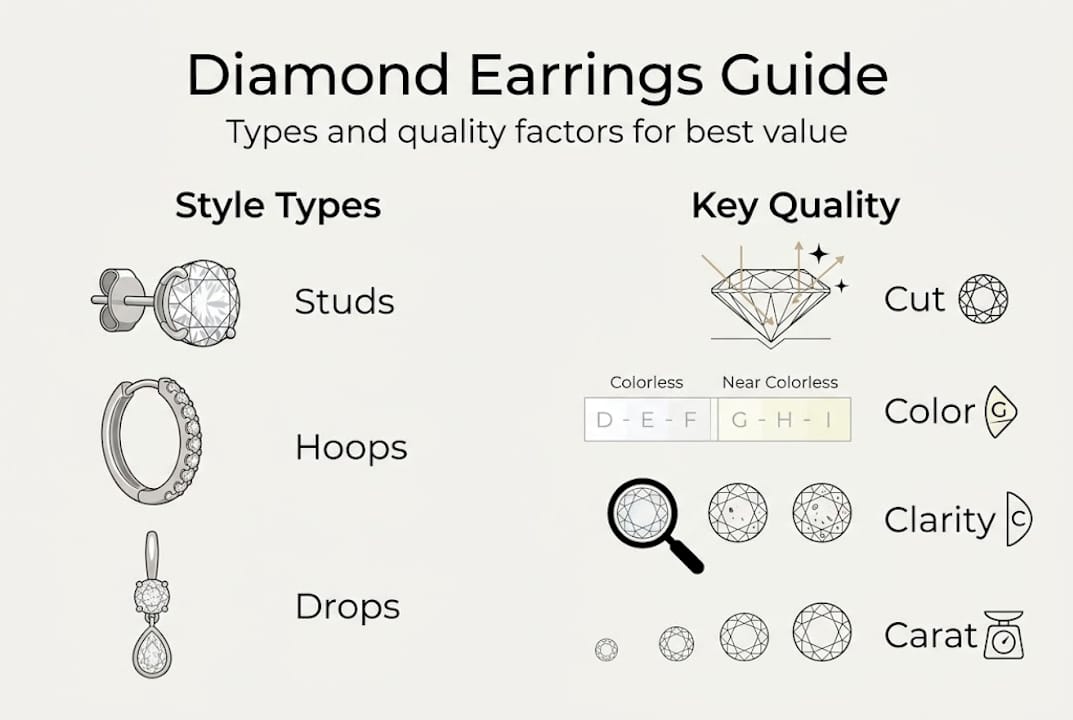
Studs are the workhorses of fine jewelry. A single diamond sits close to the earlobe, creating a clean, polished look that works with everything from a blazer to a T-shirt. They’re low-maintenance, secure, and flattering on every face shape. According to expert guidance, studs are most versatile and suitable for daily wear across all face shapes, making them the safest starting point for any buyer.
Hoops bring a bolder energy. Diamond hoop earrings work beautifully for both casual and dressed-up looks, and they’ve made a strong comeback in modern jewelry fashion. The circular shape adds movement and catches light from multiple angles, which gives them a lively, eye-catching quality.
Drop earrings hang below the earlobe and add visual length to the neck and face. Diamond drop earrings are ideal for formal occasions, special events, or anyone who wants a more dramatic, fashion-forward look.
| Style | Versatility | Best occasion | Care level |
|---|---|---|---|
| Studs | Very high | Everyday and formal | Low |
| Hoops | High | Casual to semi-formal | Medium |
| Drops | Moderate | Formal and special events | Medium-high |
Here’s a quick breakdown of what each style does best:
- Studs: Everyday wear, all face shapes, minimal fuss
- Hoops: Statement look, movement, modern appeal
- Drops: Elegance, elongating effect, event-ready drama
Pro Tip: If you’re buying for someone else and aren’t sure of their style, studs give maximum wardrobe flexibility and are almost universally loved.
Know the 4Cs: Quality grades that matter for earrings
With your preferred earring style in mind, the next step is understanding which quality attributes make the biggest difference.
The 4Cs, cut, color, clarity, and carat weight, are the global standard for grading diamond quality. But here’s something most buyers don’t realize: the 4Cs don’t carry equal weight for earrings the way they do for engagement rings. You can make smarter trade-offs when you know what actually shows up at ear level.
Cut is the most important C for earrings. A well-cut diamond reflects light brilliantly, and that sparkle is what people notice first. Never compromise on cut.
Color matters, but not as much as you’d think. The G-H-I color range appears near-colorless in white gold settings and offers real value. D-F grades are premium but unnecessary for studs, where the color difference is nearly invisible to the naked eye.
Clarity is the most forgiving C for earrings. Small inclusions that would be visible in a ring under magnification are nearly impossible to spot in an earring worn at a distance. SI1 and SI2 clarity grades are excellent choices for value-conscious buyers.
Carat affects size and price dramatically. Going from 0.90 to 1.00 carat can jump the price significantly, but the visual difference is minimal. Understanding diamond quality and value helps you find that sweet spot.
| Quality factor | Best range for earrings | Best range for rings |
|---|---|---|
| Cut | Excellent or Very Good | Excellent |
| Color | G, H, or I | D to G |
| Clarity | SI1 to VS2 | VS1 to VVS2 |
| Carat | 0.50 to 1.00 per ear | 0.75 to 2.00+ |
Here’s a simple process to evaluate quality at a glance:
- Start with cut grade. Reject anything below Very Good.
- Filter by color in the G-H-I range for white gold settings.
- Accept SI1 or SI2 clarity to save money without sacrificing visible beauty.
- Choose carat based on your budget after the first three steps are locked in.
- Check for a grading certificate from GIA or AGS before finalizing.
For real-world examples of what good value looks like, browsing affordable earrings examples can help you calibrate expectations.
Choose the right setting and metal for your diamonds
Once you know what diamond quality to seek, the next decision is the setting that best protects and enhances your stones.
The setting is the metal framework that holds your diamond in place. It affects security, style, and how much light reaches the stone. Three settings dominate the earring market: prong, bezel, and halo.
A prong setting uses small metal claws to grip the diamond, exposing the maximum surface area to light. This creates the most sparkle. A bezel setting wraps a thin metal rim around the diamond’s edge, offering more protection and a sleek, modern look. A halo setting surrounds the center stone with smaller accent diamonds, making the overall earring appear larger and more luxurious.
Metal choice is just as important. The G-H-I color range appears near-colorless in white gold settings, which is why white gold is the go-to metal for value-focused buyers who want a premium look.
Here’s how the main metals compare:
- White gold: Enhances near-colorless diamonds, modern look, requires occasional rhodium plating
- Yellow gold: Warm, classic tone, pairs best with lower color grades (J-K) to mask warmth
- Rose gold: Romantic and trendy, works beautifully with warmer-toned diamonds and all skin tones
- Platinum: Most durable and hypoallergenic, premium price point, naturally white
White gold studs are consistently among the best-selling options because they balance affordability with a clean, high-end look. If you prefer something warmer and more distinctive, rose gold studs are a gorgeous alternative that flatters a wide range of skin tones.
Pro Tip: Prong settings maximize light exposure and brilliance. Bezel settings offer more protection for active lifestyles. Pick based on how and where you’ll wear them most.
Balance price, authenticity, and ethical options
Having picked your preferred setting and finish, you should now consider how price, authenticity, and ethics factor into your final choice.
Budget is where many buyers get stuck. The good news is that smart trade-offs in color and clarity (as covered above) can free up significant spending room without any visible sacrifice in beauty. A realistic starting budget for a quality pair of diamond studs is around $300 to $800, though prices vary widely based on carat and metal.
Lab-grown diamonds are the biggest value shift in fine jewelry right now. Lab-grown diamond earrings are chemically and visually identical to mined diamonds, but they typically cost 50 to 70 percent less for the same size and quality grade. For buyers who want maximum sparkle per dollar, lab-grown is a genuinely smart choice. They’re also responsibly sourced, which matters to a growing number of shoppers.
Here’s how to verify authenticity before you buy:
- Ask for a grading certificate from GIA, IGI, or AGS.
- Confirm the retailer offers a return policy of at least 30 days.
- Look for a warranty that covers prong tightening and setting inspection.
- Check that the retailer discloses whether the diamond is natural or lab-grown.
- Read reviews that specifically mention post-purchase service, not just the initial purchase.
“Clean your diamond earrings regularly to maintain their brilliance. Oils from skin and hair products build up quickly on stones worn close to the face, dulling their sparkle over time.”
Ethical sourcing is a real concern for many buyers, and it’s worth asking about. Reputable retailers who care about diamond earrings ethics will be transparent about their supply chain and offer conflict-free guarantees.
A jeweler’s perspective: What most buyers overlook when choosing diamond earrings
Here’s something we see constantly: buyers spend weeks comparing carat weights and barely a minute thinking about cut or setting style. Carat size is easy to quantify, so it gets all the attention. But a 1.00-carat diamond with a mediocre cut will look duller than a 0.75-carat stone with an excellent cut. Size without brilliance is just weight.
The second thing buyers overlook is comfort. Earrings are worn for hours. Heavy drops or oversized hoops can cause real discomfort by the end of a long day. Always check the gram weight of the earring, not just the diamond carat weight.
The third trap is skipping certification because the price looks great. A low price without a grading certificate is a red flag, not a bargain. Trusting diamond grading insights from a verified source protects you from overpaying for understated quality or underpaying for something that doesn’t hold up.
Our honest advice: trust your eye as much as the numbers. If a pair looks stunning on screen or in person, that visual reaction is data. The certificate confirms what you see. It doesn’t replace the experience of actually loving what you’re wearing.
Find your perfect pair at SuperJeweler
Ready to put your new expertise to use? SuperJeweler makes it easy to shop with confidence, offering a wide selection of certified, affordable diamond earrings including lab-grown and natural stones across every style, metal, and price point.

You can filter by setting, metal, carat, and quality grade to find exactly what fits your needs and budget. Every piece comes with free worldwide shipping and a satisfaction guarantee. And if you’re already thinking ahead to a bigger occasion, exploring diamond wedding bands alongside your earring selection is a great way to build a coordinated look you’ll wear for a lifetime.
Frequently asked questions
What is the best diamond color for earrings?
The G-H-I range appears near-colorless in white gold settings and offers the best balance of quality and value, making it the top recommendation for most earring buyers.
How do lab-grown diamonds compare for earrings?
Lab-grown diamonds are visually and chemically identical to mined stones but cost significantly less, making them an excellent choice for buyers who want high quality without a high price tag.
Is clarity as important in diamond earrings as in rings?
Clarity is much less critical for earrings because small inclusions are nearly impossible to see at the distance earrings are worn from the eye.
Should I choose studs, hoops, or drops for a gift?
Studs are the most versatile and universally flattering option for a gift, fitting every style, face shape, and occasion without any guesswork.
Recommended
- How to verify diamond quality: a step-by-step guide 2026
- How to identify quality diamonds for engagement rings
- Why Buy Diamond Earrings: Beauty, Value, and Ethics
- Lab Grown Diamond Earrings | SuperJeweler
- Diamond quality checklist: how to choose a perfect lab-grown gem – Eternal Carat
