Both lab-grown and natural sapphires are genuine corundum, chemically and physically identical, but they diverge sharply on origin, price, and long-term value. If your priority is a big, clean-looking stone at a reasonable price, lab-grown sapphire is usually the smarter buy. If provenance, rarity, and resale potential matter more to you than size, a natural sapphire is worth the premium.
That’s the whole decision in one sentence. The rest comes down to what you’re optimizing for.
- Ask for a lab report before you buy anything above a few hundred dollars.
- Confirm treatment disclosure in writing, not just verbally from a salesperson.
- Compare stones under the same lighting since color perception shifts dramatically between fluorescent, LED, and daylight bulbs.
Quick fact: Lab-grown sapphires are typically produced through flame fusion, the Czochralski method, or hydrothermal growth, and none of these processes changes the stone’s hardness or optical behavior versus a natural sapphire.
Key Takeaways
Lab-grown and natural sapphires share identical hardness and chemistry, but they diverge on price, rarity, and resale, so the right choice depends entirely on whether you’re optimizing for size and budget or provenance and value retention.
| Point | Details |
|---|---|
| Same mineral, different origin | Both are corundum with Mohs hardness of 9; only formation method and price differ. |
| Inclusions reveal origin | Curved striae and gas bubbles suggest lab-grown; silk and zircon halos suggest natural. |
| Price gap is structural | Lab-created stones often run tens to low hundreds per carat versus hundreds to thousands for fine natural stones. |
| Insist on independent reports | GIA, GRS, SSEF, and Gübelin reports settle origin questions that appearance alone cannot. |
| Treatment disclosure protects value | Heat treatment is standard; dyeing and fracture-filling reduce value and must be disclosed in writing. |
| Shop with documented options | Superjeweler’s blue gemstones and gemstone ring categories pair clear product details with return and warranty protection. |
Table of Contents
- Lab Sapphire vs Natural: The Core Differences at a Glance
- What a Sapphire’s Color, Clarity, and Inclusions Reveal
- Why the Price Gap Between Lab and Natural Sapphire Is So Large
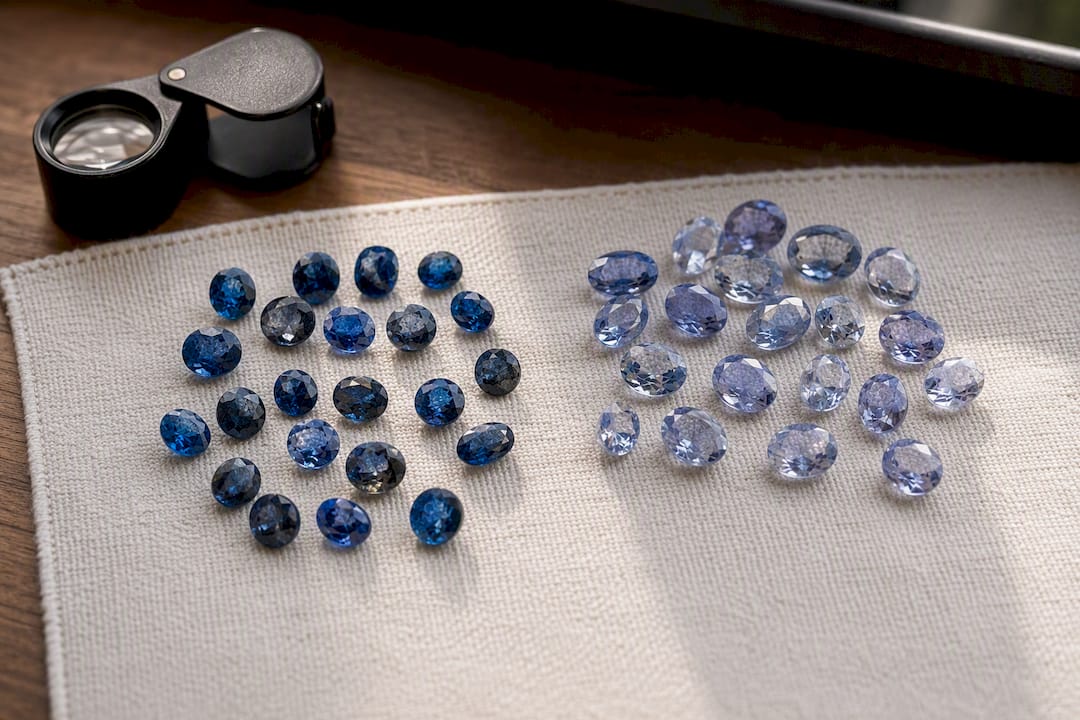
- How to Tell Lab From Natural Sapphire Before You Buy
- Heat Treatment, Dyeing, and What the Paperwork Should Say
- Matching Your Priorities to the Right Sapphire
- Why Independent Lab Reports and Retailer Policies Matter
- A Buyer’s Real Decision Between Size and Provenance
- Where to Shop for Certified Sapphires and Gemstone Settings
- Sources
Lab Sapphire vs Natural: The Core Differences at a Glance
The fastest way to understand natural vs lab sapphire is to separate the traits that are identical from the ones that aren’t. Hardness, brilliance, and color potential are the same. Origin, price, and resale value are not.
Natural sapphires form over millions of years under intense heat and pressure inside the earth’s crust, often in deposits in Sri Lanka, Madagascar, or Montana. Lab-created sapphire forms in weeks, not eons, inside a controlled furnace or autoclave that recreates the same crystal-growing conditions synthetically.
- Origin: Natural stones are mined; lab sapphires are grown in a facility using flame fusion, Czochralski pulling, or hydrothermal methods.
- Visual appearance: Nearly indistinguishable to the naked eye. Differences show up only under 10x magnification or with lab equipment.
- Price: Lab-created commercial sapphires often run from the tens to low hundreds of dollars per carat, while fine natural sapphires range from several hundred to many thousands of dollars per carat depending on color, clarity, and origin and treatment history.
- Resale: Natural stones, especially unheated ones with documented origin, can retain or grow in value. Lab-grown stones carry little resale market because supply is essentially unlimited.
- Durability: Both sit at 9 on the Mohs hardness scale, second only to diamond, so daily wear performance is equal.
- Certification: Reputable sellers disclose origin and treatment on paperwork or a lab report; that disclosure is where natural and lab sapphire truly part ways in terms of buyer protection.
None of these differences make one option universally “better.” They just point toward different buyers.
What a Sapphire’s Color, Clarity, and Inclusions Reveal
Color and cut usually matter more to the eye than origin does. A well-cut, vivid blue lab sapphire will often look more attractive on a finger than a poorly cut natural stone with a washed-out hue. This surprises a lot of first-time buyers who assume “natural” automatically means “better looking.”
Where origin actually shows up is under magnification, and it’s a genuinely fascinating bit of gemology. Natural sapphires typically contain angular color zoning, fine needle-like inclusions called silk, tiny mineral crystals, and sometimes “fingerprint” patterns left by healed internal fractures. Lab-grown sapphires, by contrast, tend to show curved growth lines (called curved striae) and trapped gas bubbles, both of which are essentially impossible in nature. Hydrothermal synthetics carry their own signature: a distinctive inclusion gemologists call a “nail-head,” referring to its flat-topped, nail-like shape.
- Natural markers: silk (rutile needles), angular zoning, mineral crystal inclusions, fingerprint patterns, zircon halos.
- Lab-grown markers: curved striae, gas bubbles, flux platelets, nail-head inclusions (hydrothermal method specifically).
- Shared traits: Mohs hardness of 9, similar refractive index, comparable brilliance and fire when well cut.
Statistic callout: Gemologists rely on microscopic inclusion patterns and spectroscopy as the primary tools for telling natural sapphires apart from synthetic ones, since curved growth lines and gas bubbles reliably flag lab origin while silk and zircon halos point to a natural stone.
That means the “tell” almost never happens at the jewelry counter under a loupe held by an untrained eye. It happens in a lab, with a microscope and often a spectrometer, which is exactly why documentation matters more than gut instinct once you’re spending real money.
Why the Price Gap Between Lab and Natural Sapphire Is So Large
The price gap isn’t marketing. It’s basic supply economics. Natural sapphires are finite, geographically limited, and take geological time to form. Lab sapphires can be grown on demand, in bulk, in a facility that runs year-round. That structural difference in scarcity is the entire reason a natural sapphire commands a premium over a lab-grown stone of comparable size and color.
Commercial-grade lab-created sapphires commonly sell for the tens to low hundreds of dollars per carat. Fine natural sapphires, particularly those with strong color saturation and good clarity, can range from several hundred to several thousand dollars per carat, and exceptional unheated stones from historic sources like Kashmir or Ceylon can command far steeper premiums because of their rarity and documented origin.
- Lab-created commercial sapphire: tens to low hundreds of dollars per carat.
- Mid-tier natural sapphire: several hundred to low thousands per carat.
- Fine unheated natural sapphire with known origin: can reach several thousand dollars per carat and beyond.
- Resale reality: lab-grown stones rarely resell for meaningful value since new supply is unlimited; natural stones, especially with lab documentation, have an actual secondary market.
Statistic callout: Because lab production scales like any factory output, lab-created sapphires typically sell for a fraction of what a comparable natural stone commands, and that gap widens further at the high end of the natural market.
If resale is genuinely part of your calculation, expect a lab-grown sapphire to function more like a fashion purchase than an asset. You’re paying for the look now, not banking on appreciation later. A natural stone with an independent lab report is the only version of this purchase that behaves anything like an investment, and even then, only the rarer, unheated, well-documented stones hold that potential.
How to Tell Lab From Natural Sapphire Before You Buy
Verification isn’t guesswork if you know what to ask for and who actually does this work. Here’s the practical sequence:
- Request an independent lab report. GIA, GRS, SSEF, and Gübelin are the four names that carry real weight in the trade. Their reports explicitly state natural or synthetic origin, based on microscopy, spectroscopy, and trace-element chemistry, not just a visual opinion.
- Ask what testing method was used. A credible seller can tell you whether the report relied on standard gemological microscopy or advanced techniques like LA-ICP-MS trace-element analysis, which is often necessary for stones with subtle or ambiguous features.
- Check for growth-line and inclusion notes on the report. Curved striae and gas bubbles point to lab origin; silk, zircon halos, and fingerprint inclusions point to natural.
- Review treatment disclosure language. The report or receipt should state plainly whether the stone is heated, filled, or otherwise treated.
- Compare the paperwork to the physical stone. Serial numbers, weight, and measurements on a lab report should match the actual piece you’re holding.
This isn’t a hypothetical risk. GIA’s own Carlsbad laboratory has documented parcels submitted as “natural” sapphires that actually contained lab-grown stones or simulants mixed in, which is exactly why independent testing matters even when a seller seems confident about what they’re selling.
Pro Tip: Never rely on a loose gemstone’s “certificate” that was issued by the seller itself. Ask specifically for a report from one of the four major independent labs, and if the seller can’t produce one for a stone over a few hundred dollars, treat that as your answer.
Heat Treatment, Dyeing, and What the Paperwork Should Say
Most natural sapphires on the market today have been heat-treated to improve color and clarity, and the trade broadly accepts this as standard practice, provided it’s disclosed. Heat treatment doesn’t fundamentally alter the stone’s structure or long-term durability; it’s the difference between an untreated stone and one that’s had its natural potential coaxed out with controlled heat.
Fracture-filling and dyeing are a different story. These treatments mask inclusions or fractures with foreign material or add color artificially, and they meaningfully reduce a stone’s value compared to an untreated or simply heated equivalent. One specific example worth knowing: quench-crackled and dyed laboratory-grown sapphire is a documented treatment where a lab-grown stone is deliberately fractured with rapid heating and cooling, then dyed to intensify or change its color. Spectroscopy and microscopy reveal telltale signs of this process.
- Heat treatment: industry-standard, generally accepted, minimal value impact when disclosed.
- Fracture-filling: fills cracks with glass or resin, reduces durability and value, must be disclosed.
- Dyeing/quench-crackle: artificially alters color, significantly reduces value, leaves detectable spectroscopic signatures.
- Red flag: any seller who won’t put treatment status in writing on the receipt or lab report.
Insurance appraisals and future resale both hinge on this paperwork. A stone described only as “sapphire” with no treatment history is a liability down the road, not a convenience now.
Matching Your Priorities to the Right Sapphire
Different buyers have genuinely different correct answers here. Work through which scenario sounds like you before you shop.
- Budget-first buyer: You want maximum size and a saturated blue for the least money. A lab-grown sapphire delivers exactly that, often at a fraction of natural pricing for a visually comparable stone.
- Heirloom-first buyer: You want a stone that carries a story, ideally one that could be passed down or appraised as a genuine asset. Natural, with an independent lab report, is the only route that fits.
- Sustainability-minded buyer: Lab-grown sapphires avoid mining-related land disturbance, though natural sapphire mining in some regions supports local economies. This one depends on which tradeoff matters more to you personally.
- Color-specific buyer: If you want a very particular shade, lab-grown offers more consistency since color is controlled in production rather than left to geology.
- Everyday-wear buyer: Since both options share the same 9 Mohs hardness, durability isn’t the deciding factor here. It comes down to whether you’d rather not worry about a natural stone’s higher replacement cost if it’s ever lost.
Whichever scenario fits, ask the seller these questions directly: Is this natural or lab-grown? Can I see an independent lab report? What treatments has this stone undergone? What’s your return policy if the paperwork doesn’t match the stone? Is there a warranty on the setting and stone?
Pro Tip: When comparing two similar-looking stones side by side, put the paperwork on the table before you look at the stones themselves. A gorgeous stone with no documentation is a bigger risk than a slightly less flashy one with a GIA report in hand.
Why Independent Lab Reports and Retailer Policies Matter
A sapphire’s beauty is easy to see. Its origin isn’t, which is exactly why third-party verification carries so much weight. GIA, GRS, SSEF, and Gübelin built their reputations by staying independent of sales transactions entirely, so their conclusions aren’t influenced by what a seller wants a stone to be.
- Request a lab report for any sapphire purchase above a few hundred dollars.
- Keep that documentation with your other records for insurance and future resale.
- Favor retailers with clear return policies and warranty coverage on both the stone and setting.
- Superjeweler lists lab-grown diamond and gemstone categories with transparent product descriptions, so you know exactly what you’re buying before checkout.
A Buyer’s Real Decision Between Size and Provenance
Picture two rings side by side: a two-carat lab sapphire with flawless color, and a one-carat natural stone with a GIA report and a slightly softer hue. The lab stone wins on visual impact per dollar, easily. But the natural stone carries something the lab one never will: a report stating it came from the earth, with an origin story a jeweler could eventually authenticate for resale or insurance.
My honest take? Most buyers overvalue size and undervalue paperwork. If you’re buying for how a ring looks at dinner, go lab-grown and don’t apologize for it. If you’re buying something meant to outlast you, spend the extra money on a natural stone with documentation, not just a bigger lab-grown one.
— Andrew
Where to Shop for Certified Sapphires and Gemstone Settings
Superjeweler is the practical middle ground between guessing at a jewelry counter and gambling on an unverified online listing. Every gemstone and lab-grown diamond category on the site is built around clear product descriptions, transparent pricing, and policies that protect you after checkout, not just before it.

If you’ve landed on lab-grown after reading this, Superjeweler’s blue gemstones collection is the right place to start browsing sapphire options in a range of cuts and settings. Prefer to shop by setting style first? The gemstone rings category lets you compare stone options side by side before you commit. And if your sapphire search is really part of a bigger engagement ring decision, Superjeweler’s engagement rings selection includes budget-friendly options for shoppers who want maximum visual impact without maximum spend.
Whatever you choose, ask for documentation, confirm treatment history in writing, and take advantage of Superjeweler’s return and warranty policies so your purchase is protected long after you leave the checkout page. If you’re storing a higher-value natural stone at home rather than wearing it daily, a dedicated jewelry safe is worth the investment too.
Sources
For deeper research or to verify a report, the Gemological Institute of America publishes peer-reviewed findings on inclusion analysis in Gems & Gemology, its research journal. The International Gem Society offers accessible technical explanations of lab-growth methods for buyers without a gemology background.
- Gems & Gemology, “Inclusions in Natural, Synthetic, and Treated Sapphire” (GIA)
- International Gem Society — What are lab-grown sapphires?
- The Sapphire Bank — Natural vs Lab-Created Sapphire (pricing and resale analysis)
Recommended
- Lab Grown Diamond Jewelry | SuperJeweler
- Lab Grown Diamond Rings | SuperJeweler
- Lab Grown Diamonds | SuperJeweler
- Lab Grown Diamond Necklace | SuperJeweler
