Use this checklist to pick a meaningful birthstone gift that fits the recipient’s style, wear habits, and your budget. The best tips for choosing birthstone gifts start with one rule: identify the month first, then let durability, style, and budget narrow the field. Here’s the short version you can act on right now.
Quick checklist:
- Start with the month (or a personally meaningful month, like a child’s birth month for a parent’s gift)
- Match the jewelry type to wear habits: rings for durable stones (Mohs 7+), pendants or earrings when durability or size is uncertain
- Check Mohs hardness: Superjeweler recommends Mohs 7+ for everyday rings; softer stones belong in pendants or earrings
- Match the metal to what the recipient already wears (yellow gold, white gold, rose gold, or silver)
- Set a budget and know your alternatives: lab-grown stones, cluster settings, and smaller carat weights all stretch a dollar without sacrificing look
- Ask for certification (GIA or AGS) on any stone above a modest price point, confirm treatment disclosure, and verify the return policy before checkout
Pro Tip: Instead of defaulting to the traditional red garnet for January, consider a green tsavorite or orange spessartite garnet. Both are genuine garnets, but the color contrast makes the gift feel curated rather than catalog-ordered.
Key Takeaways
The single most reliable rule for choosing a birthstone gift: start with the month, confirm the stone’s Mohs hardness before selecting a ring, and match the metal to what the recipient already wears.
| Point | Details |
|---|---|
| Start with the month | Identify the birth month first, then use the modern birthstone list as your starting point. |
| Mohs 7+ for rings | Only choose a ring format for stones rated Mohs 7 or higher; use pendants or earrings for pearl, opal, and moonstone. |
| Match the metal | Observe the recipient’s existing jewelry to confirm whether they wear yellow gold, white gold, rose gold, or silver. |
| Ask for certification | Request GIA or AGS certification and full treatment disclosure for any stone above a modest price point. |
| Superjeweler as a starting point | Superjeweler offers birthstone jewelry across all budget tiers, with personalized options, lab-grown stones, and a clear return policy. |
Table of Contents
- What month is each birthstone? A quick reference chart
- Does the stone’s meaning matter, or should you go with what looks good?
- How to match a birthstone gift to the recipient’s style
- Which jewelry type should you choose for a birthstone gift?
- Durability and care: which stones can handle daily wear?
- Birthstone gift ideas by budget: small, mid-range, and splurge
- How to personalize a birthstone gift
- When is the right time to give birthstone jewelry?
- How to buy birthstone jewelry online with confidence
- What buyers most often miss when choosing birthstone gifts
- Birthstone jewelry worth browsing at Superjeweler
- Sources
What month is each birthstone? A quick reference chart
The list below reflects the modern American standard, which most jewelers follow today. Alternative stones are widely accepted and often more affordable or visually striking.
| Month | Modern Birthstone | Alternative(s) | Durability Note |
|---|---|---|---|
| January | Garnet | Rhodolite, Tsavorite | Mohs 6.5–7.5 — fine for rings |
| February | Amethyst | None standard | Mohs 7 — ring-safe |
| March | Aquamarine | Bloodstone | Mohs 7.5 — ring-safe |
| April | Diamond | White Sapphire, Moissanite | Mohs 10 — most durable |
| May | Emerald | Chrysoprase | Mohs 7.5 — inclusions make it fragile; bezel setting recommended |
| June | Pearl | Alexandrite, Moonstone | Mohs below 7 (pearl) — pendant/earrings only |
| July | Ruby | Carnelian | Mohs 7+ — excellent for rings |
| August | Peridot | Spinel, Sardonyx | Mohs 6.5–7 — use protective setting for rings |
| September | Sapphire | Lapis Lazuli | Mohs 7+ — excellent for rings |
| October | Opal | Tourmaline, Pink Tourmaline | Mohs 5.5–6.5 (opal) — pendant/earrings only |
| November | Citrine | Yellow Topaz | Mohs 7 (citrine) — ring-safe |
| December | Blue Topaz | Tanzanite, Turquoise, Zircon | Mohs 7+ (topaz) — ring-safe |
A few edge cases worth knowing:
- June has three accepted stones: pearl, alexandrite, and moonstone. Alexandrite is the rarest of the three and commands a premium. Pearl is the most traditional but the softest.
- October offers tourmaline as a practical alternative to opal. Tourmaline rates Mohs 7–7.5, making it far more ring-friendly than opal’s 5.5–6.5.
- December has four recognized options. Blue topaz is the most affordable and widely available; tanzanite sits at the luxury end.
- Soft-stone flag: Pearl (June) and opal (October) rate below Mohs 7. For either stone, a pendant or stud earring is the safer format. If a ring is requested, insist on a bezel or cup setting that wraps the stone’s edge.
- For October, Paraiba tourmaline is positioned as a high-value collector’s alternative prized for its neon blue-green color. Buyers should request origin certification and copper-content verification for any Paraiba piece.
Does the stone’s meaning matter, or should you go with what looks good?
Both, but in different proportions depending on who you’re buying for.
Symbolism earns its weight when the recipient is sentimental, values tradition, or will wear the piece to mark a milestone. A grandmother who knows that garnet represents love and devotion will notice if you chose it deliberately. A friend who collects jewelry for its visual impact probably cares more about whether the color flatters her skin tone than what the stone “means.”
The practical split: lead with symbolism for milestone gifts (a 40th birthday, a push present, a graduation) and lead with color and wearability for everyday gifts. A stone that clashes with the recipient’s wardrobe or sits in a drawer is a failed gift regardless of its symbolic weight.
Common symbolic meanings for popular stones:
- Garnet (January): Love, devotion, and safe travel
- Amethyst (February): Calm, clarity, and protection
- Aquamarine (March): Courage and clear communication
- Emerald (May): Rebirth, growth, and loyalty
- Ruby (July): Passion, vitality, and good fortune
- Sapphire (September): Wisdom, sincerity, and faithfulness
- Opal (October): Creativity, hope, and spontaneity
For deeper background on birthstone symbolism and meaning, the modern versus traditional lists diverge more than most buyers realize.
Pro Tip: When the traditional stone’s color feels too muted or common, check the alternative list first. Spinel (August) comes in vivid red, hot pink, and cobalt blue. A hot-pink spinel reads as bold and fashion-forward without straying from the birth month.
How to match a birthstone gift to the recipient’s style
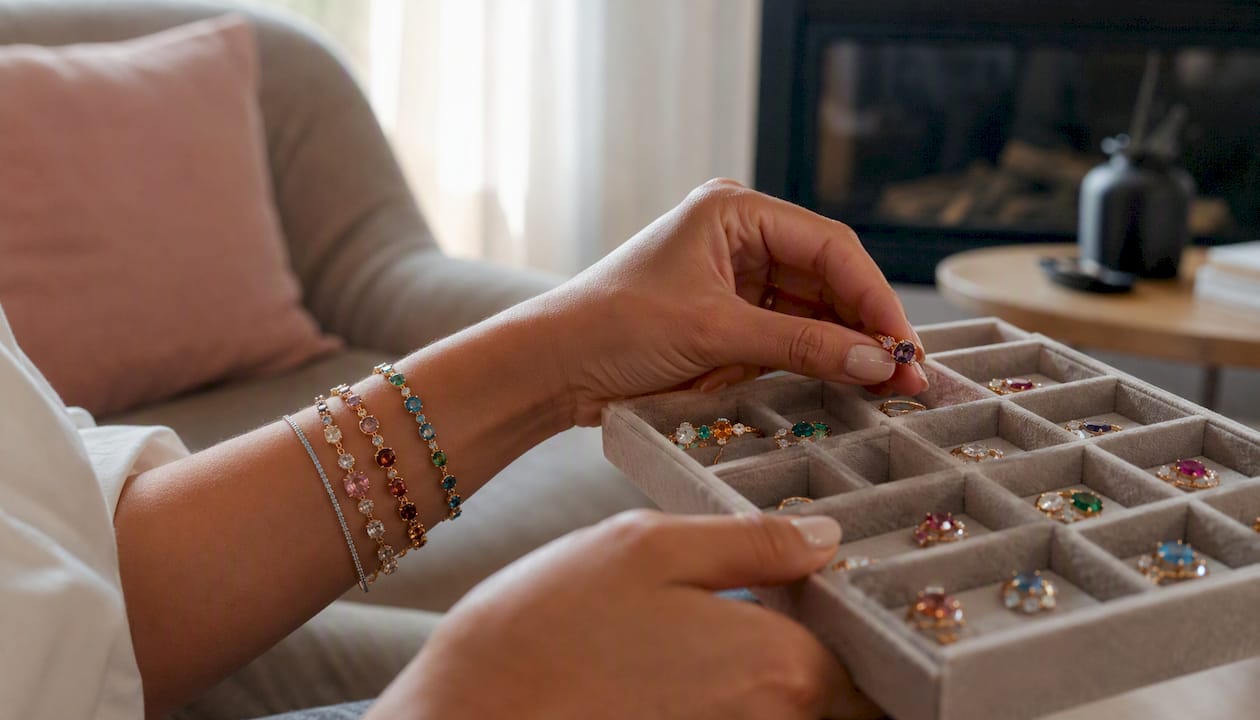
The fastest way to get this right: look at what they already wear before you buy anything.
Observational clues to gather:
- Metal color: Do they wear yellow gold, white gold/silver, or rose gold? Mixing metals is a style choice, not a rule, but most people have a clear preference.
- Piece types: Do they wear rings daily, or mostly earrings and necklaces? Someone who never wears rings is not the right candidate for a ring gift.
- Scale: Are their pieces delicate and minimal, or bold and layered? A tiny solitaire pendant reads as elegant on a minimalist; it reads as underwhelming on someone who stacks statement necklaces.
- Stone colors already in rotation: If they wear a lot of navy and forest green, a deep green tsavorite or teal aquamarine will integrate naturally.
Three subtle questions to ask (or workarounds):
- “Do you prefer gold or silver jewelry?” — sounds casual, answers the metal question cleanly.
- “Would you wear something every day or save it for going out?” — reveals the durability and format you need.
- If you can’t ask directly, check their social media or ask a close mutual friend for a quick style read.
Style-to-stone guidance:
- Minimalist: Small bezel-set solitaire in white gold or sterling silver. Aquamarine, white topaz, or pale amethyst.
- Classic: Prong-set oval or round stone in yellow gold. Ruby, sapphire, or emerald in a simple four-prong setting.
- Bohemian: Rose-cut or freeform stone, mixed metals, or a layered pendant. Moonstone, labradorite, or opal in an open-bezel setting.
- Bold: Large cushion or pear-shaped stone, pavé accents. Deep garnet, vivid citrine, or a color-saturated spinel.
Pro Tip: Rose gold flatters warm skin tones and pairs especially well with warm-colored stones: citrine, garnet, morganite, and peach sapphire. White gold or platinum reads crisper with cool-toned stones like aquamarine, blue topaz, and tanzanite. Matching metal temperature to stone temperature is a small detail that makes the piece look intentional.
Which jewelry type should you choose for a birthstone gift?
Start here: when you don’t know the recipient’s ring size or the stone is below Mohs 7, choose a pendant or stud earrings. That single rule eliminates most sizing and durability problems before they start.
Rings
- Best when: you know the size, the stone is Mohs 7+, and the recipient wears rings daily.
- Risk: sizing errors are the top reason for returns. If you’re guessing, size up — it’s easier to size down.
- Avoid for: opal, pearl, and moonstone in everyday-wear settings.
Necklaces and pendants
- Best when: size is unknown, the stone is soft, or you want a versatile piece that works across outfits.
- Pendants are the safest format for soft stones (pearl, opal) because the stone faces less direct impact.
- Chain length matters: 16–18 inches sits at the collarbone; 20 inches falls lower and works better with V-necks.
Earrings
- Best when: the recipient wears earrings daily and you want a low-risk, high-impact gift.
- Studs are universally wearable; drops and hoops suit specific styles.
- Soft stones work well in studs because the setting protects the stone from most impacts.
Bracelets
- Best when: the recipient is a bracelet person (check their wrist for existing pieces).
- Birthstone charm bracelets and tennis-style bracelets allow multi-stone personalization.
- Avoid hard stones in rigid bangles worn during physical work — impact risk is higher than with pendants.
Sizing workarounds: If you must give a ring and don’t know the size, an adjustable band or a ring with a wide shank (easier to resize) buys flexibility. Alternatively, a pendant with the birthstone set in the same metal as their existing rings delivers the same visual impact without the sizing gamble.
Durability and care: which stones can handle daily wear?
The Mohs hardness scale runs from 1 (talc) to 10 (diamond). For everyday rings, Mohs 7 is the practical floor. Below that, the stone scratches from dust particles (which are largely quartz, rated Mohs 7) and chips from routine contact.
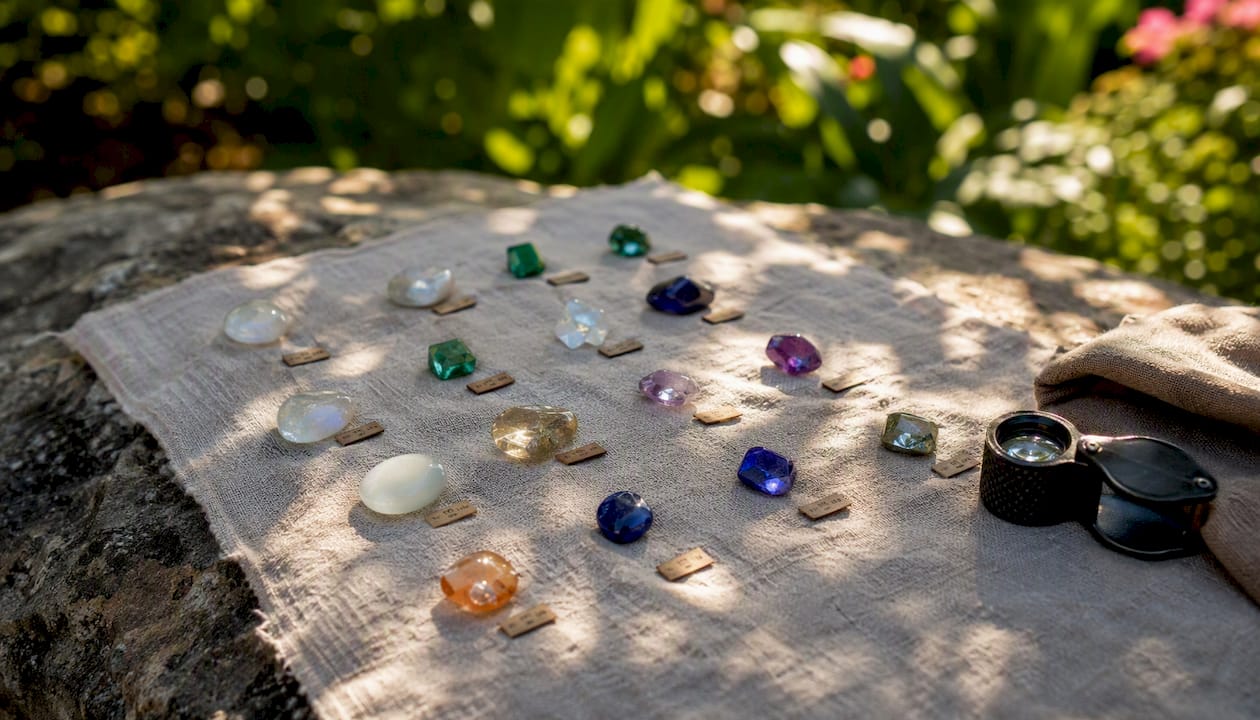
| Birthstone | Mohs Hardness | Daily Ring? | Best Setting |
|---|---|---|---|
| Diamond | 10 | Yes | Any |
| Ruby / Sapphire | 7+ | Yes | Any |
| Aquamarine | 7.5 | Yes | Prong or bezel |
| Emerald | 7.5 | Caution | Bezel (inclusions make it fragile) |
| Amethyst / Citrine | 7 | Yes | Prong or bezel |
| Garnet | 6.5–7.5 | Yes (most varieties) | Bezel for softer varieties |
| Peridot | 6.5–7 | Caution | Bezel or protective prong |
| Opal | 5.5–6.5 | No | Cup or bezel in pendants/earrings |
| Moonstone | 6–6.5 | No | Bezel in pendants/earrings |
| Pearl | below 7 | No | Cup setting in pendants/earrings |
Care and cleaning notes for the most delicate stones:
- Pearl: Never use ultrasonic cleaners or steam. Wipe with a soft, damp cloth after wearing. Pearls are porous and absorb perfume, hairspray, and sweat, which degrades their luster over time. Put them on last, take them off first.
- Opal: Avoid prolonged water exposure and sudden temperature changes. Store separately to prevent scratching. Never use chemical cleaners.
- Emerald: Most natural emeralds are treated with oil or resin to fill surface fractures. Ultrasonic cleaning dissolves the filler. Use warm soapy water and a soft brush only.
- Turquoise: Porous and sensitive to oils and chemicals. Wipe clean with a dry cloth; avoid all liquid cleaners.
On treatment disclosure: Ask explicitly whether a stone has been heat-treated, oiled, or fracture-filled. Treatment affects care requirements and, at higher price points, resale value. A reputable seller discloses this upfront. If they don’t, ask directly before purchasing.
Birthstone gift ideas by budget: small, mid-range, and splurge
Under $100
Sterling silver settings with genuine semi-precious stones are the sweet spot here. Amethyst, blue topaz, garnet, and peridot are all available in attractive settings at this price. Small stud earrings or a simple pendant in sterling silver deliver real stone quality without the markup of gold. Lab-grown stones also appear at this tier and are chemically identical to mined equivalents.
- Amethyst studs in sterling silver
- Blue topaz pendant on a silver chain
- Garnet solitaire ring in sterling silver
- Peridot drop earrings
$100–$500
This range opens up 10K or 14K gold settings, larger stone weights, and more refined designs. Sapphire, ruby, and aquamarine in gold settings are achievable here, especially in smaller carat weights. Lab-grown gemstones offer excellent visual quality at this tier and are a strong choice for daily-wear gifts. Cluster settings, which group smaller stones to create the look of a larger center stone, add perceived value without inflating cost.
- Sapphire solitaire pendant in 14K white gold
- Ruby stud earrings in 10K yellow gold
- Aquamarine ring with pavé diamond accents
- Lab-grown emerald pendant in 14K gold
$500 and above
At this level, natural mined stones with GIA or AGS certification are worth requesting. Alexandrite (June’s rarest stone) commands a significant premium due to its limited supply and color-change properties, shifting from green in daylight to red under incandescent light. Tanzanite, padparadscha sapphire, and fine ruby also sit in this tier. For October, Paraiba tourmaline is a collector-grade alternative with neon blue-green color that stands apart from standard tourmaline.
- Alexandrite ring in 18K gold with GIA certificate
- Fine ruby pendant with diamond halo in 14K gold
- Tanzanite and diamond ring in white gold
- Paraiba tourmaline with origin certification
Budget-stretching alternatives: Smaller carat weights in better-quality settings consistently outperform larger stones in poor settings. A 0.5ct ruby in a well-crafted 14K bezel looks more expensive than a 1ct ruby in a thin, low-quality prong setting.
How to personalize a birthstone gift
Personalization adds emotional weight and often costs surprisingly little extra. The most meaningful options don’t require a large budget.
Personalization ideas by relationship:
- Partner: Engrave the inside of a ring or pendant with a date, initials, or a short phrase. A two-stone piece combining both partners’ birthstones in one setting reads as intentional and romantic.
- Parent or grandparent: A family birthstone necklace with each child’s or grandchild’s stone on a single chain is one of the most requested personalized pieces. Personalized necklaces with multiple stones can be built to order.
- Friend: A birthstone charm bracelet or personalized bracelet with a single stone and an initial charm is personal without being overly intimate. For gifts for friends, the key is choosing something that reflects their personality rather than the relationship’s depth.
- Child: A locket with a birthstone set into the cover, or a small pendant with their stone, works for younger recipients and can be upgraded as they grow.
Practical notes on personalization:
- Engraving typically adds $20–$50 and requires 1–2 extra business days.
- Multi-stone pieces need a lead time of 1–2 weeks for custom orders; plan ahead for birthdays and holidays.
- When combining multiple birthstones in one piece, consider color harmony. Stones that clash visually (a bright orange citrine next to a cool blue topaz) can undercut the design. Ask the jeweler for a rendering or photo before committing.
- Personalized jewelry categories often include engraved lockets, initial pendants, and stackable birthstone rings that can be added to over time.
When is the right time to give birthstone jewelry?
The obvious answer is birthdays, but birthstone jewelry fits more occasions than most buyers realize.
Occasion guide:
- Birthday: The most natural fit. A personal pendant or stud earrings with the recipient’s own stone is always appropriate. For milestone birthdays (30, 40, 50), a more substantial piece in gold with a quality stone signals the occasion’s weight.
- Anniversary: A piece that incorporates both partners’ birthstones, or the stone associated with the anniversary year, works well. For Mother’s Day, a multi-stone family necklace is one of the most popular choices.
- New baby / push present: The baby’s birthstone in a pendant or ring for the mother is a lasting keepsake.
- Graduation: A ring or necklace with the graduate’s stone marks the transition without the formality of a family heirloom.
- “Just because”: Smaller pieces (studs, a simple pendant) work here. The gesture is the point, not the scale.
Etiquette notes:
- Avoid giving birthstone jewelry as a substitute for a family heirloom at a formal milestone where one is expected. A grandmother’s ring carries history that a new piece can’t replicate.
- For very formal occasions (a wedding, a religious ceremony), keep the piece understated so it doesn’t compete with the event’s own jewelry tradition.
- Presentation matters. A small velvet box, a handwritten note explaining why you chose that stone, and a brief mention of its meaning elevate any piece significantly.
How to buy birthstone jewelry online with confidence
Immediate checklist before you click “buy”:
- Request a GIA or AGS certificate for any stone priced above a modest budget
- Ask explicitly: “Has this stone been treated, heated, or filled?”
- Confirm the return policy in writing before purchase
- Check that product photos include multiple angles and a zoom function
- Look for metal stamps (925 for sterling silver, 10K/14K/18K for gold) in the product description
Red flags to walk away from:
- No treatment disclosure anywhere on the product page
- Vague origin claims (“natural gemstone” with no further detail)
- No return policy or a policy buried in fine print
- Single low-resolution product photo with no zoom
- Prices dramatically below market for the stated stone and metal
A clear, easy-to-find return policy materially reduces your risk when buying online. Before purchasing, locate the returns portal and confirm the window (30 days is standard; 60 is better) and whether the process is self-service.
Many jewelers now offer virtual consultations for higher-value purchases. Scheduling a virtual consultation lets you ask about treatments, see the stone under different lighting, and confirm metal quality before committing.
On lab-grown stones and simulants: Lab-grown gemstones are chemically identical to mined stones and a reputable seller will say so clearly. A simulant (like cubic zirconia standing in for diamond) is a different material entirely. Both are legitimate choices, but the seller must disclose which you’re getting. If the listing is ambiguous, ask before buying.
Pro Tip: Before purchasing online, run a reverse image search on the product photo. If the same image appears on multiple unrelated sites, the seller may be using stock photos rather than actual product images, which is a meaningful quality signal.
What buyers most often miss when choosing birthstone gifts
Most returns and disappointments trace back to three misjudgments: durability, size, and metal mismatch. Buyers often pick the right stone and the wrong format.
The single most common mistake is choosing a ring for a soft stone. Opal and pearl are beautiful, but they belong in pendants and earrings, not in rings worn daily. A bezel or cup setting helps, but no setting fully protects a stone rated below Mohs 6 from the cumulative wear of daily hand use.
Things buyers consistently overlook:
- Treatment disclosure: An oiled emerald or a heated ruby needs different care than an untreated stone. Not asking costs money later.
- Setting protection for soft stones: A prong setting leaves the stone’s edge exposed. For anything below Mohs 7, a bezel wraps the girdle and absorbs lateral impact.
- How pearls react to perfume and cosmetics: The rule is simple: pearls go on last, come off first. Most buyers don’t know this until the luster starts to fade.
- Return windows: Many online jewelers offer 30-day windows. Custom and engraved pieces are often final sale. Check before you personalize.
- Ring sizing: If you’re guessing, size up by half a size. Sizing down is easier and cheaper than sizing up.
- Metal match: A yellow gold pendant given to someone who exclusively wears white gold will sit unworn. A quick look at their existing pieces takes 10 seconds and prevents a mismatch.
The corrective action that prevents most of these: before you buy, ask the recipient (or a close friend) to send you a photo of one piece they wear regularly. Metal color, scale, and style are all visible in a single image.
Birthstone jewelry worth browsing at Superjeweler
Superjeweler carries gemstone jewelry across every budget tier discussed in this guide, from sterling silver birthstone studs under $100 to certified natural stones in 14K gold settings. The personalized jewelry category covers engraved pendants, multi-stone family necklaces, and stackable birthstone rings. For buyers interested in lab-grown options, the lab-grown diamond jewelry section offers chemically identical stones at accessible prices. June birthstone shoppers can browse pearl jewelry specifically curated for that month’s soft-stone considerations.
Superjeweler ships worldwide with a clear return policy and product descriptions that include metal stamps, stone treatments, and certification details where applicable. Browse the full gemstone jewelry collection to find a piece that fits the recipient’s month, style, and your budget.
Sources
These are the primary references used to build this guide. Each covers a specific aspect of the birthstone buying process.
- What is the Rarest Birthstone? Top 10 Rarest Birthstone List — Nendine
- Why Paraiba Tourmaline is 2026’s Most Expensive “Alternative” Birthstone — My Birthstone Guide
- Loop Returns — Example merchant returns portal (Dana Rebecca Designs)
Recommended
- Why choose birthstone jewelry: gifts with personal touch
- How to Pick Birthstone Gifts: A Practical Buyer’s Guide
- How to Pick Birthstone Jewelry: A Practical Guide
- Birthstone Jewelry Buying Guide: Choose With Confidence
