Pick 14k gold for anything you’ll wear daily, especially engagement rings and stacked bands, because its higher alloy content resists scratches and bends better than softer 18k gold. Choose 18k for pieces you’ll wear occasionally or want to pass down, since its richer color and higher purity come at the cost of durability and price. Both are measured against the same industry standard: 24 karat represents pure gold, so the trade-off always comes down to gold content versus toughness.
TL;DR:
- 14k gold is more durable and better suited for daily wear like engagement rings, due to its higher alloy content of about 58.3% pure gold.
- Resale value typically reflects the melt value of gold, making 18k jewelry worth more in resale since it contains more pure gold, but both are primarily priced for beauty and wearability.
- 18k gold offers a richer color and usually requires more careful maintenance, particularly for white gold, which may need more frequent rhodium re-plating.
- For sensitive skin, 18k gold generally presents fewer reactions because of its higher pure gold content and lower alloy percentage compared to 14k.
- When choosing between 14k and 18k, consider your daily activities, budget, skin sensitivity, and willingness to perform regular maintenance.
Table of Contents
- What Does “Karat” Actually Mean in 14k vs 18k Gold?
- How Does Gold Color Change Between 14k and 18k?
- Which Karat Holds Up Better for Everyday Wear?
- Does Karat Affect Price and Resale Value?
- Which Gold Karat Is Better for Sensitive Skin?
- How Do You Choose the Right Karat for Your Purchase?
- How Should You Care for 14k and 18k Gold Jewelry?
- What’s the Real-World Answer Here?
- Where to Shop 14k and 18k Gold Rings and Bands
- Sources
What Does “Karat” Actually Mean in 14k vs 18k Gold?
Karat measures how much pure gold is mixed into a piece of jewelry, out of a 24-part scale. That number isn’t a marketing term. It’s a legal and industry standard that determines exactly how much of a ring, band, or bracelet is actual gold versus other metals.
Here’s the math that matters for this comparison:
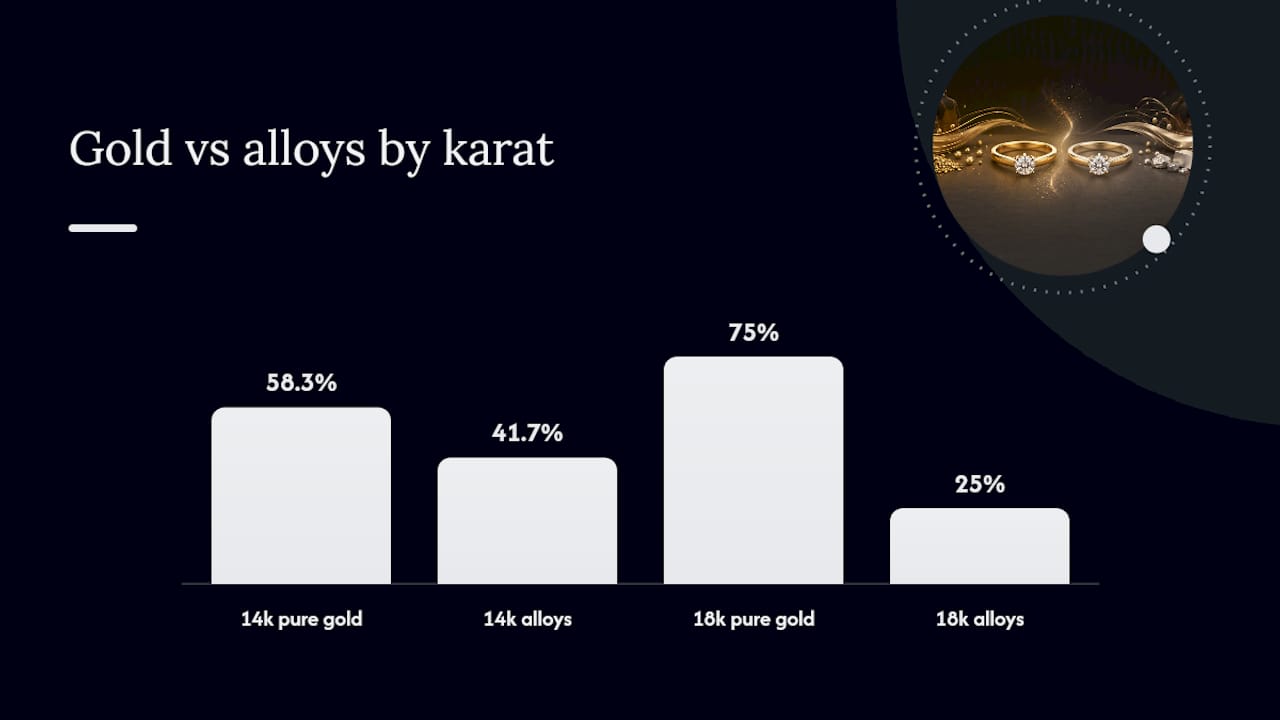
- 14k gold contains about 58.3% pure gold, with the remaining 41.7% made up of alloy metals, according to the International Gem Society.
Jewelers add alloy metals for a reason beyond stretching the gold supply. Pure 24k gold is soft enough to dent with a fingernail, so copper, silver, zinc, and sometimes nickel get blended in to give the metal enough structure to hold a stone or survive daily contact with doorknobs and steering wheels. The specific alloy mix also shifts the final color, which is why yellow, white, and rose gold in the same karat can look and feel slightly different from one jeweler to the next.
Every legitimate piece should carry a hallmark stamp, usually something like “14K,” “18K,” “585” (for 14k), or “750” (for 18k), stamped inside a ring band or on a clasp. If you’re buying online, check the product listing for this stamp reference and, ideally, a certification or appraisal document for higher-value pieces. No stamp or vague “gold plated” language without karat specifics is a red flag worth asking about before you buy.
How Does Gold Color Change Between 14k and 18k?
The more pure gold in the mix, the warmer and richer the color, which is why 18k yellow gold has that deep, almost buttery tone that photographs so well in engagement ring close-ups. 14k yellow gold still looks unmistakably gold, just a shade lighter and slightly more muted because a larger share of the alloy (often silver and zinc) dilutes the natural yellow hue.
White gold works differently. Both 14k and 18k white gold start as a yellowish alloy (gold mixed with white metals like palladium or nickel) and get a rhodium plating to achieve that bright, silvery finish. The plating is doing most of the visual work, not the karat, but here’s the practical difference: because 18k has more soft gold underneath, some jewelers note it wears through plating slightly faster in high-friction spots, meaning more frequent rhodium re-plating to keep that white shine looking fresh.
Rose gold gets its blush from copper content, so 18k rose gold, with a higher percentage of copper relative to its total alloy mix, often reads as a deeper, more saturated pink than 14k rose gold’s softer, more muted tone.
- Warmer skin tones tend to complement richer 18k yellow and rose tones especially well.
- Cooler skin tones often look sharp against either karat of white gold, since the rhodium finish is doing the visual heavy lifting.
- Catalog photos frequently underplay how warm 18k gold looks in person, so don’t rule it out based on a screen image alone.
Pro Tip: If you’re shopping online, view product photos in different lighting when possible, and remember that 18k gold often looks noticeably richer in natural light than it does in a catalog photo.
Which Karat Holds Up Better for Everyday Wear?
14k gold wins on durability, and the reason comes down to simple chemistry. More alloy metal means a harder, denser structure that resists scratching, warping, and the kind of dings that come from typing, gardening, or gripping a steering wheel all day. The International Gem Society confirms 14k’s higher alloy percentage is what makes it noticeably tougher than 18k for pieces that rarely come off your hand.
That difference matters most in specific jewelry types:
- Engagement rings. Prongs holding a diamond in place need to resist bending, since a loosened prong risks losing the stone entirely. 14k is the safer structural choice here.
- Thin or delicate bands. A slim stacking ring in 18k gold is more prone to warping under daily pressure than the same design in 14k.
- Active lifestyles. Gym sessions, manual work, and frequent hand-washing all accelerate wear on softer metal, so 14k tends to age better under that kind of stress.
18k gold isn’t fragile. It’s entirely wearable every day with the right care, according to GIVA, but it does scratch more easily than 14k over years of the same use. If you go with 18k for a daily piece, plan on removing it before heavy manual tasks, workouts, or swimming, and expect a slightly shorter interval between professional cleanings and prong checks.
Does Karat Affect Price and Resale Value?
Retail price tracks gold content almost directly, since 18k contains significantly more pure gold than 14k by weight. That gap shows up on the price tag before you even factor in the diamond or design work, which is one reason 14k dominates the budget and mid-range engagement ring market.
Resale is a different story, and it’s the part most first-time buyers get wrong.
- Resale value rarely matches retail price, because most buyers (pawn shops, refiners, even some jewelers) offer closer to melt value, the raw worth of the gold itself, according to the International Gem Society.
- Karat percentage directly sets melt value: an 18k piece will typically melt for more than an equivalent 14k piece, purely because it contains more actual gold.
- Craftsmanship, brand, and design rarely factor into melt value at all, which explains why a $2,000 ring might only fetch a few hundred dollars in a resale transaction.
- Get pieces above a few hundred dollars in value appraised and separately insured, especially 18k jewelry, since replacement cost reflects both the higher gold content and the finer craftsmanship typical of 18k pieces.
If resale flexibility matters to you, understand that neither karat is a great short-term investment vehicle. Gold jewelry is priced for wear and beauty first. For a broader look at how gold compares to other investment-grade metals, see this breakdown of gold versus platinum for jewelry and investing.
Which Gold Karat Is Better for Sensitive Skin?
If your skin reacts to metal jewelry, karat matters more than you’d think. Nickel and copper, common alloy metals in lower-karat gold, are the most frequent triggers for jewelry-related skin irritation, according to the International Gem Society.
- 14k gold contains a higher percentage of these alloy metals simply because it has less pure gold overall, which raises the odds of a reaction for sensitive skin.
- 18k gold’s higher gold content and lower alloy percentage generally make it the gentler option if you have a history of contact irritation.
- White gold plated with rhodium can mask a nickel-heavy alloy underneath, so the plating matters as much as the karat once it wears down.
- If reactions have been severe in the past, consider nickel-free alloy options or platinum, which is naturally hypoallergenic, as a step up from either 14k or 18k gold.
How Do You Choose the Right Karat for Your Purchase?
Run through this checklist before you commit to a karat, and you’ll avoid the most common buyer’s remorse: picking a gorgeous 18k ring and then babying it for the next decade.
- Define the use case first. Daily wear (engagement ring, wedding band) points to 14k. Special occasions or statement pieces point to 18k.
- Set a budget range. If gold content is driving your price up past comfort, 14k stretches the same budget further, often into a larger diamond or better setting.
- Decide how much color richness matters to you. If a deeper, warmer gold tone is a priority, 18k delivers it. If you’re fine with a slightly lighter shade for better durability, 14k is the trade worth making.
- Check your allergy history. A track record of skin irritation from jewelry pushes the decision toward 18k or a hypoallergenic alternative.
- Be honest about maintenance tolerance. If you’re not going to remember rhodium re-plating appointments or prong checks, 14k’s lower-maintenance profile fits your habits better.
When you’re evaluating a specific piece, whether in a store or on a step-by-step guide to the jewelry buying process, ask the seller these questions directly:
- What’s the exact karat stamp on this piece, and can I see it?
- What alloy metals make up the remaining percentage?
- Is this white gold plated, and how often does re-plating typically need to happen?
- What’s the warranty or repair policy if a prong loosens or the plating wears?
Pro Tip: Ask specifically whether resizing is included or discounted. Higher-karat gold like 18k is softer and generally easier to resize without weakening the band, while 14k rings, especially with intricate settings, sometimes need extra reinforcement during a resize.
For quick scenario guidance: engagement rings and wedding bands worn constantly do best in 14k. Anniversary gifts, cocktail rings, and pieces meant for special occasions only can lean into 18k’s richer look without the daily wear tradeoff working against you.
How Should You Care for 14k and 18k Gold Jewelry?
Both karats benefit from the same basic habits, with a few adjustments based on how much gold content you’re protecting.
- Clean routinely with warm water, mild dish soap, and a soft brush, avoiding chlorine, harsh household chemicals, and swimming pools, which can pit and discolor gold alloys over time.
- Remove rings and bracelets before heavy manual work, weightlifting, or anything involving repeated impact, since 18k gold is more prone to scratching under this kind of stress than 14k.
- Schedule professional cleaning and a prong check roughly once or twice a year, more often for daily-worn 18k pieces.
- White gold owners should plan for rhodium re-plating every one to two years, depending on wear frequency.
- Store pieces separately in soft pouches or a lined box to prevent metal-on-metal scratching, especially important for softer 18k gold.
What’s the Real-World Answer Here?
Most guides treat this like a purity contest, where higher karat automatically wins. That framing misses what actually matters to a jewelry buyer: how the piece will look and function five years into wearing it every single day.
Here’s the take that doesn’t get said enough: for engagement rings specifically, chasing 18k because it sounds more premium is often the wrong instinct. A softer metal wrapped around a diamond you’re wearing at a keyboard, a gym, and a kitchen sink is asking for trouble that no amount of “purity” offsets. The International Gem Society’s hardness comparison backs this up plainly. Save 18k for pieces that live in a jewelry box more than on your hand.
Shoppers can compare 14k and 18k side by side on the same design, check the karat stamp on every listing, and rely on warranty and return policies if a piece doesn’t hold up the way it should. Inspect the hallmark on anything you buy, whether from us or elsewhere, before you consider the purchase final.
— Andrew
Where to Shop 14k and 18k Gold Rings and Bands
Once you know which karat fits your life, the next step is finding a piece that fits your style and budget without settling on either. Many retailers carry both 14k and 18k options across engagement rings, wedding bands, and everyday jewelry, so you’re not locked into one karat just because a single retailer only stocks one.

Every listing shows the karat and metal type clearly, so you can compare a 14k setting against an 18k version of a similar design before deciding. If budget is the deciding factor, the cheap engagement rings under $1,000 collection is a practical place to start, since 14k gold settings typically stretch further in that price range without sacrificing a real diamond. For couples ready to browse the full range, the engagement ring collection covers both karats across dozens of styles, and the wedding band selection does the same for daily-wear bands.
Purchases often include warranty coverage and return policies, so if a karat or style doesn’t feel right once it’s on your hand, you may have options to address the issue. Browse the current engagement ring selection and filter by metal type to see 14k and 18k side by side before you buy.
Sources
This guide draws on karat purity standards and durability comparisons from the International Gem Society, a recognized authority on gemstone and precious metal education, along with everyday-wear guidance from Abra Jewellery and care recommendations from GIVA, both established jewelry retailers with published consumer guidance on gold maintenance.
Recommended
- Why choose white gold for engagement and wedding rings
- White Gold vs Platinum: Key Differences for Jewelry Buyers
- Ring metals guide: 7 top choices for your perfect band
