TL;DR:
- Hypoallergenic jewelry lacks a regulated definition in the U.S., so the label alone does not guarantee it is reaction-free. Nickel remains the primary allergen, and nickel release levels, not just content, determine allergy risk; materials like titanium and surgical steel are safest. Careful testing, transparency from brands, and understanding material terms are essential for selecting truly hypoallergenic jewelry suitable for sensitive skin.
If you’ve ever taken off a necklace because your neck broke out in a red, itchy rash, you already know why hypoallergenic jewelry matters. The term gets used constantly in product listings and marketing copy, but almost no one explains what it actually means or, more importantly, what it doesn’t guarantee. There is no official U.S. regulatory definition for “hypoallergenic” jewelry, which means any brand can use the label freely. Understanding what sits behind that word is the difference between buying jewelry that works for your skin and spending money on something that irritates it just as much as before.
Key Takeaways
| Point | Details |
|---|---|
| “Hypoallergenic” is unregulated | No U.S. law defines the term for jewelry, so the label alone is not a safety guarantee. |
| Nickel is the top allergen | Up to 15% of people react to nickel, making metal content the most critical factor to check. |
| Nickel release matters more than content | How much nickel contacts your skin is more relevant than whether a metal simply contains traces of it. |
| Safest materials are well established | Titanium, platinum, high-karat gold, niobium, and surgical-grade stainless steel are consistently low-risk options. |
| Patch testing protects you | Testing a new metal against your skin before prolonged wear is the most reliable personal safety check. |
What is hypoallergenic jewelry, really?
The word “hypoallergenic” literally means “below average allergy risk.” It originated in the cosmetics industry in the 1950s and migrated into jewelry marketing over the decades. In practice, it signals that a piece was made with materials less likely to trigger a reaction than standard alloys. But the Federal Trade Commission does not regulate the term for jewelry the way it does for cosmetics, so there is no threshold a manufacturer must meet before using it.
The more precise industry concept is contact dermatitis, which is the skin reaction caused when an allergen physically touches and penetrates the skin at the point of contact. Most jewelry reactions fall into this category. They are localized, showing up exactly where a clasp rests, where an earring post sits, or where a ring band presses against the finger.
Nickel allergies affect up to 15% of the global population, making it the single most common cause of contact dermatitis from jewelry. The critical insight most shoppers miss is this: a piece labeled hypoallergenic is not guaranteed reaction-free. It is simply formulated to reduce the odds.
Why jewelry causes allergic reactions
The role of nickel in jewelry alloys
Nickel is cheap, durable, and easy to work with, which is exactly why manufacturers add it to base metal alloys used in inexpensive jewelry. The problem is that nickel causes an itchy rash at contact points, and once a person develops a nickel sensitivity, it typically stays with them for life. Common symptoms include redness, itching, swelling, and blisters at the site where the jewelry touched the skin.
Beyond nickel, other metals in alloys can also cause problems:
- Cobalt, often found alongside nickel in base metal alloys, triggers reactions in some individuals even when nickel is absent.
- Copper, used in rose gold alloys and some sterling silver, can cause greenish skin discoloration and mild irritation in people with copper sensitivity.
- Brass and pewter, common in fashion jewelry, frequently contain nickel as a binding metal.
Why nickel release is the number that matters
Here is where most jewelry conversations get it wrong. The question is not simply whether a metal contains nickel. It is how much nickel actually releases from that metal and contacts your skin. Nickel release, not just nickel content, is the critical factor in triggering dermatitis in sensitive wearers.
The European Union sets a practical standard under REACH Annex XVII: nickel release must stay at or below 0.5 µg/cm² per week for jewelry in prolonged skin contact. The United States has no equivalent federal standard, which is part of why “hypoallergenic” labeling here is so inconsistent. When shopping, look for manufacturers who voluntarily disclose nickel release compliance rather than just listing metals used.
The best hypoallergenic jewelry materials
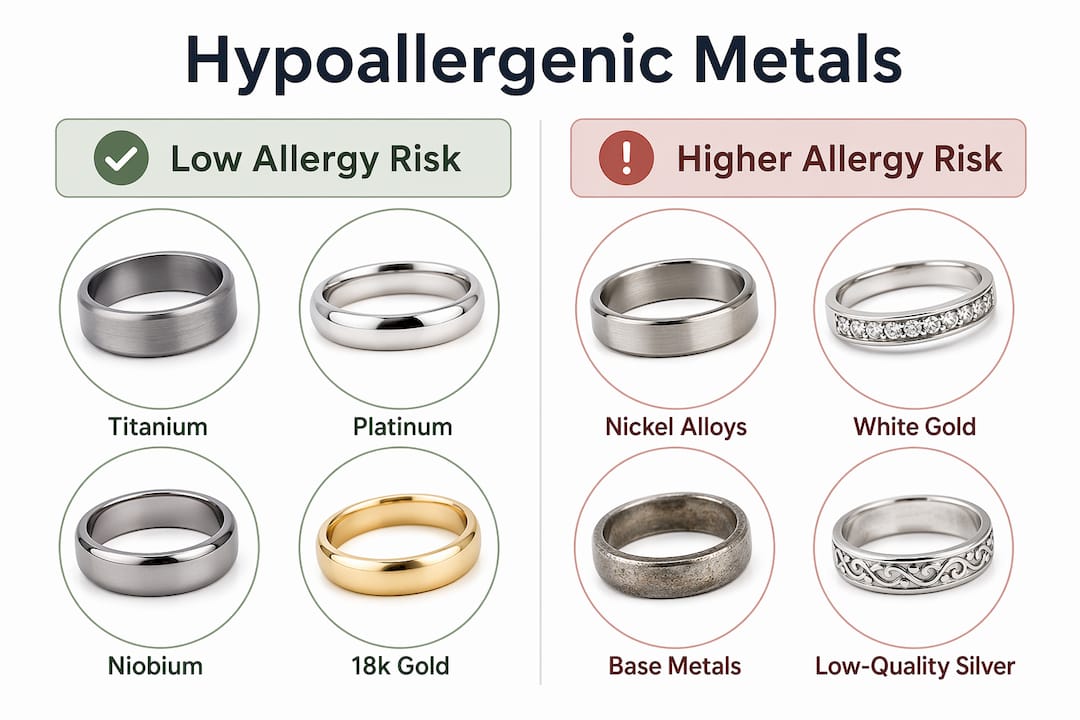
Not all metals behave the same way on sensitive skin. Some are genuinely low-risk. Others are marketed as safe but still contain trace allergens. The table below compares the most commonly recommended options.
| Material | Allergy risk | Best for | Notes |
|---|---|---|---|
| Titanium (implant-grade) | Very low | Extreme sensitivity | Lightweight, durable, no nickel |
| Platinum | Very low | Fine jewelry | Naturally pure, rarely alloyed with nickel |
| 18k or 24k gold | Low | Rings, necklaces, earrings | Higher karat = less alloy = fewer allergens |
| Niobium | Very low | Body and ear jewelry | Excellent for piercings, fully inert |
| Surgical-grade stainless steel | Low to moderate | Everyday wear | Some grades contain trace nickel; check grade |
| Sterling silver | Moderate | Fashion jewelry | Often alloyed with copper; less safe for severe cases |
| Gold vermeil | Low | Affordable fine jewelry | Gold-plated over sterling silver with a 2.5-micron minimum gold layer |
The Mayo Clinic recommends titanium, high-karat gold, nickel-free stainless steel, and sterling silver as metals least likely to cause reactions. For people with the most severe sensitivity, implant-grade titanium and niobium are the gold standard because they are essentially inert at skin contact.
A few points worth understanding about labeling nuances:
Nickel-free means the metal contains no detectable nickel. Hypoallergenic means it is less likely than standard alloys to cause a reaction, but it does not mean nickel-free. You can have hypoallergenic jewelry that still contains trace nickel as long as the release rate stays low. Know which term you are actually reading before you buy.
Pro Tip: If you are buying earrings and your ears are freshly pierced or particularly reactive, go straight to implant-grade titanium or niobium. These materials are used in medical and body piercing contexts for a reason. They give you almost no risk of cross-reaction.
Gold vermeil deserves specific mention as an affordable middle ground. In the U.S., vermeil requires a gold layer of at least 14 karats and 2.5 microns thick over sterling silver. That thickness matters because thinner plating wears down faster, eventually exposing the underlying metal to your skin.
How to choose and care for hypoallergenic jewelry
Knowing which materials are safer is only part of the equation. How you shop and how you care for your jewelry affects the outcome just as much.
Steps to choose the right piece
- Ask for metal documentation. Reputable jewelers provide material certificates or explicit disclosures about metal content and alloy composition. Buying from jewelers with material transparency is one of the strongest protections you have as a sensitive-skin shopper.
- Check for nickel release compliance. If a brand voluntarily notes EU nickel release compliance on pieces sold in the U.S., that is a meaningful signal of quality control.
- Patch test new materials. Before wearing a new piece for hours at a time, patch testing each new material against your inner arm for 24 hours helps identify personal sensitivity before you commit to prolonged wear.
- Start with shorter wear periods. Even with a verified hypoallergenic metal, wearing a new piece for 30 to 60 minutes the first time and watching for any response is smart practice.
- Avoid moisture at contact points. Sweat and water accelerate the breakdown of plating and increase nickel release from alloys. Remove jewelry before swimming, showering, or exercising until you have confirmed it is safe for your skin.
Caring for what you already own
Proper maintenance preserves the protective properties of coatings and surface layers. Cleaning and protecting coatings helps maintain hypoallergenic protection and prevents skin irritation over time. Use a soft, dry cloth to wipe pieces after wearing them. Avoid harsh chemical cleaners on plated pieces, as these strip coatings faster.
If you notice redness, swelling, or itching around where a piece rests on your skin, remove it immediately. Allow the area to recover fully before trying the piece again. If reactions persist, see a dermatologist. A simple patch test at a dermatologist’s office can identify exactly which metals trigger your immune response.
Pro Tip: Clear nail polish applied to the inside of a ring band or the back of a watch creates a temporary barrier between metal and skin. It is not a permanent fix, but it works in a pinch while you figure out your options.
Matching hypoallergenic options to your budget and style
Hypoallergenic jewelry exists at every price point. You do not have to spend a fortune to wear pieces that are safe for sensitive skin.
For everyday wear at an accessible price, stainless steel personalized necklaces are a practical starting point. Surgical-grade stainless steel holds up well to daily contact and is easy to maintain. For men shopping for wedding bands, titanium and tungsten rings combine durability with very low allergy risk, and they sit at price points well below gold.
Here is a quick reference for matching your needs to material options:
- Severe sensitivity or new piercings: Implant-grade titanium or niobium only
- Moderate sensitivity, everyday rings: High-karat gold, platinum, or verified nickel-free stainless steel
- Fashion jewelry on a budget: Gold vermeil over sterling silver; check plating thickness
- Engagement and wedding jewelry: Platinum or 18k gold settings; avoid white gold unless it is rhodium-plated and you can confirm nickel-free alloy composition
- Personalized pieces: Look for stainless steel or sterling silver with clearly disclosed alloy content
When shopping for gemstone necklaces, pay attention to the setting metal, not just the stone. Gemstones themselves do not cause allergic reactions; the prongs, chains, and clasps do.
Pro Tip: White gold often contains nickel in its alloy to achieve its color. If you love the look of white gold but have a nickel allergy, ask specifically about rhodium-plated nickel-free white gold, or choose platinum instead. The visual result is nearly identical.
My honest take on the hypoallergenic label
I’ve spent years watching people get burned, literally, by trusting marketing language without understanding what it actually guarantees. “Hypoallergenic” is one of the most overused and under-explained terms in the jewelry industry. I’ve seen beautifully packaged pieces with that label that contained alloy compositions I would never recommend to anyone with sensitive skin.
What I tell anyone who asks: the label is a starting point, not a finish line. Your job as a buyer is to dig one level deeper. Ask what the metal actually is. Ask whether the brand can confirm nickel release compliance. If they cannot answer those questions clearly, shop somewhere else.
In my experience, the brands worth trusting are the ones that make alloy composition boring and obvious, not mysterious. Transparency on something this specific signals that the manufacturer actually understands the chemistry and cares about the outcome for the wearer. That matters more than whether a listing includes the word “hypoallergenic” or not.
Your skin is personal. What works fine for someone else may not work for you. Knowing your specific triggers and matching those to verified material information is the only approach that consistently produces good results. Price and aesthetics matter, but they have to come second to how a piece actually feels to wear.
— Andrew
Shop hypoallergenic jewelry at Superjeweler

At Superjeweler, you will find detailed metal descriptions across the full jewelry catalog, so you are never left guessing about what you are putting on your skin. From affordable engagement rings under $1,000 set in high-karat gold to a full range of engagement ring styles with verified metal options, the selection is built for shoppers who want both quality and comfort. Superjeweler also offers free worldwide shipping and flexible return policies, which means you can try a piece and send it back without risk if it does not work for your skin. Browse by metal type, read material disclosures directly on product pages, and check customer reviews to see how pieces hold up for wearers with similar sensitivities.
FAQ
What does hypoallergenic mean in jewelry?
Hypoallergenic jewelry is made with materials less likely to cause an allergic reaction than standard alloys. The term is not regulated in the U.S., so it does not guarantee a reaction-free experience.
What metals are safest for sensitive skin?
Implant-grade titanium, platinum, niobium, and 18k or higher gold are the safest choices. Surgical-grade stainless steel is also a reliable lower-cost option for most people with mild to moderate sensitivity.
Is hypoallergenic jewelry completely safe?
No. “Hypoallergenic” means reduced risk, not zero risk. Individual reactions vary, and some people may still react to metals labeled hypoallergenic depending on their specific sensitivities.
How do I know if my jewelry is causing a reaction?
Look for redness, itching, swelling, or blisters at the exact point where the jewelry contacts your skin. These are the hallmark signs of contact dermatitis triggered by a metal allergen.
What is the difference between nickel-free and hypoallergenic?
Nickel-free means no detectable nickel is present in the metal. Hypoallergenic means the piece is formulated to minimize allergy risk but may still contain trace nickel at levels below recognized release thresholds.
Recommended
- Affordable Jewelry Shopping Guide for Quality Finds
- What Is Conflict-Free Jewelry? A Guide to Ethical Choices
- Jewelry Care Tips: Keep Your Pieces Sparkling Longer
- Personalized Jewelry
