TL;DR:
- Moissanite is a lab-created gemstone made of silicon carbide that offers exceptional brilliance and near-diamond hardness at a lower cost. It resists scratching, produces more fire than diamond, and is ethically sourced, making it popular for jewelry like engagement rings and bracelets. Buyers should consider its optical properties and resale limits, as it is valued for beauty and affordability rather than investment.
Moissanite is a lab-created gemstone made of silicon carbide (SiC) that delivers exceptional brilliance and near-diamond hardness at a fraction of the cost. First discovered by Nobel Prize-winning chemist Henri Moissan in 1893 inside a meteor crater in Arizona, natural moissanite is so rare it is virtually impossible to mine for jewelry. Every moissanite stone sold today is grown in a laboratory. It rates 9.25 on the Mohs hardness scale, making it one of the hardest gemstones on earth and a practical choice for everyday wear.
Table of contents
- What is moissanite and what are its key properties?
- How is moissanite made?
- Why shoppers choose moissanite for jewelry
- Common questions when buying moissanite
- Key Takeaways
- Perspective
- Moissanite jewelry at Superjeweler
- FAQ
What is moissanite and what are its key properties?
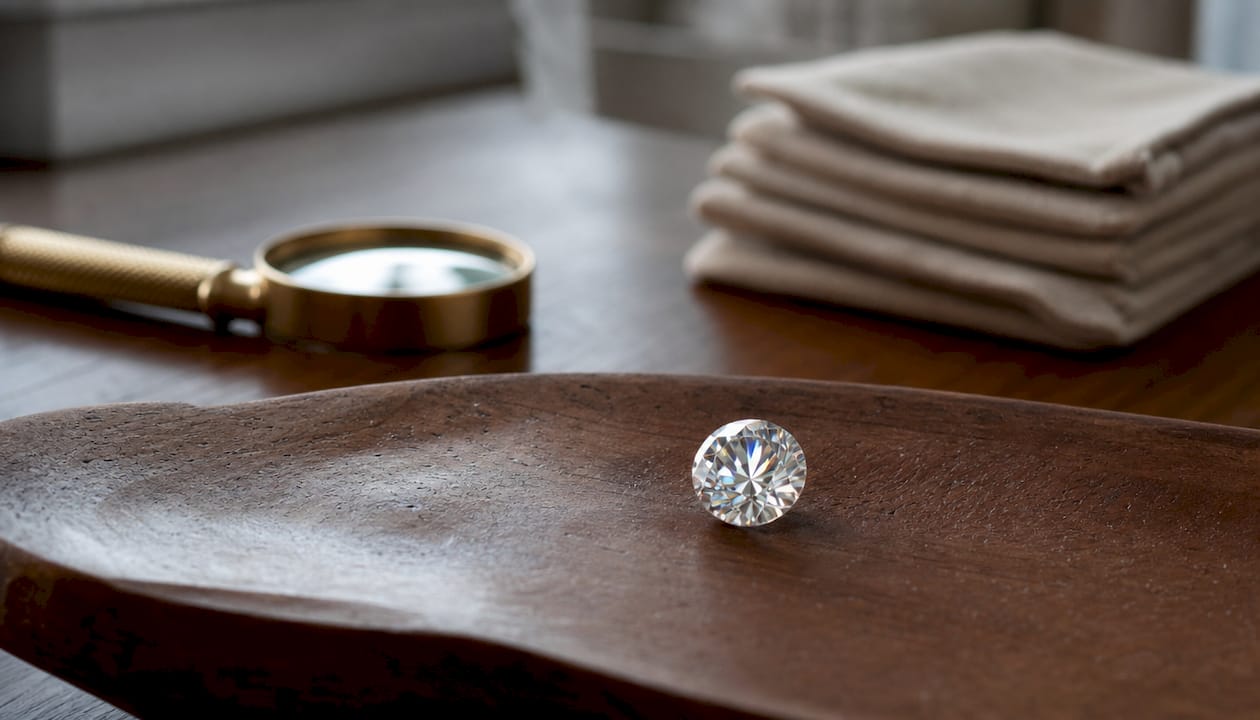
Moissanite is a real gemstone with a distinct chemical identity: silicon carbide, not carbon like a diamond. That difference in structure produces some surprising optical effects that set moissanite apart from every other stone on the market.
Hardness and durability
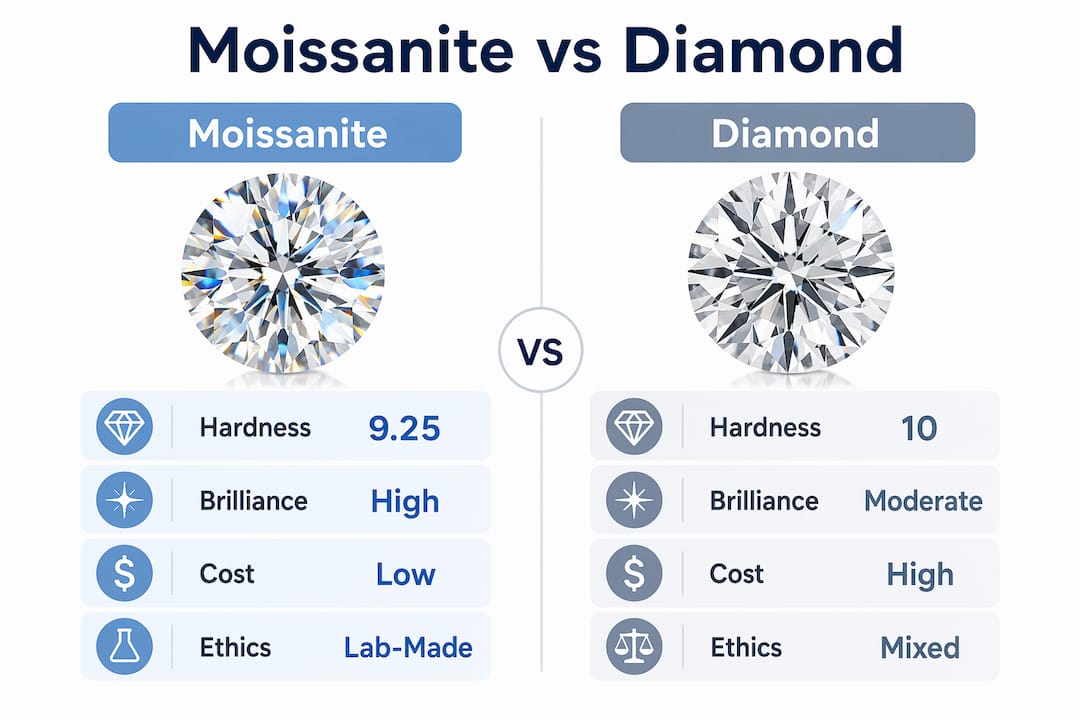
Moissanite’s 9.25 Mohs hardness rating places it above sapphire (9.0) and far above most gemstones used in everyday jewelry. The Mohs scale is relative, not proportional. That means moissanite’s 9.25 rating does not represent a small, mathematically precise gap below diamond’s 10. It signals that moissanite resists scratching from almost every material a person encounters in daily life. Combined with strong toughness and resistance to chipping, moissanite holds up well in rings, bracelets, and other pieces worn constantly.
Optical properties: fire, brilliance, and birefringence
Moissanite produces more fire than diamond due to its higher refractive index. Fire refers to the colorful rainbow flashes a stone throws when light passes through it. Some shoppers love the intense spectral display. Others prefer diamond’s cooler, white-light sparkle. Neither is objectively better; it comes down to personal taste.
The most technically distinctive property of moissanite is birefringence. Moissanite is birefringent, meaning light splits into two rays as it passes through the stone. Under magnification, this creates a doubled facet-edge appearance that a trained gemologist can spot immediately. Diamond does not share this property.
- Hardness: 9.25 on the Mohs scale, suitable for daily wear
- Fire: Higher than diamond, producing vivid rainbow flashes
- Brilliance: Exceptional white-light return, close to diamond
- Birefringence: Unique doubled facet appearance under magnification
- Thermal conductivity: Close to diamond, which can confuse basic testers
Pro Tip: If you are comparing moissanite to diamond in person, look at the stone under a loupe at 10x magnification. The doubled facet edges in moissanite are a reliable identifier that no diamond will show.
How is moissanite made?
Moissanite’s path from a meteor crater to a jewelry store is one of the more unusual stories in gemology. Understanding that path explains why the stone is both affordable and consistent in quality.
The discovery and natural rarity
Henri Moissan first identified silicon carbide crystals in 1893 while examining rock samples from a meteor crater in Canyon Diablo, Arizona. He initially believed the crystals were diamonds. Later analysis confirmed they were a new mineral. Natural moissanite forms around meteor craters and is so scarce that no viable natural supply exists for the jewelry industry. Every moissanite stone in a ring or bracelet today was grown in a lab.
Lab creation: the process behind the stone
- Crystal growth initiation. Scientists use a high-temperature process to grow silicon carbide crystals from a seed material under controlled conditions.
- Boule formation. The crystal grows into a large cylindrical mass called a boule, similar to the process used for lab-grown diamonds and semiconductor wafers.
- Cutting and faceting. The boule is sliced and then cut by skilled gem cutters into standard shapes: round brilliant, oval, cushion, and others.
- Grading and quality control. Finished stones are graded for color, clarity, and cut before being set into jewelry.
The industrial origins of moissanite production connect directly to semiconductor research. Cree, Inc., a semiconductor company, developed the proprietary crystal-growing process that made gem-quality moissanite commercially available starting in the 1990s. That cross-industry innovation is why moissanite quality is consistent and why the stones are available at scale.
Why shoppers choose moissanite for jewelry
Moissanite’s appeal in the jewelry market comes down to three factors: price, beauty, and ethics. Each one addresses a real concern that shoppers bring to the buying process.
Affordability without visual compromise
Moissanite costs approximately 80–90% less than diamonds of comparable size and quality. That price gap is significant. A 2-carat moissanite engagement ring can cost what a 0.5-carat diamond ring costs. The visual difference between the two, in terms of sparkle and size, is minimal to the untrained eye. For shoppers who want a large, brilliant stone without a large budget, moissanite delivers a result that diamond simply cannot match at the same price point.
Ethical and environmental considerations
Lab-grown moissanite requires no mining. That matters to shoppers who are concerned about the environmental impact of gemstone extraction or the ethical sourcing of mined stones. The production process is controlled, traceable, and does not displace communities or damage ecosystems. Buyers who prioritize ethical sourcing find moissanite a natural fit alongside other lab-grown gemstone options.
Popular jewelry types featuring moissanite
- Engagement rings. The most popular application. Moissanite’s hardness and brilliance make it ideal for a ring worn every day. Superjeweler offers a full range of moissanite engagement rings in multiple cuts and settings.
- Eternity bands. Moissanite’s consistent lab-grown quality means stones in an eternity band match perfectly in color and size. A moissanite eternity band delivers a uniform sparkle that is hard to achieve with mined stones.
- Tennis bracelets. The stone’s durability handles the daily flex and movement of a bracelet without risk of scratching or clouding. A moissanite tennis bracelet offers the look of a diamond line bracelet at a fraction of the price.
- Fashion rings and pendants. Shoppers who want statement pieces without committing to diamond prices use moissanite in cocktail rings, pendants, and earrings.
Pro Tip: When selecting a moissanite for an engagement ring, choose a stone graded “colorless” (equivalent to D-F on the diamond color scale). Lower color grades can show a faint yellow or green tint in certain lighting, which becomes more noticeable in larger stones.
Common questions when buying moissanite
Shoppers considering moissanite for the first time tend to have the same practical concerns. The answers below address the questions that come up most often.
Will moissanite scratch or cloud over time?
Moissanite’s hardness of 9.25 on the Mohs scale means it resists scratching from virtually every material except diamond. It will not cloud or lose its sparkle from normal wear. The stone’s surface stays clear for decades with basic care.
How do jewelers tell moissanite from diamond?
Thermal conductivity tests can mistake moissanite for diamond because both stones conduct heat at similar rates. Professional gemologists rely on birefringence testing and electrical conductivity measurements to make a definitive identification. A standard diamond tester that measures only heat is not reliable for distinguishing the two stones.
Does moissanite hold its value?
Moissanite has minimal resale value compared to diamond. The secondary market for moissanite jewelry is limited, and prices do not hold the way diamond prices can. Shoppers should buy moissanite for the beauty and value it delivers today, not as a financial investment.
How do you care for moissanite jewelry?
- Clean with warm water, mild dish soap, and a soft brush every few weeks.
- Avoid ultrasonic cleaners if the stone is set in a prong setting with worn prongs.
- Store moissanite pieces separately to prevent them from scratching softer stones.
- Have prongs checked by a jeweler once a year for rings worn daily.
Full guidance on keeping gemstone jewelry in top condition is available in Superjeweler’s jewelry care tips resource.
Key Takeaways
Moissanite is a lab-created silicon carbide gemstone that delivers near-diamond hardness, stronger fire than diamond, and costs 80–90% less, making it the most practical choice for shoppers who prioritize brilliance and value over resale potential.
| Point | Details |
|---|---|
| Real gemstone, distinct identity | Moissanite is silicon carbide, not carbon, giving it unique optical properties no other stone shares. |
| Exceptional hardness | A 9.25 Mohs rating means moissanite resists scratching from nearly every everyday material. |
| Stronger fire than diamond | Moissanite produces more colorful rainbow flashes due to its higher refractive index. |
| Costs 80–90% less than diamond | Shoppers get a larger, brilliant stone for the same budget they would spend on a smaller diamond. |
| No significant resale value | Moissanite is a purchase for present beauty and value, not a long-term financial asset. |
Moissanite deserves more credit than it gets
The jewelry industry spent decades treating moissanite as a budget substitute for diamond. That framing misses the point entirely. Moissanite is not a lesser diamond. It is a different stone with different strengths, and for a specific type of buyer, those strengths are exactly what they need.
The shoppers I see making the smartest decisions are the ones who ask the right question upfront: what do I actually want this stone to do? If the answer is “look stunning on my hand every day and not cost me a year’s salary,” moissanite wins that comparison without much debate. The fire is genuinely beautiful. The hardness is real. The price difference is not marginal.
Where I think buyers need to be honest with themselves is on resale value and cultural weight. Diamond carries a symbolic status that moissanite does not yet match in most markets. If that matters to you or your partner, acknowledge it before you buy. There is no wrong answer, but there is a wrong assumption. Buying moissanite expecting it to appreciate like a diamond is a mistake. Buying it because you want the most brilliant stone your budget can deliver is a very good decision.
The key differences between moissanite and diamond come down to chemistry, optics, and priorities. Know yours, and the choice becomes straightforward.
— Andrew
Moissanite jewelry at Superjeweler
Superjeweler carries one of the strongest selections of moissanite jewelry available online, from solitaire engagement rings to full eternity bands and tennis bracelets. Every piece ships free worldwide and comes backed by Superjeweler’s warranty and return policy.

Shoppers who want the brilliance of a large stone without the price of a large diamond will find the right fit in Superjeweler’s moissanite engagement ring collection. For buyers who are still weighing options, the engagement rings catalog includes moissanite alongside lab-grown diamonds and traditional diamond settings, so every budget and preference has a clear path forward.
FAQ
Is moissanite a real gemstone?
Yes. Moissanite is a real gemstone composed of silicon carbide. It occurs naturally near meteor craters but is so rare that all jewelry-grade moissanite is lab-grown.
How hard is moissanite compared to diamond?
Moissanite rates 9.25 on the Mohs hardness scale. Diamond rates 10. Moissanite is harder than every other gemstone used in jewelry except diamond, making it fully suitable for daily wear.
Can you tell moissanite from diamond with the naked eye?
Most people cannot tell the difference with the naked eye. Under 10x magnification, moissanite shows doubled facet edges due to birefringence, which diamond does not exhibit.
Does moissanite lose its sparkle over time?
No. Moissanite does not cloud, fade, or lose brilliance with age. Regular cleaning with mild soap and water keeps the stone looking the same as the day it was purchased.
Is moissanite a good choice for an engagement ring?
Yes. Moissanite’s hardness, brilliance, and affordability make it one of the most practical choices for an engagement ring. It costs significantly less than diamond while delivering comparable or stronger visual impact.
Recommended
- Moissanite Tennis Bracelet | Super deals with SuperJeweler
- Gemstone Buying Process: A Complete Guide for 2026
- Diamond vs. Moissanite: Key Differences Explained
- Moissanite Engagement Rings from SuperJeweler. Amazing Prices and Quality!
