For everyday wear, most shoppers land within a moderate range of total carat weight (CTW), with a balanced pick around 1.00 CTW. That number describes both earrings combined, not one, so a 1.00 CTW pair means each ear carries a 0.50 carat diamond. The right choice from there depends on your earlobe size, how active your days are, and what kind of backing holds the stud in place.
TL;DR:
- A 0.25 CTW pair offers a subtle look ideal for daily wear and minimizes snagging risks in casual or active routines.
- Moving from 0.50 CTW to 1.00 CTW significantly boosts visible size and sparkle, making the size difference more noticeable than pure weight suggests.
- Larger sizes like 2.00 CTW or more are best suited for special occasions due to their weight, price, and higher snag risk during regular activities.
- Lab-grown diamonds often provide more size at the same price point, enabling buyers to choose larger stones without increasing their budget.
- Confirming the per-ear carat weight, post length, and quality certification before purchase helps prevent common sizing and fitting issues.
Table of Contents
- Diamond Stud Size Chart by Carat Weight
- Millimeter Size Chart: What the Diamond Actually Looks Like
- How Cut and Setting Change Perceived Size
- How to Choose the Right Stud Size for Your Life
- Backing Types That Keep Bigger Studs Secure
- Lab-Grown vs. Natural Diamonds: What Changes for Size
- How SuperJeweler Helps You Match Size to Budget
- The Simple Self-Check Before You Buy
- Ready to Find Your Size at SuperJeweler
- Sources
Diamond Stud Size Chart by Carat Weight
Carat weight gets thrown around loosely in jewelry stores, and it trips people up constantly. Total carat weight (CTW) refers to both stones added together. A “1.00 CTW pair” is not a single 1 carat diamond, it’s two 0.50 carat diamonds, one per ear. Mix that up while shopping online and you can end up with earrings half the size you expected.
Here’s how the common CTW buckets translate to actual daily wear:
- 0.25 CTW (about 0.125 ct per ear): Subtle and easy to forget you’re wearing them. Reads more as a glint than a statement, and it’s the least likely size to snag on scarves, hoods, or a toddler’s grabby hands.
- 0.50 CTW (about 0.25 ct per ear): The classic light everyday stud. Visible up close, understated from across a room. Popular for first diamond purchases and for anyone who wears earrings from morning gym session to evening dinner without swapping.
- 1.00 CTW (about 0.50 ct per ear): The size most retail guidance points to as the everyday sweet spot, based on how common sizing charts frame the balance point between noticeable sparkle and practical wear. It catches light in normal conversation distance without becoming the focal point of your face.
- 2.00 CTW (about 1.00 ct per ear): A genuine statement size. Beautiful for date nights, weddings, and career milestones, but heavier and pricier, and it draws attention every time.
- 3.00+ CTW (1.50 ct per ear or more): Formal-occasion territory for most budgets. Gorgeous in photos, but the weight and cost make this an occasional-wear size for the vast majority of shoppers rather than a daily habit.
The jump from 0.50 CTW to 1.00 CTW feels bigger on the ear than the math suggests, because face-up size increases with the diamond’s diameter, not its weight in a straight line. Going from 1.00 CTW to 2.00 CTW roughly doubles the price and the visual weight, but it also roughly doubles the snag risk with hair, hoodie zippers, and phone calls. If you want to see what larger stones actually look like before committing, browsing huge diamond stud earrings gives you a realistic sense of scale at the top end.
Millimeter Size Chart: What the Diamond Actually Looks Like
Carat weight tells you what a diamond weighs. It doesn’t reliably tell you how big it looks on your ear, because two diamonds of the same carat weight can have different face-up diameters depending on how they’re cut. Millimeter (mm) diameter is the more honest number if visual size is what you actually care about, a point GIA’s education materials back up when they explain how proportions affect a stone’s face-up appearance.
Standard round brilliant cuts follow a fairly predictable mm-to-carat relationship:
The most common mistake shoppers make is reading “1.00 ct” in a product listing and assuming that’s the size of the whole pair. It usually is not, it’s often the per-ear weight, which means the CTW is double that number. Always check which figure a listing quotes before you compare prices across retailers. When in doubt, ask for the millimeter diameter directly. It removes the ambiguity that carat weight alone leaves on the table.
How Cut and Setting Change Perceived Size
Carat weight is only part of the story. A diamond’s cut proportions determine how much of that weight shows up as visible diameter, which is why two 0.50 carat diamonds can look noticeably different side by side.
Shallow-cut stones spread their weight wider, so they look larger face-up for the same carat weight, sometimes at a slight cost to brilliance. Deeper cuts concentrate weight below the surface, which can make a diamond look smaller than its carat weight suggests even though it weighs the same. Shape matters too. Elongated shapes like oval and marquise tend to look larger than a round diamond of identical carat weight because they cover more surface area on the eye. Princess and cushion cuts fall in between, reading close to true carat size with slightly more visible spread than a round brilliant.
Setting style adds another layer:
- Prong settings expose more of the stone to light and let it read slightly larger, since the metal frame is minimal.
- Bezel settings wrap metal around the diamond’s edge, which protects it well for active wear but can shave a touch off the perceived size.
- Halo settings surround the center stone with smaller accent diamonds, making the overall stud look noticeably bigger than the center stone’s actual carat weight.
- Metal color plays a role too. White gold and platinum tend to make a diamond look whiter and brighter by contrast, while yellow gold can warm up the stone’s appearance, which some wearers prefer and others avoid for that exact reason.
Pro Tip: If your budget caps out at 0.75 CTW but you want the visual punch of a full carat, ask about a halo setting. The ring of accent stones can push the face-up size closer to what a larger solitaire stud would show, without the price jump of the bigger center diamond.
How to Choose the Right Stud Size for Your Life
Picking a size doesn’t have to be a guessing game if you work through it in order.
- Measure your earlobe and note its shape. Thin, short lobes tend to make studs look proportionally bigger, while thicker or longer lobes can absorb more size before a stud looks oversized. There’s no wrong lobe type, just different sweet spots.
- Test scale with paper cutouts or try-on photos. Cut small circles at 5mm, 6mm, and 7mm and hold them against your ear in a mirror, or use a retailer’s virtual try-on tool if one is available. This single step prevents more sizing regret than anything else on this list.
- Match the size to your actual daily routine. If you’re chasing toddlers, hitting the gym, or working with your hands all day, a lower-profile setting in the 0.50 to 1.00 CTW range reduces snag risk and daily fuss. If your days are mostly desk-and-dinner, you have more room to go bigger without practical downsides.
- Confirm the details before you buy. Check the per-ear carat weight (not just CTW), the post length, whether a grading report is included, and the return policy.
Watch for these red flags before checking out:
- A listing that states CTW without breaking out per-ear carat weight
- No certification or grading report mentioned anywhere on the product page
- Backing described vaguely, or no backing type listed at all
- A post length that seems standard regardless of the stone size, since larger stones often need sturdier posts
For a deeper look at balancing quality against price at each size point, SuperJeweler’s guide to choosing diamond earrings walks through the tradeoffs in more detail.
Backing Types That Keep Bigger Studs Secure
The back of a stud earring does more work than most people give it credit for, especially once you move past 0.50 CTW.
Friction (push) backs are the standard choice for smaller, lighter studs. They’re easy to put on and take off, but they can work loose over a long day, which becomes a real risk once you’re dealing with a stone valuable enough that losing it would sting.
Screw backs thread onto the post and stay put through activity, sleep, and hair brushing, which makes them a common recommendation for stones above 0.50 carat per ear. Locking backs, sometimes sold under names like Guardian or La Pousette backs, use a hinge mechanism that clicks shut, offering the highest security for larger or higher-value stones according to jewelers who specialize in stud sizing and mounting.
Post length matters as much as backing style. A post that’s too short on a thick earlobe won’t let the backing seat properly, while a post that’s too long on a thin lobe leaves the stud loose and prone to tilting forward. If your lobes run thicker than average, it’s worth asking your jeweler for a longer post rather than settling for standard length.
Setting choice affects comfort too, particularly with larger stones:
- Bezel and basket settings distribute weight more evenly across the lobe, reducing the forward tilt that heavier prong-set stones can develop over a day of wear.
- Four-prong settings show more diamond but concentrate weight at fewer contact points, which can accelerate tilt on thinner lobes.
- Six-prong settings add stability for stones above 1.00 carat per ear without adding much visible metal.
Lab-Grown vs. Natural Diamonds: What Changes for Size
Lab-grown diamonds are chemically and optically identical to natural diamonds, graded on the same scales, and they typically cost noticeably less per carat, which changes what “reasonable size” means for a given budget.
Because lab-grown stones often run considerably cheaper than natural diamonds of comparable quality, a budget that buys 0.50 CTW in natural diamonds might stretch to 1.00 CTW or beyond in lab-grown, without any visible difference in sparkle or clarity to the naked eye. That’s a full size bucket jump, from subtle to bold, for the same dollar amount.
Statistic Callout: Retail sizing data consistently points to lab-grown diamonds letting shoppers move up roughly one full CTW bucket compared to natural stones at the same price point, based on the size-per-dollar comparisons in current retail guidance.
The practical advice here is simple:
- If face-up size matters more to you than the “natural” label, lab-grown gives you more visible diamond per dollar.
- Regardless of origin, always confirm the stone comes with an independent grading report, GIA or an equivalent lab like IGI, so you know exactly what you’re paying for.
- Compare lab-grown and natural side by side at the same mm diameter, not just the same carat weight, since that’s the number that actually predicts how big the stud will look.
For shoppers weighing this tradeoff directly, lab-grown diamond earrings make the size-per-dollar difference easy to see across a full range of CTW options.
How SuperJeweler Helps You Match Size to Budget
Choosing a diamond stud size gets easier when a retailer shows you the numbers upfront instead of burying them in fine print. Superjeweler lists both carat weight and available size options across its diamond stud earrings, covering everything from subtle everyday pairs to the huge diamond stud earrings built for statement occasions.
Both natural and lab-grown diamond studs are commonly offered side by side, enabling comparison of face-up size at similar price points to assess value. Jewelry purchases are generally supported by standard warranty and return policies, which can be especially important when buying sizes sight unseen online. If product listings lack clear details on per-ear carat weight or post length, customer service teams can often provide those specifics before checkout.
The Simple Self-Check Before You Buy
Most people overthink diamond stud size, and then underthink the two details that actually matter: per-ear carat and how the back holds the stone. Everything else is preference dressed up as a decision.
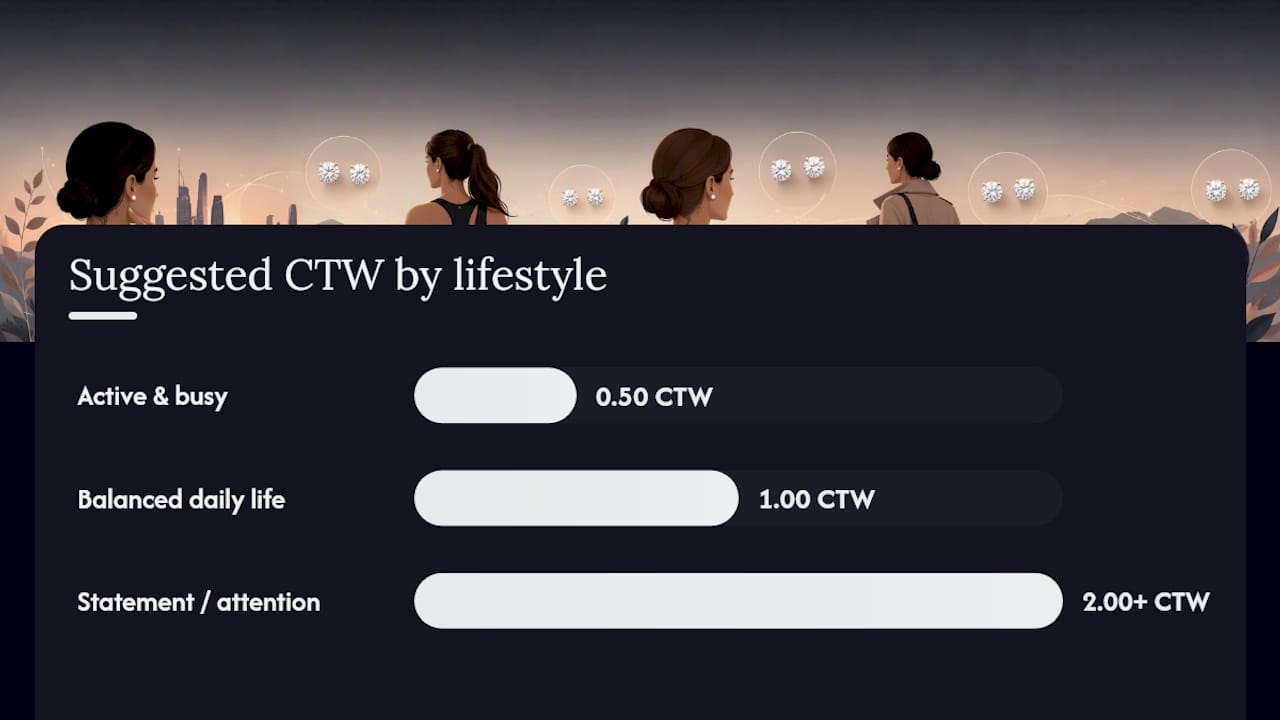
Ask yourself three questions. How active is my day, hands, hair, gym, kids, versus a mostly desk-and-dinner routine? How does my earlobe compare to average, thin and short, or thicker and longer? And how do I feel about people noticing my earrings, do I want a quiet accessory or a piece that starts conversations? Your answers point you toward a bucket. Active and low-attention preference leans toward 0.50 CTW. Balanced daily life with moderate visibility leans toward 1.00 CTW. A love of statement pieces and tolerance for extra care leans toward 2.00 CTW and up.
If budget is the limiting factor rather than taste, lean lab-grown before you lean smaller. You’ll get more visible diamond for the same money, with identical brilliance to the naked eye. Whatever size you land on, confirm the per-ear carat weight and post length in writing before you pay. That single habit prevents almost every sizing complaint I’ve seen in this category.
— Andrew
Ready to Find Your Size at SuperJeweler
A comprehensive range of diamond studs is available, from subtle 0.25 CTW everyday pairs to bold 2.00 CTW statement studs, in both natural and lab-grown diamonds, typically with millimeter and carat details provided on product pages.

If a full carat per ear is on your wish list but the budget says otherwise, lab-grown is worth a serious look. Browsing lab-grown diamonds shows you how much size that switch can unlock for the same spend, and the same logic applies if you’re shopping engagement rings rather than studs, where budget-friendly engagement ring options show real diamonds at accessible price points.
Before you check out on any diamond stud purchase, run through this quick list: confirm the per-ear carat weight (not just CTW), check the post length against your lobe thickness, verify a grading report is included, and read the return policy in case the size doesn’t look the way you pictured it. Start browsing SuperJeweler’s diamond stud selection today and use the size chart above to pick the pair that fits your daily life.
