The fastest way to a real number is to run a diamond price calculator using your carat, cut, color, and clarity, then collect two or three offers from actual buyers. Certification and condition will swing that final figure more than almost anything else, so don’t quote a number to anyone until you’ve confirmed both.
TL;DR:
- Natural, certified diamonds typically fetch 30 to 60 percent of their retail value, depending on size, clarity, and market demand, with lab-grown stones considerably lower.
- The resale value dramatically drops for diamonds just below common weight thresholds and for less popular shapes, while high-quality color and clarity grades improve offers.
- Selling channels affect recovery rates: private sales and consignment often yield the highest proceeds over time, while pawn shops offer the lowest and fastest cash.
- Certification from reputable labs like GIA can increase the offer by 10 to 30 percent, and removing the diamond from custom settings may boost resale value.
- Resale prices for lab-grown diamonds have fallen sharply since 2020 due to market saturation and declining production costs, limiting recovery to roughly a third of the original price.
Table of Contents
- Diamond Trade In Value: The Quick Estimate Method
- How the 4Cs and Certification Shape Your Offer
- Natural vs. Lab-Grown: Why Resale Value Diverges Sharply
- Where to Sell: Channel-by-Channel Recovery Rates
- How to Get the Highest Offer for Your Diamond
- Using a Diamond Price Calculator the Right Way
- Three Realistic Scenarios With Expected Offers
- SuperJeweler’s Take: Trade-In, Cash Sale, or Upgrade?
- Ready to Replace or Upgrade Your Diamond?
- Where to Verify Diamond Value and Grading
- Sources
Diamond Trade In Value: The Quick Estimate Method
Most online calculators spit out two figures: an estimated retail price and an estimated wholesale price. Retail is what a jeweler would charge a customer walking into a store. Wholesale is closer to what a dealer pays another dealer, and it’s the number that actually matters when you’re the one selling.
The gap between those two figures exists because retail markups on diamonds commonly run 100 to 200%, so a stone that sold for $6,000 at full retail might carry a true wholesale value closer to $2,500 to $3,000. Resale offers generally fall below wholesale once a buyer factors in profit margin and risk.
Here’s the multiplier approach sellers actually use, working from either the retail price or the calculator’s wholesale estimate:
- Start with retail price. If you don’t have a recent appraisal, use the original purchase price as your retail baseline.
- Apply a 0.30 to 0.60 multiplier for natural, certified stones. Use the low end for smaller or lower-clarity stones, the high end for larger, well-cut, well-certified ones.
- Apply a 0.10 to 0.30 multiplier for lab-grown stones, reflecting the market conditions covered below.
- Cross-check against the calculator’s wholesale figure. If your multiplier-based estimate and the wholesale number land within the same range, you’ve got a credible ballpark.
Worked example: a 1-carat natural diamond with a $6,000 retail price and GIA paperwork. At a 0.40 to 0.55 multiplier, expect offers in the $2,400 to $3,300 range depending on channel, with private buyers and specialty dealers clustering toward the top of that band and pawn shops well below it.
How the 4Cs and Certification Shape Your Offer
Carat weight moves price in steps, not a smooth line. Diamonds just under a popular weight threshold, like 0.90 carats instead of 1.00, or 1.90 instead of 2.00, tend to sell for noticeably less than the threshold weight itself. Buyers shop by round numbers, and carat-weight cutoffs create real liquidity cliffs where a fraction of a carat separates two very different offers.
Cut and shape affect how fast a stone sells as much as what it sells for. Round brilliants and other classic shapes move quickly because demand is deep and constant. Fancy or dated shapes can sit for months waiting for the right buyer, which pushes sellers toward accepting a lower offer just to close the deal.
Color and clarity work the way you’d expect: stones in the higher grading bands (D to J color, VS clarity and above) hold value better, while lower bands see steeper discounts because buyers assume they’ll be harder to resell themselves.
- Carat: weight just below a popular threshold often prices like the lower bracket, not a fraction less than the higher one.
- Cut and shape: round and princess cuts typically resell faster than uncommon fancy shapes.
- Color and clarity: mid to high grades hold value; heavily discounted grades see compounding markdowns.
- Certification: GIA or AGS paperwork typically adds meaningful value and speeds up a sale.
- Setting and condition: loose stones and simple mountings appraise and sell more easily than elaborate custom pieces.
Certification deserves its own emphasis. A GIA report doesn’t just describe the stone, it removes doubt for the buyer, and that reduced risk often shows up as a 10 to 30% uplift in the offer compared to an uncertified stone of similar quality.
Pro Tip: If your diamond is uncertified, get it graded before you shop it around. The certification fee is usually small compared to the difference in offers you’ll see once buyers can verify what they’re looking at.
Setting matters more than most sellers expect. Custom mounts and elaborate settings often subtract value rather than add it, because buyers are pricing the center stone and treating the metal work as a liability they’ll have to remove and possibly melt down.
Natural vs. Lab-Grown: Why Resale Value Diverges Sharply
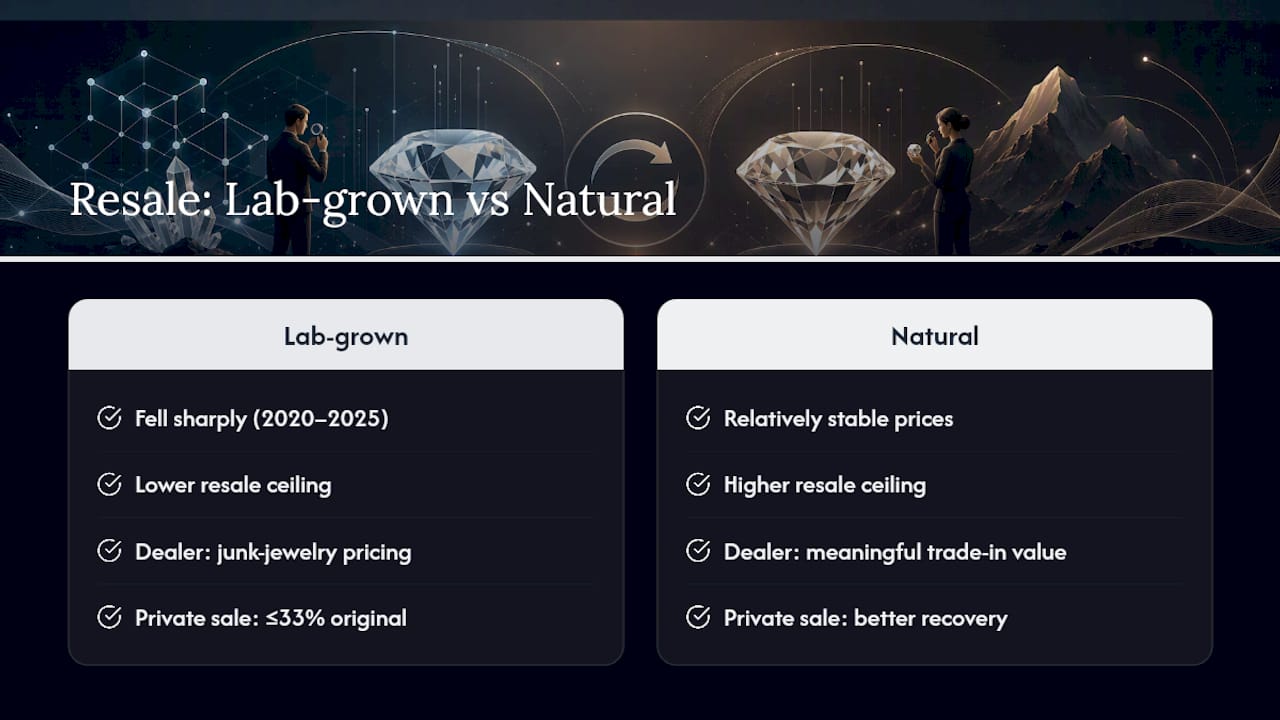
Lab-grown diamond prices have fallen sharply between 2020 and late 2025, and that collapse has reshaped what sellers can expect on the resale side.
The cause is straightforward production economics. Lab-grown supply has scaled up fast, manufacturing costs keep dropping, and the market has gotten saturated with new inventory competing against a growing pool of used stones. Every year that production costs fall, the retail price of a brand-new lab-grown diamond drops too, which drags the resale ceiling for older stones down with it.
If you’re holding a lab-grown diamond, set your expectations accordingly. A trade-in or dealer sale will likely land near junk-jewelry pricing rather than anything close to what you paid. A private sale to another individual buyer, patient and slower as it is, remains the more realistic route to a better number, though even there don’t count on recovering much more than a third of the original price.
Where to Sell: Channel-by-Channel Recovery Rates
Every selling channel trades speed against net proceeds, and picking the wrong one for your priorities is the single most common way sellers leave money on the table.
| Channel | Typical Recovery (% of Retail) | Typical Timeline | Who Pays the Fees |
|---|---|---|---|
| Private sale | 30 to 50% | Weeks to months | Seller (marketing time, no commission) |
| Specialty online platform | 30 to 50% | Days to weeks | Seller (platform commission) |
| Estate jeweler or dealer | 30 to 50% | Same day to a few days | Built into the offer |
| Consignment | 30 to 50% (after fees) | Weeks to months | Seller (consignment commission) |
| Auction house | Varies; strong for rare or high-value pieces | Weeks to months | Seller (seller’s premium) |
| Pawn shop | 10 to 25% | Same day | Built into the offer |
- Choose private sale or consignment if net proceeds matter most and you can wait. Consignment and auction routes tend to outperform quick-cash channels for stones over one carat.
- Choose an estate jeweler or specialty online platform for a middle ground between speed and proceeds.
- Choose auction for rare, large, or signed pieces, where competitive bidding can push recovery well above typical dealer offers.
- Avoid pawn shops unless you need cash today and have already accepted the lowest end of the range.
How to Get the Highest Offer for Your Diamond
A few hours of prep work before you contact a single buyer routinely changes the outcome by hundreds or thousands of dollars.
- Locate your GIA or AGS certificate and original purchase receipt before requesting quotes.
- Get the stone regraded if the certificate is old or missing; buyers discount heavily for grading uncertainty.
- Ask a jeweler whether removing the diamond from its setting will improve the offer, especially for custom or dated mounts.
- Collect at least two or three independent quotes before accepting anything.
- Verify any buyer’s credentials, licensing, and reviews before shipping a stone or handing it over in person.
- Clean the stone professionally and take clear, well-lit photos if you’re selling privately or online.
Timing carries real weight too. Demand for diamonds climbs around the holiday season and engagement season in late winter, and selling into that window can mean a faster sale at a better price than listing in a slow month.
Pro Tip: Never accept the first offer you receive, even from a jeweler you trust. Buyers expect negotiation, and simply saying “I have another quote” often moves the number by several hundred dollars.
Using a Diamond Price Calculator the Right Way
Calculators are only as good as what you enter, so double-check three fields before trusting the output: carat weight to the hundredth, the actual cut grade from your certificate (not a guess), and whether the stone is certified at all. Get any one of those wrong and the estimate shifts meaningfully.
- Enter your specs and read both outputs. The retail figure tells you what a buyer would pay in a store; the wholesale figure is your real starting point.
- Apply the multiplier from the estimate method above to the wholesale figure to project a realistic dealer offer.
- Discount further for a private-sale floor if you’re not certified, uncertain about clarity grade, or selling a less popular shape.
- Get a professional appraisal if the calculator’s estimate will inform a major decision, like an insurance claim or an estate settlement, since no online tool replaces an in-person evaluation for that purpose.
Calculators are directional, not definitive. Treat the number as a starting point for negotiation, not a guaranteed offer.
Three Realistic Scenarios With Expected Offers
0.25-carat natural diamond, $800 retail, uncertified. Expect $150 to $300 from most dealers, since the small size and missing certification both work against you. Getting it graded first could push the top end higher.
1.00-carat natural diamond, $6,000 retail, GIA-certified, VS2 clarity, near-colorless. Recovery in the 30 to 50% range is realistic through a dealer or specialty platform, landing around $1,800 to $3,000, with private sale potentially reaching $3,600.
- Uncertified stones: subtract roughly 10 to 20 percentage points from any of these ranges.
- Fancy or dated shapes: expect the low end of the range regardless of the channel.
- Lab-grown equivalents of any scenario above: expect 10 to 30% of retail, not 30 to 60%.
SuperJeweler’s Take: Trade-In, Cash Sale, or Upgrade?
Selling for cash makes sense when liquidity matters more than sentiment. But if you’re parting with a diamond because you want something different, an upgrade or trade-in credit toward a new piece can stretch further than a cash sale followed by a separate purchase, since you skip one round of retail markup entirely.
We’d weigh sentimental value honestly before deciding. A family stone might be worth more reset into a new setting than sold outright, while a diamond you never loved is better converted to cash or credit toward something you’ll actually wear. Either path is reasonable. Just make the decision with real numbers in hand, not guesswork.
— Andrew
Ready to Replace or Upgrade Your Diamond?
If you’ve run the numbers and decided cash-out proceeds won’t stretch as far as you hoped, putting that value toward something new is usually the better move. Superjeweler carries cheap engagement rings under $1,000 with real diamonds, so a trade-in or resale payout can often cover a full replacement rather than just a partial credit toward one.

Selection matters here too. Beyond entry-level rings, Superjeweler’s lab-grown diamonds category gives budget-conscious shoppers a way to get more size and clarity per dollar than a comparable natural stone, backed by warranty coverage and free shipping on every order. If your existing setting is the problem rather than the stone, browsing engagement rings directly can show you what a fresh mounting costs compared to keeping the old one. Reach out to Superjeweler’s customer support team with questions about sizing, certification, or which style fits your budget before you commit to buying or trading anything in.
Where to Verify Diamond Value and Grading
The GIA remains the standard for independent grading and is the first place to confirm a stone’s specs before pricing it. For broader market context on pricing swings and resale realism, review coverage like estate sale pricing guides, which explain markup and markdown patterns that apply directly to diamonds. Auction houses and established resale platforms remain the strongest options for high-value or rare stones once you’re ready to sell.
Sources
- Diamonds lose their sparkle as prices come crashing down | Retail industry | The Guardian
- Do Diamonds Hold Their Value? Resale Reality vs Marketing (2026) | TheDiamondPrice
- Diamond Resale Value: Where to Sell and What to Expect | CutGrade
- GIA (Gemological Institute of America)
- How Diamond Resale Value Is Determined in the Secondary Jewelry Market | MarkMeets Media
