For jewelry under $1,000, carrier insurance plus a signature requirement covers you fine. Between $1,000 and $5,000, lean on USPS Registered Mail or a third-party policy. From $5,000 to $50,000, Registered Mail or a specialty insurer like Jewelers Mutual or Secursus is the safer bet. Above $50,000, enroll in the FedEx Declared Value Advantage Program if you qualify, or work with a specialist transit insurer instead.
TL;DR:
- For shipments over $1,000, USPS Registered Mail or third-party policies provide more reliable coverage than carrier liability limits.
- Enrolling in FedEx DVA is essential for high-value jewelry above $50,000, offering up to $100,000 coverage domestically.
- Proper documentation and secure packaging are critical because insurance claims rely heavily on proof of condition and chain of custody.
- Costs for third-party jewelry insurance generally range from $1 to $6 per $100 of declared value, increasing with higher-value shipments.
- For frequent high-value shipping, specialized transit insurers or carrier programs like FedEx DVA offer the best combination of payout, speed, and security.
Table of Contents
- Which Shipping Insurance Is Best for Jewelry by Value?
- Declared Value vs. Third-Party Insurance: What’s the Real Difference?
- How Do You Pack and Hand Off an Insured Jewelry Shipment?
- What Does Jewelry Shipping Insurance Actually Cost?
- How Do You Choose the Right Insurance Option for Your Shipment?
- SuperJeweler’s Approach to Secure, Insured Shipping
- What Most Advice on Jewelry Shipping Gets Wrong
- Shop Confidently, Ship Securely at Superjeweler
- Sources
Which Shipping Insurance Is Best for Jewelry by Value?
Picking the right coverage isn’t about finding the “best” insurer in the abstract. It’s about matching the tool to the dollar amount at risk and how fast you need the package to move. Below is how the major carrier programs and specialty insurers stack up against each other on the things that actually matter: how much they’ll cover, what you have to do to qualify, how the package is handled in transit, and what it costs.
| Option | Max coverage per parcel | Contract/enrollment required | Security / chain-of-custody | Typical cost | Transit speed | Best for |
|---|---|---|---|---|---|---|
| FedEx Declared Value Advantage Program | Up to $100,000 domestic | Yes, must enroll and meet program requirements | Special security packaging and handling under the program | Program fees plus standard freight | Overnight to 2-day typical | High-volume sellers shipping five and six-figure pieces regularly |
| USPS Registered Mail | Up to $50,000 domestic | No enrollment, but must be presented in person | Documented handoff at every transfer point | Moderate, based on declared value | Slowest option, several days | Anyone who wants a paper trail more than speed |
| Jewelers Mutual / specialty transit insurance | Set by policy, often covers full retail value | Policy purchase, no carrier enrollment | Depends on chosen carrier; insurer covers the risk | Policy-based, competitive for frequent shippers | Matches whatever carrier you choose | Frequent shippers or pieces above carrier caps |
| Secursus | Set by policy, covers declared retail value | Policy purchase | Independent of carrier’s own limits | Roughly $1 to $6 per $100 of value | Matches carrier choice | Sellers who want fast, reliable third-party claims handling |
| Cabrella (supplemental shipping insurance) | High per-package limits, policy dependent | Policy purchase, integrates with shipping workflow | Independent of carrier | Competitive, quote based | Matches carrier choice | Retailers wanting integrated insurance at checkout or scale |
UPS deserves a mention here even though it isn’t a featured product, because its limitations shape a lot of shipper decisions. UPS commonly requires a High-Value Goods contract for elevated jewelry values, and without one, its liability on loose gemstones and precious metals is capped low. That single fact pushes a lot of sellers toward USPS or FedEx DVA by default.
A few quick notes on each option:
- USPS Registered Mail wins on documentation. Every transfer point gets logged, which matters enormously if you ever need to prove where a package was at a given hour.
- FedEx DVA wins on ceiling. A $100,000 declared value domestically is far beyond what any standard carrier service offers, but you have to qualify first.
- Jewelers Mutual, Secursus, and Cabrella win on payout basis. They typically insure against declared retail value rather than a carrier’s own liability schedule, which tends to mean a cleaner claim if something goes wrong.
- UPS is the one to watch for surprises. Without an HVG contract, coverage on jewelry can be far thinner than shippers assume.
Statistic to remember: FedEx’s standard liability without DVA enrollment tops out at $1,000, but the same carrier’s DVA program raises that ceiling to $100,000. That’s a hundredfold jump, and it’s the single biggest reason serious jewelry sellers eventually enroll.
Declared Value vs. Third-Party Insurance: What’s the Real Difference?
Declared value is a carrier’s promise to pay up to a stated amount if a package is lost or damaged in their custody. It’s built into the shipping label, tied to their own tariff rules, and subject to their own claims process. Third-party insurance, by contrast, is a separate contract you buy from an insurer whose entire business is jewelry risk. The insurer isn’t the one moving your package. It’s the one paying out if the carrier drops the ball.

The distinction matters most at claim time. Carriers evaluate claims against their own liability limitations and often push back on valuation, especially for handmade or one-of-a-kind pieces without third-party appraisal. Specialty insurers tend to settle claims faster and closer to full retail value, since that’s the core service they’re selling.
Claims get denied for a handful of predictable reasons:
- The declared value wasn’t backed by documentation (no receipt, no appraisal).
- The packaging didn’t meet the carrier’s stated requirements, which voids liability in many tariffs.
- The item falls under an exclusion, such as loose stones shipped without an HVG contract on some carriers.
- The claim was filed after the carrier’s deadline, which is often measured in days, not weeks.
One trap worth flagging directly: some marketplace or platform-level shipping protection, including certain third-party insurance products bundled into checkout flows, explicitly excludes precious metals and stones. Don’t assume a checkout insurance checkbox covers a diamond ring just because it’s labeled “shipping protection.”
To maximize your odds if you ever need to file:
- Photograph the item from multiple angles before boxing it, with a ruler or coin for scale.
- Keep the original receipt, appraisal, or certificate on file, not just a digital copy buried in an inbox.
- Record serial numbers or laser inscriptions where the piece has them.
- Save the shipping receipt and tracking number in the same file as the item photos.
Pro Tip: Create a simple digital folder for every high-value shipment before you seal the box: photos, appraisal, receipt, tracking number. It takes five minutes and it’s the difference between a smooth claim and a denied one.
How Do You Pack and Hand Off an Insured Jewelry Shipment?
Insurance only pays out cleanly if the packaging met the carrier’s own standards. Skip a step here and you can hand an insurer grounds to deny the claim entirely.
- Double-box everything. Use a rigid inner box for the jewelry itself, cushioned to prevent movement, then place that inside a larger corrugated outer box with packing material filling every gap.
- Run the shake test. Nothing should rattle when you shake the sealed outer box. If you hear movement, open it back up and add more cushioning.
- Strip the outer label of anything descriptive. No “jewelry,” no “diamond,” no “gold.” A neutral label prevents the package from becoming an obvious target on a delivery truck or a porch.
- Match the signature requirement to the value. Under $1,000, standard signature is usually enough. Above that, require adult signature or direct signature, and for anything going through Registered Mail, plan to present the package in person at the counter.
- Present Registered Mail correctly at the Post Office. It must be handed to a clerk, not dropped in a collection box, and the clerk will seal and log it in front of you.
- Get proof at drop-off. Ask for a receipt, snap a photo of the sealed package before you hand it over, and confirm the tracking number is active before you leave the counter.
Pro Tip: Take the drop-off photo with the tracking label clearly visible in the same frame. If a claim ever comes down to “was this really sealed and intact when I shipped it,” that one photo does most of the work for you.
What Does Jewelry Shipping Insurance Actually Cost?
Costs scale with declared value, and the rate isn’t flat across providers. Third-party specialty insurance generally runs $1 to $6 per $100 of declared value, depending on the insurer, the route, and how the package is handled.
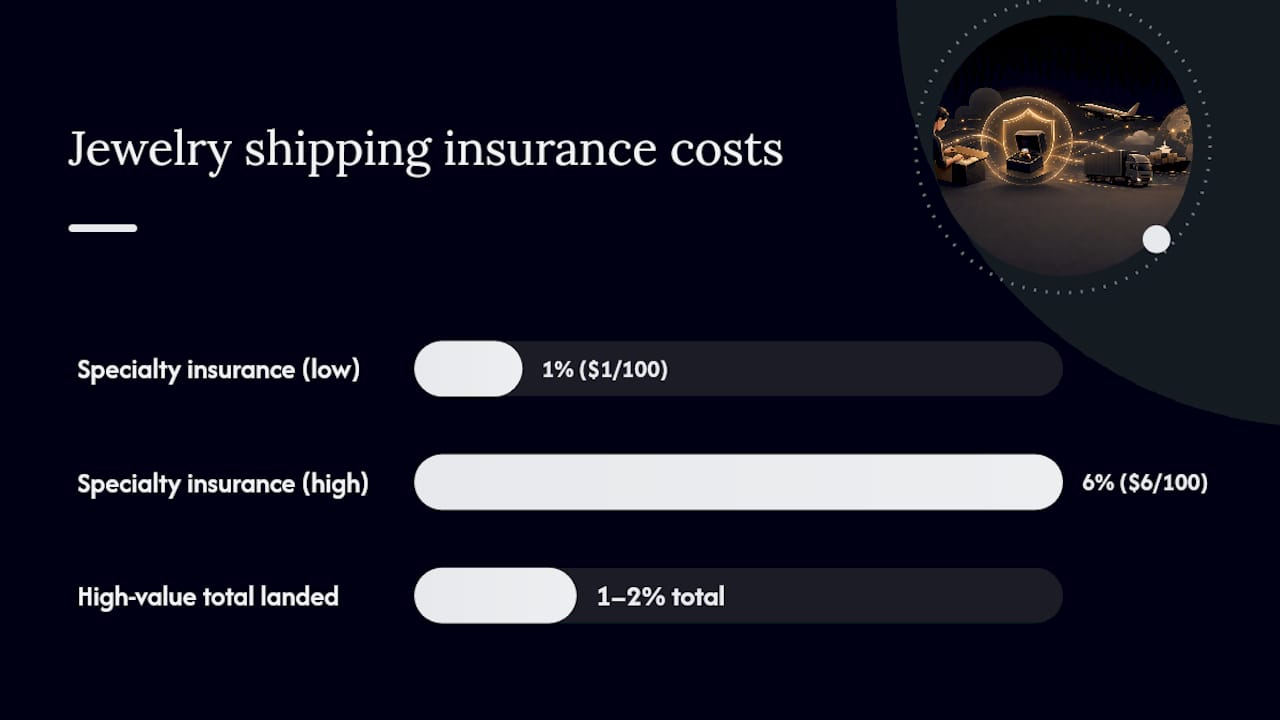
Once a shipment climbs into the high five figures or higher, an armored courier or dedicated art-freight service becomes worth pricing out, even though it raises the percentage cost. Total landed cost, including specialty handling, can reach roughly 1% to 2% of declared value for the highest-value shipments, a cost most sellers accept gladly compared to the alternative of an uninsured loss.
How Do You Choose the Right Insurance Option for Your Shipment?
Start with two questions: what’s the item worth, and how often are you shipping pieces like this? A one-off gift shipment and a jeweler moving inventory weekly need different setups.
- Under $1,000, one-off shipment: standard carrier insurance with signature confirmation is enough. Don’t overbuy coverage for low-value pieces.
- $1,000 to $5,000: USPS Registered Mail or a basic third-party policy from Secursus or a similar insurer covers the gap carriers leave open.
- $5,000 to $50,000, occasional shipper: Registered Mail plus a specialty policy from Jewelers Mutual gives you both chain-of-custody and full retail-value payout.
- Above $50,000, or frequent seller at any value tier: pursue FedEx DVA enrollment or a dedicated transit insurer built for repeat high-value freight.
When you’re evaluating a carrier program or a specialty insurer, ask directly:
- Is coverage based on carrier liability limitations or full declared retail value?
- What’s the stated turnaround time for claims once documentation is submitted?
- What exclusions apply to loose stones, estate pieces, or custom work?
- What documentation is required at the time of filing, not after?
Pro Tip: Ask any specialty insurer for their average claims turnaround time in writing before you buy the policy, not after you need it. A vague answer is itself a red flag.
Red flags that should send you elsewhere: a policy that won’t specify its claims timeline, coverage that’s vague about whether it pays retail value or wholesale value, or any provider that can’t explain in plain terms what documentation triggers a payout.
SuperJeweler’s Approach to Secure, Insured Shipping
Superjeweler ships fine jewelry nationwide and treats secure packaging as standard practice, not an upsell. The team has written practical guidance on why jewelry insurance matters for buyers who want to protect a purchase after it arrives, and that same care extends to how orders leave the warehouse.
Andrew, who covers jewelry care and protection topics for Superjeweler, has focused much of that coverage on helping buyers understand what actually happens between checkout and delivery, not just what a warranty page promises.
If you’re ordering something with meaningful value, whether it’s an engagement ring or a personalized piece meant as a gift, reach out to customer service before you check out. Requesting signature confirmation or special handling instructions on an order takes one message, and it closes the exact gap this article has spent most of its length explaining.
What Most Advice on Jewelry Shipping Gets Wrong
Most guides treat shipping insurance like a single decision: buy coverage, move on. That’s backwards. The real decision is a value-band problem, and the guides that skip straight to “just buy insurance” miss that a $900 pendant and a $60,000 estate necklace have almost nothing in common operationally.
The bigger blind spot is chain-of-custody. Everyone focuses on the dollar ceiling a carrier or insurer will pay, and almost nobody talks about how documented the handoff actually is. A $50,000 Registered Mail limit with a logged transfer at every point is often more defensible in a claim than a higher declared-value number with no custody trail behind it. Speed gets treated as a feature. For high-value jewelry, it’s often the tradeoff you should be willing to make.
If there’s one thing worth prioritizing above all else, it’s documentation before the box is ever sealed. Photos, appraisal, receipt, packaging that meets the carrier’s own stated rules. Insurance is only as good as the paper trail behind it, and that paper trail is the one part entirely under your control.
— Andrew
Shop Confidently, Ship Securely at Superjeweler
Superjeweler backs every order with clear warranty support and shipping practices built for jewelry that actually matters to the person receiving it. Choosing a retailer that takes packaging and delivery seriously is half the insurance equation, and it’s one you don’t have to think about twice when you buy from a seller that already does.

If you’re shopping engagement rings under $1,000 or browsing personalized jewelry for a gift, you can request signature confirmation or special handling instructions directly through customer service at checkout, at no extra hassle on your end. For higher-value pieces, that one message is worth sending before you finalize the order. Browse the current engagement ring selection and ask about secure delivery options before you check out.
Sources
- High-Value Jewelry Declared Value Advantage Program
- Protection in Transit (Registered Mail) — USPS Publication 370
- How to ship jewelry for your e-commerce store: tips, examples for shipping jewelry — GoShippo
- How to ship jewelry: Packing, carriers & insurance — Secursus
Recommended
- Protect Your Jewelry Investment: The True Value of a Warranty
- Jewelry Appraisal Explained: Ensure Value and Authenticity
- What a Jewelry Appraisal Cost Actually Looks Like in 2026
