There is no single official list, but the anniversary gemstones by year that jewelers and gift buyers rely on are remarkably consistent across sources. This guide consolidates the assignments cited by the GIA and Jewelers of America, covering years one through sixty, with buying guidance for the milestones that matter most.
TL;DR:
- The list of anniversary gemstones is mostly consistent for the first 20 years but diverges afterward due to modern gemstone availability and trade adaptations.
- Major milestone anniversaries like the 10th, 25th, 40th, 50th, and 60th have traditional gemstones or materials that strongly influence gift choices.
- When selecting jewelry, consider the recipient’s lifestyle, durability of the stone, and certification to ensure longevity and value preservation.
- The traditional list is more of a guidance tool, especially for milestones, rather than a strict rulebook, making personal taste a significant factor.
- Silver, ruby, and gold are recurring themes at key milestones, but in-between years often feature less culturally recognized gemstones without strict significance.
Table of Contents
- Anniversary Gemstones by Year: The Full Chart
- Milestone Anniversaries: What to Buy for 10, 25, 30, 40, 50, and 60
- How to Choose Anniversary Gemstone Jewelry That Lasts
- Why the List Exists: Tradition Meets Modern Retail
- An Editor’s Take on Buying by the Chart
- Shop Anniversary Gemstones by Category at Superjeweler
- Sources
Anniversary Gemstones by Year: The Full Chart
The lists you see on jewelry sites all trace back to a handful of trade sources, and the further you go past year 20, the more they start to diverge. Years one through twenty are fairly locked in. Beyond that, retailers fill gaps with gemstones that didn’t exist in the original 19th-century customs, which is why you’ll sometimes see two different stones listed for the same year.
Here’s the chart broken down by year, combining the GIA’s documented assignments with the Jewelers of America trade standard and cross-checked against the International Gem Society’s consumer chart:
- 1st: Gold jewelry (some lists specify gold jewelry over the metal itself)
- 2nd: Garnet
- 3rd: Pearl
- 4th: Blue topaz
- 5th: Sapphire
- 6th: Amethyst
- 7th: Onyx
- 8th: Tourmaline
- 9th: Lapis lazuli
- 10th: Diamond
- 11th: Turquoise
- 12th: Jade
- 13th: Citrine
- 14th: Opal
- 15th: Ruby
- 16th: Peridot
- 17th: Watches (a non-gemstone tradition that persists on most modern lists)
- 18th: Cat’s eye
- 19th: Aquamarine
- 20th: Emerald
- 21st: Iolite
- 22nd: Spinel
- 23rd: Imperial topaz
- 24th: Tanzanite
- 25th: Silver jubilee (sterling silver, sometimes paired with a gemstone of the couple’s choosing)
- 30th: Pearl (some modern lists substitute diamond)
- 35th: Emerald (occasionally listed as coral on older traditional charts)
- 40th: Ruby
- 45th: Sapphire
- 50th: Gold, golden jubilee
- 55th: Emerald (a repeat from year 20 on several lists, which causes confusion)
- 60th: Diamond, diamond jubilee
Notice how ruby, sapphire, and emerald each show up twice on this list. That’s not an error. It reflects how different trade groups extended the original list at different points in the 20th century, and nobody ever fully reconciled the duplicates. If you’re shopping for a 35th anniversary and see conflicting stones between two retailers, both are technically “right.” Pick the one that fits the recipient better.
Milestone Anniversaries: What to Buy for 10, 25, 30, 40, 50, and 60
Major milestones carry the strongest expectations, and guests, family members, and the couple themselves tend to notice if you skip the traditional stone entirely. The Jewelers of America treats these six years as the ones worth prioritizing quality over novelty.
- 10th (diamond): A diamond eternity band or upgraded solitaire works well here. This is often the first “real” diamond milestone after the wedding set itself.
- 25th (silver): Sterling silver jewelry or a silver-set gemstone piece. Many couples pair the silver tradition with a modern gemstone like sapphire for color.
- 30th (pearl): Pearl strands, pearl stud earrings, or a pearl pendant. Akoya and freshwater pearls both fit; South Sea pearls push the gift upscale.
- 40th (ruby): Ruby is durable and dramatic in a cocktail ring or tennis bracelet. Rubies rank second only to diamonds and sapphires on the Mohs hardness scale, so they hold up to daily wear.
- 50th (gold): The golden jubilee. A gold bangle, gold hoops, or a diamond-and-gold combination piece marks this one properly.
- 60th (diamond jubilee): A second diamond milestone, often celebrated with a statement piece rather than a simple band, since few couples reach this year.
Pro Tip: For ruby, emerald, and diamond purchases at these price points, ask for a grading report from an independent lab like the GIA or AGS. A certified stone protects the investment and gives you a paper trail if you ever need to insure, resize, or resell the piece.
How to Choose Anniversary Gemstone Jewelry That Lasts
Picking the right stone from the chart is half the job. The other half is making sure the piece survives daily life and actually gets worn.
- Match the stone to how the recipient lives. Someone who wears jewelry to the gym or while gardening needs harder, more forgiving stones than someone who saves pieces for date nights.
- Check the Mohs hardness before you buy. Diamonds sit at 10, sapphires and rubies at 9, but pearls, opal, and turquoise fall between 2.5 and 7. Softer stones need bezel or protective settings, not exposed prong mounts that catch on fabric and knock against hard surfaces.
- Pick the metal for the lifestyle, not just the look. Platinum resists tarnish and scratches better than gold but costs more; white gold needs periodic rhodium replating; sterling silver tarnishes fastest and suits occasional wear better than everyday rings.
- Ask about certification on anything ruby, emerald, or diamond. Heat treatment in rubies and sapphires, and oiling in emeralds, are standard industry practices that affect value. A GIA or AGS report discloses this upfront.
- Consider lab-grown diamonds for the diamond years. Lab-grown diamonds carry the same hardness and optical properties as mined stones at a lower price point, which matters if you’re covering both the 10th and the 60th.
- Personalize where the stone allows it. Engraving inside a band, a hidden birthstone accent, or a custom-set piece adds meaning without changing the traditional assignment.
Why the List Exists: Tradition Meets Modern Retail
The anniversary gemstone tradition didn’t start in a jewelry store. It grew out of 19th-century Germanic customs, where friends and family gave garlands or gifts marking a couple’s years together, according to Time’s history of the tradition. Those early customs covered a handful of milestone years, not an annual list.
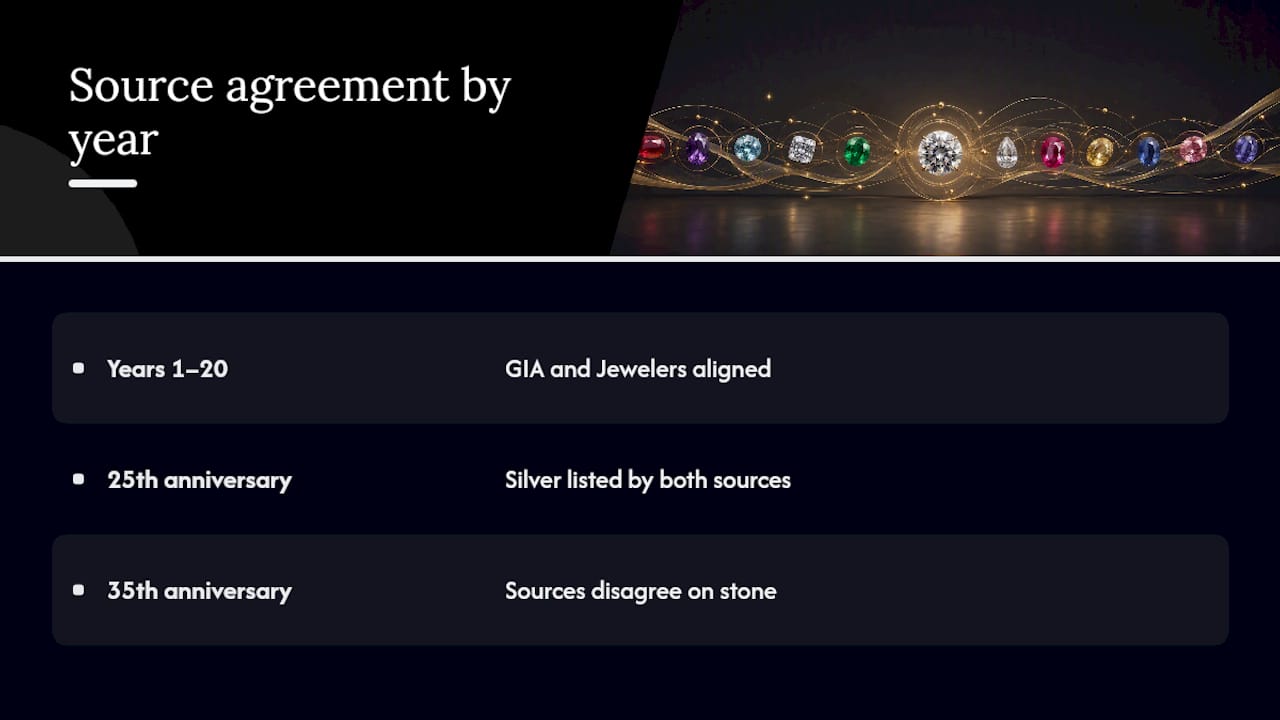
The full year-by-year list you see today came later, when American trade associations formalized and expanded the assignments in the 20th century to give jewelers a consistent sales calendar. That standardization effort is why the Jewelers of America list and the GIA’s blog posts line up closely for years one through twenty but diverge more after that point. Retailers kept adapting the later years to fit modern gemstone availability, which is exactly why you’ll find silver listed for the 25th on every source but see genuine disagreement about the 35th. Treat the chart as a strong starting point, not a rulebook. If the recipient loves aquamarine more than the “correct” stone for their year, buy the aquamarine.
An Editor’s Take on Buying by the Chart
Most guides treat the anniversary gemstone list like scripture, as if skipping the “correct” stone is some kind of etiquette violation. It isn’t. The list itself is a patchwork built by trade groups trying to sell more jewelry across more years, not a set of rules handed down with any real authority. Knowing that changes how you should shop.
Where the chart earns its keep is at the milestones. By the 25th, 40th, and 50th anniversaries, the traditional stone has become a shared cultural shorthand. Silver at 25, ruby at 40, gold at 50. Everyone who hears “it’s their ruby anniversary” understands the reference instantly, and that shared meaning is worth honoring even if you personally don’t love rubies. Between milestones, though, the individual-year assignments (citrine at 13, tanzanite at 24) carry almost no cultural weight outside the jewelry trade. Nobody’s grandmother knows the 24th anniversary stone off the top of her head.
My honest advice: use the milestone years as anchors, and use the in-between years as an excuse rather than an obligation. The gemstone gives you a reason to buy something meaningful. The recipient’s actual taste should decide what that something is.
— Andrew
Shop Anniversary Gemstones by Category at Superjeweler
Superjeweler carries the milestone stones covered in this guide across styles built for how people actually wear jewelry day to day, not just how it photographs in a case.
Start with gemstone rings for sapphire, ruby, or emerald milestones, or browse gemstone necklaces if a pendant fits the recipient’s style better than a ring. For the diamond years, lab-grown diamonds deliver the same hardness and brilliance as mined stones without stretching the budget as far. Every category lets you filter by stone, metal, and price, so narrowing from “ruby” to “ruby tennis bracelet under $500” takes a few clicks, not an afternoon. If engraving or a custom setting would make the piece feel more personal, personalized jewelry covers that too. And if the anniversary in question is really about renewing wedding vows, Superjeweler’s wedding bands collection is worth a look alongside the gemstone pieces. All orders ship free, and returns are straightforward if a size or style needs a swap. Pick the year on the chart, pick the category here, and you’ve got a gift that fits both the tradition and the person.
Sources
- Wedding Anniversary Gemstone List: Years One through 10 — GIA blog
- Anniversary | Jewelers of America
- Gemsociety
- Classic anniversary gifts by year: history of a tradition — Time
Recommended
- Gemstone Buying Process: A Complete Guide for 2026
- Top 4 Lab-Grown Diamonds vs Natural Diamonds 2026
- How to Compare Lab Grown vs Natural Diamonds: 2026 Guide
- Gemstone clarity guide: essential tips for jewelry buyers
