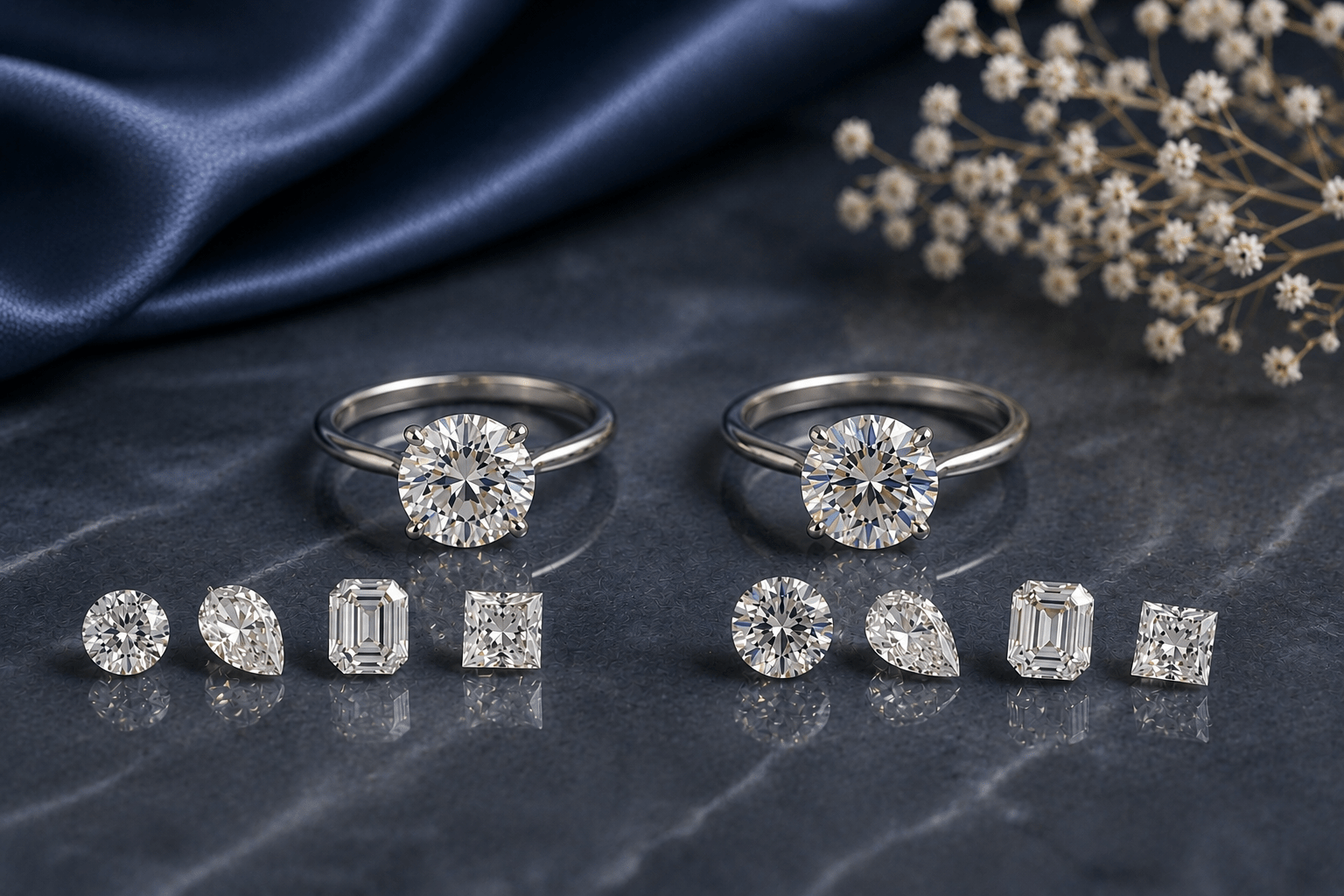
TL;DR:
- Moissanite is a genuine gemstone made of silicon carbide, with optical and physical properties that differ from diamond. It offers higher brilliance and fire at a fraction of the cost but lacks the same resale value and traditional symbolism. Proper testing with dual-conductivity tools or magnification reliably distinguishes moissanite from diamond, ensuring an informed purchase.
The difference between diamond and moissanite comes down to four factors: chemical composition, hardness, brilliance, and price. Diamonds are pure carbon, rated 10 on the Mohs hardness scale, and carry centuries of cultural weight as the standard for fine jewelry. Moissanite is a lab-created silicon carbide mineral, rated approximately 9.25 to 9.5 on the same scale, and it outperforms diamonds in brilliance due to a higher refractive index. For anyone choosing between the two for an engagement ring or fashion piece, understanding these distinctions is the difference between a purchase you love and one you second-guess.
What is the difference between diamond and moissanite in physical properties?
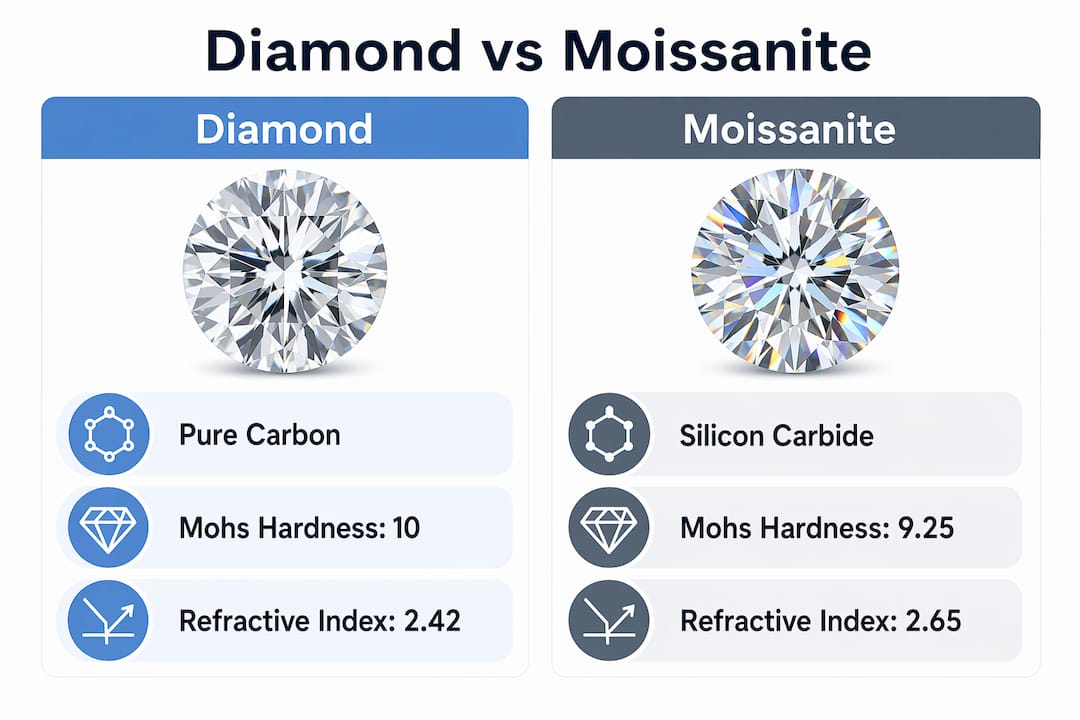
Diamonds and moissanite are fundamentally different materials, not just different grades of the same thing. Moissanite is composed of silicon carbide, while diamond is made entirely of carbon atoms arranged in a cubic crystal structure. That structural difference drives every other distinction you will encounter when comparing the two stones.
| Property | Diamond | Moissanite |
|---|---|---|
| Chemical composition | Pure carbon | Silicon carbide |
| Mohs hardness | 10 | 9.25 to 9.5 |
| Refractive index | 2.42 | 2.65 |
| Origin | Natural or lab-grown | Lab-created |
| Fire (dispersion) | 0.044 | 0.104 |
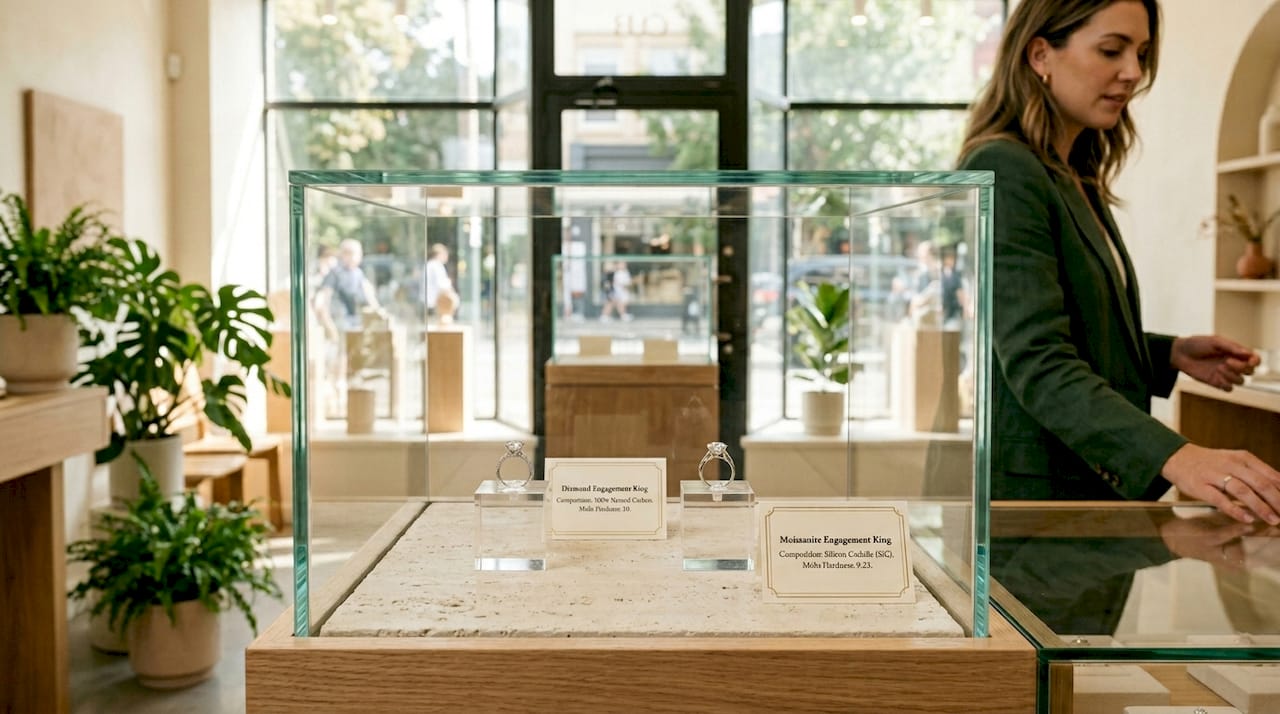
Diamond hardness at 10 makes it the hardest known natural material, meaning it resists scratching from virtually every substance encountered in daily life. Moissanite at 9.25 to 9.5 is still harder than sapphire, ruby, and every other gemstone you will find in fine jewelry, so durability is not a practical concern for either stone in normal wear.
The refractive index tells you how much a stone bends light as it passes through. Moissanite’s index of 2.65 versus diamond’s 2.42 means moissanite bends light more aggressively, producing more sparkle per square millimeter of surface. This is not a flaw. It is a measurable optical property that some buyers prefer and others find too intense for classic styles.
Pro Tip: When comparing stones in a jewelry store, ask to view them under natural daylight, not just store lighting. Moissanite’s higher fire becomes most visible under direct sunlight, which helps you decide whether that level of sparkle fits your personal style.
What are the visual and aesthetic differences between diamond and moissanite?
Moissanite’s visual signature is distinct from diamond once you know what to look for, though untrained eyes often cannot tell them apart in a finished ring setting. The key differences show up in three areas: brilliance, fire, and color behavior.
- Brilliance: Moissanite produces more white light return than diamond due to its higher refractive index. Diamond’s brilliance is bright and clean. Moissanite’s is intense and slightly more prismatic.
- Fire: Moissanite’s fire is nearly twice that of diamond, meaning it disperses light into rainbow-colored flashes more aggressively. In larger stones, this can look spectacular or, to some buyers, slightly synthetic depending on personal taste.
- Color: Most moissanite sold today is colorless or near-colorless, graded equivalent to D through F on the GIA diamond color scale. Lower-tier moissanite can show a faint yellow or gray tint under certain lighting, which is why quality selection matters.
- Double refraction: Moissanite shows double refraction, a phenomenon where light splits into two rays as it passes through the stone. Diamond does not. Under magnification, this makes the back facets of a moissanite appear slightly doubled, which is one of the most reliable visual identifiers.
- Clarity: Premium moissanite is grown in controlled lab conditions, so inclusions are rare. Diamonds range widely in clarity from flawless to heavily included, and that range is reflected in price.
One misconception worth addressing directly: moissanite is not a fake diamond. It is a distinct gemstone with its own identity, optical properties, and market value. Calling it a simulant is technically accurate in the sense that it resembles diamond visually, but that framing undersells what moissanite actually is as a material.
The cut plays a significant role in how both stones perform visually. Round brilliant cuts maximize light return in both diamonds and moissanite. Elongated shapes like oval, pear, and marquise tend to show moissanite’s double refraction more noticeably, which is worth considering before you choose a shape.
How does pricing and value compare between diamond and moissanite?
Price is where the moissanite vs diamond comparison becomes most consequential for buyers working with a real budget. A one-carat natural diamond of good quality (G color, VS2 clarity) typically costs between $4,000 and $6,000. A comparable moissanite in the same size costs a fraction of that, often under $600. Lab-grown diamonds fall between the two, offering diamond composition at lower prices than natural stones but still significantly above moissanite.
The practical implication is significant. Moissanite allows a larger center stone within the same budget, which matters when visual presence is a priority. A buyer who budgets $2,000 for a center stone can choose a modest natural diamond or a two-carat-equivalent moissanite with money left over for a platinum setting.
Here is how to think through the value equation:
- Define your priority. If the stone’s material composition and long-term resale value matter to you, diamond is the correct choice. If visual impact per dollar is the priority, moissanite wins clearly.
- Factor in the setting. Savings on the center stone can be redirected into higher-quality precious metals or custom design work, which elevates the overall ring more than marginal stone grading improvements would.
- Consider lab-grown diamonds as a middle option. Lab-grown diamonds carry the same chemical composition and hardness as natural diamonds at 30 to 50 percent lower prices, placing them between natural diamonds and moissanite on the cost spectrum.
- Assess resale expectations honestly. Neither moissanite nor lab-grown diamonds hold resale value well compared to natural diamonds. If you plan to sell or upgrade later, natural diamond retains more market value.
Many couples choose moissanite as a deliberate expression of smart luxury, prioritizing brilliance, durability, and ethical sourcing over traditional stone prestige. This shift reflects broader changes in how buyers define value in fine jewelry.
How to tell moissanite from diamond with testing and tools
Distinguishing moissanite from diamond requires more than a visual inspection. Standard diamond testers that measure thermal conductivity will often misidentify moissanite as diamond because both stones conduct heat at similar rates. This is a known limitation that has caused real confusion in retail and appraisal settings.
The Diamondnite Dual Tester solves this problem by measuring both thermal and electrical conductivity simultaneously. Moissanite conducts electricity weakly; diamond does not. That difference allows the Diamondnite to reliably separate the two stones in seconds, which is why it has become a standard tool for jewelers handling both materials.
Beyond electronic testing, jewelers use two reliable visual methods. First, moissanite’s double refraction is visible under 10x magnification. Looking through the crown of the stone at the back facets, moissanite will show doubled lines while diamond will show single, sharp facet edges. Second, moissanite often shows a slight grayish or greenish tint under certain fluorescent lighting, which experienced gemologists recognize as a distinguishing characteristic.
The FTC updated its jewelry guidelines to require clear disclosure of a stone’s origin, whether natural, lab-grown, or a simulant. This means any retailer selling moissanite is legally required to identify it as such, not as a diamond. Consumers should always request a written description of the stone’s identity and origin before purchasing.
Pro Tip: If you are buying a pre-owned ring and want to verify the stone, request a professional appraisal from a GIA-certified gemologist rather than relying on a basic thermal tester. The cost is typically under $100 and eliminates any uncertainty about what you own.
What are the practical considerations for choosing between diamond and moissanite?
Both stones handle daily wear well. At 9.25 on the Mohs scale, moissanite resists scratching from almost every material you will encounter in everyday life, including kitchen surfaces, gym equipment, and most metals. Diamond’s hardness of 10 provides a slight edge, but the practical difference for a ring worn daily is negligible for most people.
Symbolism carries real weight in this decision. Diamonds have been the cultural standard for engagement rings since De Beers popularized the tradition in the mid-20th century. For buyers who value that tradition, or whose partners do, the symbolic dimension of a diamond is not trivial. Moissanite does not carry the same cultural history, and that matters to some buyers more than any optical or material property.
Ethical and environmental considerations increasingly influence purchase decisions. Natural diamond mining carries documented environmental and labor concerns, though responsible sourcing certifications like the Kimberley Process exist to address them. Both lab-grown diamonds and moissanite are produced in controlled environments with lower environmental footprints. Engagement ring buyers increasingly prioritize ethical sourcing as a core factor alongside price and appearance.
Lower quality moissanite can appear cloudy and dull, which means quality selection is not optional. Buying from a reputable retailer with clear grading standards protects you from stones that underperform visually. Superjeweler carries moissanite that meets consistent quality standards, which matters more than the stone category itself when it comes to long-term satisfaction.
Key takeaways
The core difference between diamond and moissanite is chemical composition: diamond is carbon, moissanite is silicon carbide, and that single distinction drives every difference in hardness, brilliance, price, and cultural meaning.
| Point | Details |
|---|---|
| Composition drives all differences | Diamond is carbon; moissanite is silicon carbide, producing distinct optical and physical properties. |
| Moissanite outperforms in brilliance | A refractive index of 2.65 versus diamond’s 2.42 gives moissanite more sparkle and fire per carat. |
| Price gap is substantial | Moissanite costs a fraction of a comparable diamond, freeing budget for better settings or larger stones. |
| Testing requires dual-function tools | Standard thermal testers misidentify moissanite; the Diamondnite Dual Tester uses electrical conductivity to distinguish them accurately. |
| Quality selection matters for moissanite | Lower-grade moissanite can appear cloudy; buying from reputable retailers with clear grading standards is non-negotiable. |
Why moissanite deserves more respect than it gets
I have spent years watching buyers apologize for choosing moissanite, as if they owe someone an explanation for not spending more. That framing is wrong, and I think it comes from outdated jewelry marketing rather than any genuine assessment of the stone’s merits.
Moissanite is not a compromise. It is a different material with properties that, in some measurable ways, exceed diamond. Its fire is objectively higher. Its lab origin means no mining concerns. Its price point allows buyers to invest in settings and craftsmanship that a diamond-first budget often cannot accommodate. I have seen moissanite rings in platinum pavé settings that outshine diamond solitaires in silver-toned metals at twice the price.
Where I think buyers should be honest with themselves is on the symbolism question. If your partner has always imagined a diamond, that preference deserves respect regardless of what the optical data says. But if the choice is genuinely open, moissanite in 2026 is not a budget fallback. It is a considered decision made by buyers who understand what they are buying and why. The FTC’s disclosure requirements exist precisely because the stones are close enough in appearance that transparency matters. That is a compliment to moissanite, not a warning about it.
Work with a jeweler who knows both materials well and can show you stones side by side. The right choice becomes obvious when you see them together.
— Andrew
Find your perfect ring at Superjeweler
Whether you are drawn to the tradition of a diamond or the brilliance of moissanite, Superjeweler carries both with the pricing and selection that lets you compare honestly rather than settle.

Browse moissanite engagement rings in a full range of cuts, settings, and carat sizes, or explore diamond solitaire options if you want the classic look. For buyers working with a tighter budget, the engagement rings under $1,000 collection includes real diamonds and high-quality moissanite in settings that do not look like compromises. Free shipping worldwide and a satisfaction guarantee mean you can shop with confidence.
FAQ
Is moissanite a real gemstone?
Moissanite is a real gemstone composed of silicon carbide. It occurs naturally in extremely rare quantities but is sold commercially as a lab-created stone with consistent quality and optical properties.
How can you tell moissanite from diamond at home?
The most reliable home test uses a dual-function tester like the Diamondnite, which measures both thermal and electrical conductivity. Visually, moissanite shows double refraction under 10x magnification, which diamond does not.
Does moissanite hold its value like a diamond?
Moissanite does not hold resale value as well as natural diamonds. Natural diamonds retain more market value over time, while moissanite and lab-grown diamonds typically depreciate significantly after purchase.
Which stone is better for an engagement ring?
The better choice depends on your priorities. Diamond offers hardness, tradition, and resale value. Moissanite offers higher brilliance, lower price, and ethical sourcing. Both are durable enough for daily wear in an engagement ring setting.
Can a jeweler tell the difference between diamond and moissanite?
A trained jeweler using a dual-conductivity tester or 10x magnification can reliably distinguish the two. Standard single-function thermal testers often misidentify moissanite as diamond, so professional appraisal from a GIA-certified gemologist is the most accurate option.
Recommended
- Diamond shape impact: choosing the ideal engagement ring
- Diamond Cut in Engagement Rings: Maximizing Sparkle
- Role of cut in diamond quality: maximize sparkle in 2026
- Why Diamonds Are Valuable – Insights for Couples
