Expect to pay roughly 1% to 2% of your engagement ring’s replacement value per year in insurance premiums. That’s about $50 to $200 annually for most rings, though the exact number depends on where you live, how you insure it, and what deductible you choose.
Here’s what that looks like in real dollars:
- $5,000 ring: roughly $50–$100 per year
- $10,000 ring: roughly $100–$200 per year
Those ranges hold up across most standalone jewelry insurers and scheduled homeowner policies, but your ZIP code, your deductible, and whether you go with a rider or a standalone policy can push your quote toward the low end or the high end of that range fast.
Key Takeaways
| Point | Details |
|---|---|
| Budget 1%–2% annually | A $10,000 ring typically costs $100–$200 per year to insure. |
| Standalone often beats a rider | No deductible and no impact on your homeowner premium after a claim. |
| Get an independent appraisal | Expect to pay $75–$150, and reappraise every 2 to 3 years. |
| Push for agreed value | Avoids depreciation that can cut settlements by 30%–60% under ACV. |
| Keep receipts ready | Superjeweler orders include the product specs and receipts insurers request. |
Table of Contents
- Engagement Ring Insurance Cost: Rider vs. Standalone Policy
- What’s Actually Covered, and What Isn’t
- Sample Annual Premiums by Ring Value
- The Factors That Actually Move Your Quote
- Appraisals and Agreed Value: Get This Part Right
- How Fast Claims Actually Get Paid
- Practical Ways to Keep Costs Down
- What It Actually Costs to Get Started
- Homeowner Rider or Standalone Policy: Which Costs Less Over Time
- Sources
Engagement Ring Insurance Cost: Rider vs. Standalone Policy
You’ve got two real paths to insuring a ring in the U.S. The first is a scheduled personal property endorsement (sometimes called a floater) added to your existing homeowners or renters policy. The second is a standalone jewelry policy from a specialist insurer, purchased separately from your home coverage.
The trade-offs matter more than the labels suggest:
- A scheduled rider usually applies your home policy’s deductible, which can be $500 to $2,500, eating into smaller claims.
- Standalone policies often carry no deductible or a low flat one, and a claim on them typically won’t touch your homeowner’s premium at all.
- Standalone insurers tend to write broader “all-risk” language, while many homeowner riders default to named perils only.
If your ring is worn daily and valued above $5,000, a standalone policy usually pencils out better. For lower-value rings you already plan to insure conservatively, a rider on an existing policy can be the simpler, cheaper add.
What’s Actually Covered, and What Isn’t
The best engagement ring policies use “all-risk” language, meaning they cover a loss unless specifically excluded, rather than only covering perils they specifically list. That distinction covers accidental damage (a chipped stone from a car door), theft, and mysterious disappearance, which is exactly what it sounds like: the ring is simply gone, with no evidence of theft.
Mysterious disappearance is one of the most common claim types for engagement rings, and it’s also one of the first things basic homeowners policies exclude. Specialist jewelry insurers build it in as standard.
What insurers typically want before they’ll bind a policy or pay a claim:
- A recent written appraisal or the original sales receipt with a full stone and metal description
- Photos of the ring, ideally with the certification number visible
- A police report for theft claims
Standard exclusions across nearly every policy include normal wear and tear, gradual loss of small stones from worn prongs, and pre-existing damage noted on the appraisal.
Pro Tip: Keep your appraisal, receipt, and a few clear photos in one folder, digital or physical, before you ever need to file a claim. Insurers move faster when documentation is ready on day one.
Sample Annual Premiums by Ring Value
A ring with a typical mid-range value often costs roughly $70 to $140 a year](https://www.nerdwallet.com/insurance/homeowners/learn/jewelry-insurance) under a standard policy, which lines up with the same math. But two rings of identical value can land on opposite ends of that range.
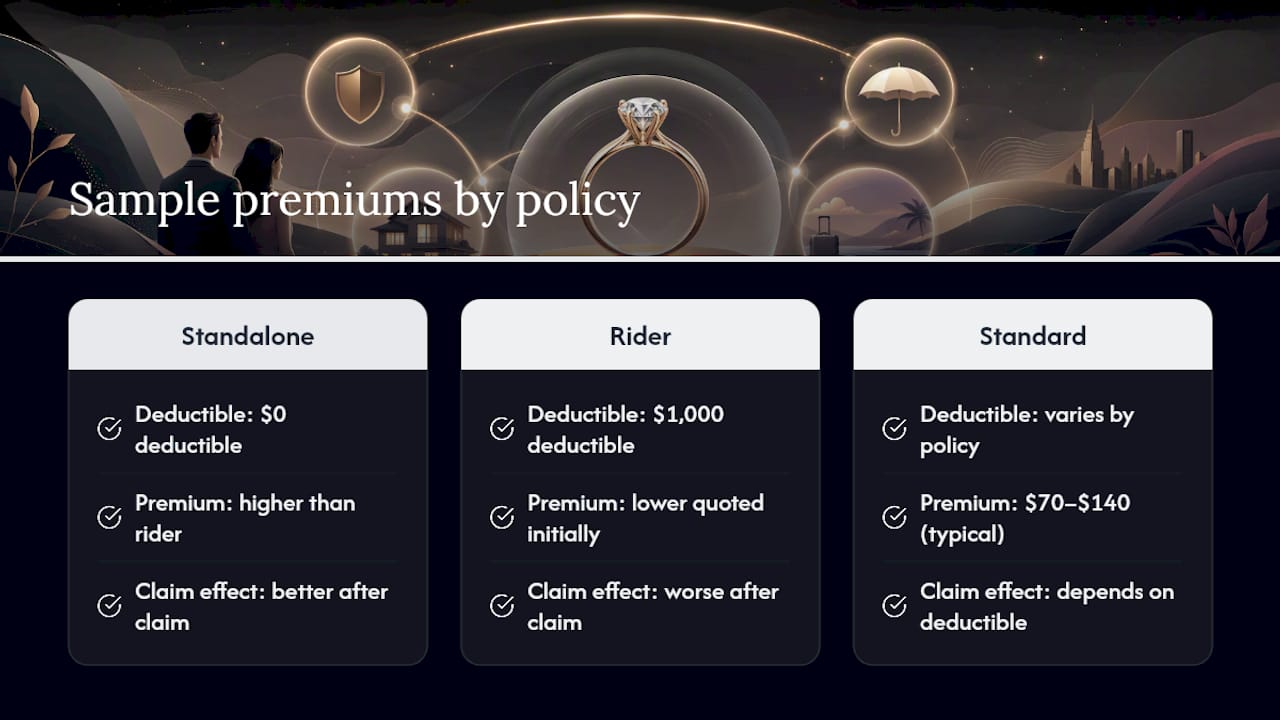
Deductible choice moves the number too. A $0-deductible standalone policy will quote higher than a rider that inherits your home policy’s $1,000 deductible, but that rider becomes the worse deal the moment you actually file a claim.
The Factors That Actually Move Your Quote
Insurers price a ring policy off a handful of variables, and they don’t all carry equal weight.
- ZIP code is often the single biggest factor beyond the ring’s value, since insurers price regional theft and loss risk differently street by street.
- Frequency of wear matters. A ring worn daily to work and travel gets classified as higher risk than one kept for special occasions.
- Metal and stone specifics factor in. Softer settings and larger center stones can raise the replacement cost basis insurers use.
- Deductible choice shifts the premium directly. Lower deductible, higher annual cost, and vice versa.
- Appraisal value and timing. An outdated or vague appraisal can lead to a lowball settlement even if your premium was calculated correctly.
Appraisals and Agreed Value: Get This Part Right
Ask for agreed-value or replacement-cost wording on your policy, not actual cash value. This is not a minor line-item choice: homeowners’ ACV settlements can run 30% to 60% lower than replacement-cost payouts because ACV factors in depreciation on an item that, realistically, never depreciates the way a couch does.
Three things to do before you ever file a claim:
- Get an appraisal from an independent appraiser, not the jeweler who sold you the ring.
- Reappraise every 2 to 3 years, since independent appraisals typically cost $75 to $150 and keep your coverage aligned with current replacement costs.
- Watch for inflated appraisals from sellers. Insurers often settle based on their own valuation network, not the number on your paperwork.
Pro Tip: An appraisal that’s too high doesn’t get you a bigger payout. It usually just means you overpaid on premiums for years.
How Fast Claims Actually Get Paid
This is where specialist insurers and home insurers diverge the most. Standalone jewelry insurers often process claims in about 5 to 14 days and frequently offer direct replacement through their own jeweler networks. Homeowner carriers, by contrast, often take 30 to 60 days, partly because a ring claim gets folded into general property-claim processing rather than handled by a jewelry specialist.
- File within your insurer’s stated window, usually 30 to 60 days from the loss.
- Expect either a cash settlement or a replacement offer. Ask which one your policy defaults to before you need it.
- Have your appraisal, receipt, and any police report ready. Missing paperwork is the top reason claims stall.
Practical Ways to Keep Costs Down
A few habits keep your premium reasonable without leaving you underinsured.
- Rings under roughly $1,000 are often fine to self-insure, since the premium can approach what you’d spend replacing minor damage out of pocket.
- Above $2,500 to $3,000, insurance becomes worth it fast, since most homeowner sublimits cap jewelry coverage around $1,500 to $2,500 anyway.
- Choose a deductible you can actually absorb without shopping around after a loss for one you can’t.
- Keep receipts, certificates, and appraisal copies together. Our budgeting guide walks through the paperwork most insurers ask for.
- Ask specifically about worldwide coverage and mysterious disappearance. Not every quote includes both by default.
Pro Tip: Call two insurers and ask the exact same question: “What’s excluded?” The answer tells you more about the policy than the premium does.
What It Actually Costs to Get Started
Setting up ring insurance isn’t free upfront, even before your first annual premium hits. Budget for an independent appraisal first, typically $75 to $150, since most insurers won’t write a policy on a ring worth more than a few thousand dollars without one. If you already have a detailed sales receipt with the stone’s carat weight, clarity grade, and metal purity spelled out, some standalone insurers will accept that in place of a fresh appraisal for newer purchases, which saves you the appraisal fee entirely.

Beyond the appraisal, most standalone jewelry policies charge no separate application or setup fee. You pay the quoted annual premium, sometimes split into monthly installments with a small service charge, and coverage typically starts within a day or two of approval. Riders added to an existing homeowners or renters policy work similarly. There’s usually no standalone activation fee, just an adjustment to your existing premium reflected on your next billing cycle.
Where costs sneak up is in the reappraisal cycle. Budget for that $75 to $150 fee again every 2 to 3 years to keep your coverage amount current. Skip it, and you risk being underinsured against a replacement cost that’s climbed since your last appraisal, particularly if diamond and gold prices have moved. Factor the appraisal cost into your total first-year outlay rather than treating it as a one-time expense you’ll never see again.
Homeowner Rider or Standalone Policy: Which Costs Less Over Time
The sticker price on a standalone policy sometimes looks higher than adding a rider to your existing homeowners policy, but that comparison misses what happens when you actually file a claim. A rider inherits your home policy’s deductible, often $500 to $2,500, which can wipe out most of the payout on a moderate claim. A standalone policy typically carries no deductible or a small flat one, and a claim against it generally doesn’t touch your home insurance premium at all.

Run the math over a five-year horizon and the gap narrows or reverses depending on your habits. If you never file a claim, the rider is almost always cheaper since you’re not paying a specialist insurer’s separate premium. If you file even one claim in that window, the standalone policy usually comes out ahead, both in dollars paid out and in what happens to your home insurance rate afterward. Filing a jewelry claim on a homeowners policy can also flag your account for a premium increase at renewal, an indirect cost that rarely shows up in comparison charts.
The honest answer is that cost-effectiveness depends on your risk profile, not just the quoted number. A ring worn daily in a higher-crime ZIP code, insured for $10,000 or more, tends to favor a standalone policy despite the higher sticker price. A rarely worn ring under $3,000, kept mostly in a safe, often makes the rider the more economical choice. Get quotes for both before deciding. The comparison only takes a few minutes and the numbers vary more by insurer than most buyers expect.
Why documenting your purchase matters from day one
Buying the ring is only half the job. Keeping the paperwork insurers actually ask for, the receipt, the certificate, the appraisal, is what turns a stressful claim into a routine one. Superjeweler provides detailed product specs and order receipts precisely because that documentation matters the moment you go looking for coverage.
— Andrew
Where to Find the Documentation Insurers Ask For
Once you’ve decided how to insure your ring, the paperwork trail matters as much as the policy itself. Every order from Superjeweler comes with a detailed product description covering carat weight, metal purity, and stone certification, plus an order receipt showing purchase price. Those two documents cover most of what a standalone insurer or homeowner carrier will request before binding coverage.

If you’re still shopping, Superjeweler’s engagement ring collection makes it easy to compare styles and settings at a range of price points, and the budget-friendly engagement ring selection is worth a look if you’re weighing replacement cost against what you’ll actually pay in premiums down the road. Every listing includes the specs insurers want to see, so you’re not scrambling for stone details after the fact. Browse the collection, save the receipt when you order, and you’ll have your insurance paperwork sorted before the ring even arrives.
Sources
Recommended
- Trends in Engagement Rings 2026: Style, Stone, and Savings
- Engagement Ring Shopping Timeline: Your 2026 Guide
- Engagement Ring Proposal Checklist: Your 2026 Guide
