TL;DR:
- Precious metals like gold, silver, platinum, and palladium are rare, durable, and highly valued for investment and industrial use. Bullion typically offers high purity and low premiums, while jewelry involves added design costs and resale limitations. Their dual demand sustains prices and influences buying decisions based on goals of wealth preservation or personal adornment.
A precious metal is defined as a rare, naturally occurring metallic element with high economic value due to its scarcity, durability, and resistance to corrosion. Gold, silver, platinum, and palladium are the four metals most widely recognized as precious, distinguished by their limited natural supply and their ability to resist tarnish and chemical breakdown. These metals serve two distinct roles: they function as stores of wealth and as essential materials in jewelry, electronics, and industrial manufacturing. Understanding the definition of precious metals, their types, and their real-world applications helps you make smarter decisions whether you are buying jewelry, considering an investment, or simply satisfying your curiosity about what makes certain metals so valuable.
What are the main types of precious metals?
Precious metals include gold, silver, platinum, and palladium as the primary examples, with rhodium, iridium, osmium, and ruthenium rounding out the broader group of noble metals. Each has a distinct set of physical and chemical properties that determines its value and applications.

Gold is the most recognized precious metal. It is extremely malleable, conducts electricity well, and never corrodes or tarnishes under normal conditions. Gold occurs naturally in the earth’s crust at roughly 0.004 parts per million, making it genuinely rare.
Silver is more abundant than gold but still qualifies as precious due to its industrial demand and monetary history. Silver has the highest electrical and thermal conductivity of any metal. That property makes it indispensable in electronics, solar panels, and medical devices.
Platinum is rarer than gold and significantly denser. It resists corrosion even at high temperatures, which makes it critical for catalytic converters in vehicles and for laboratory equipment. Platinum’s natural gray-white color also makes it a preferred metal for fine jewelry settings.
Palladium shares many properties with platinum and belongs to the same group of elements called the platinum-group metals (PGM). Palladium is lighter than platinum and has become a primary material in automotive catalysts, which has driven strong industrial demand in recent years.
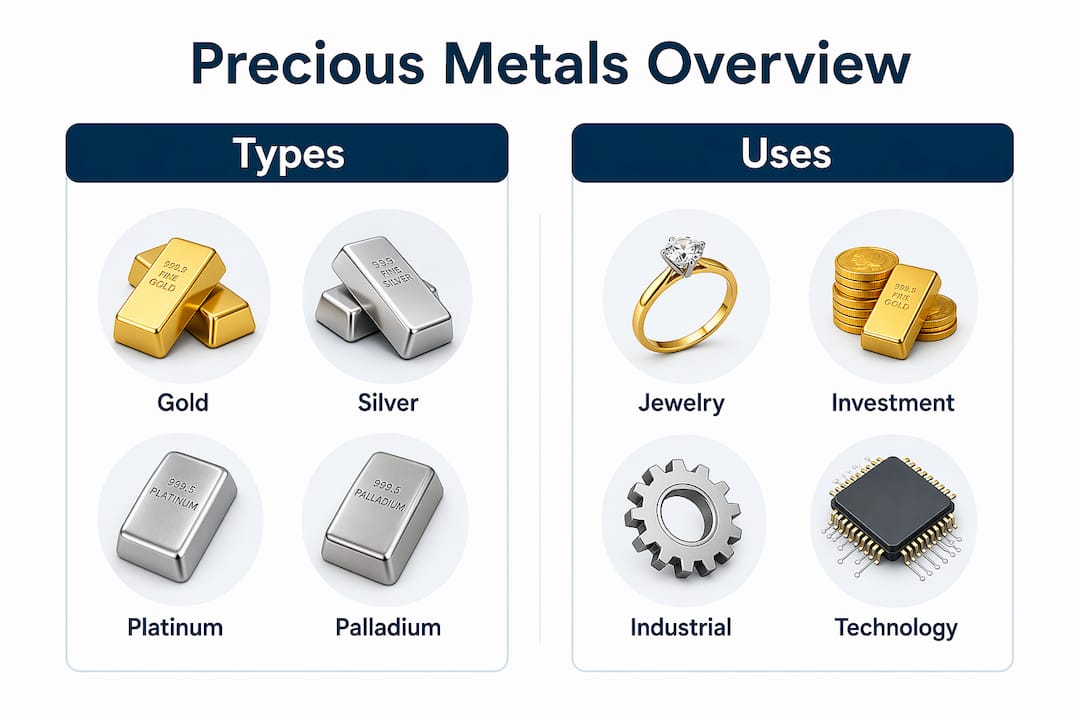
| Metal | Purity for Investment | Key Property | Primary Use |
|---|---|---|---|
| Gold | 99.9%+ (999 fine) | Corrosion-resistant, malleable | Jewelry, investment, electronics |
| Silver | 99.9%+ | Highest conductivity | Electronics, solar, investment |
| Platinum | 95%+ | High-temperature resistance | Automotive catalysts, jewelry |
| Palladium | 99.9%+ | Lightweight, corrosion-resistant | Automotive catalysts, electronics |
How do bullion and jewelry forms of precious metals differ?
Bullion and jewelry represent two very different ways to hold a precious metal, and confusing them leads to costly mistakes. The distinction comes down to purity, pricing, and what you actually recover when you sell.
Purity and manufacturing standards
Investment-grade gold bars and coins are typically 99.9% to 99.99% pure, often described as 999 or 9999 fine. The London Bullion Market Association (LBMA) sets the global benchmark, requiring at least 99.5% gold purity for approved investment bars. That standard guarantees market acceptance worldwide.
Jewelry operates on a different purity scale. 18K gold contains 75% pure gold, while 14K contains 58.3% and 10K contains 41.7%. The remaining percentage consists of base metals like copper, silver, or zinc. Those alloys add hardness and durability for daily wear. Mixing gold with copper creates rose gold, while mixing with nickel or palladium produces white gold.
Premiums and resale value
Gold bars trade at roughly 1–4% over spot price, while jewelry premiums routinely exceed 15–100% above the raw metal value. That gap exists because jewelry carries costs for design, labor, and branding that the metal market does not recognize. Retail jewelry marks up 100–200% over wholesale cost, and luxury branded pieces can carry premiums of 400–1,000% above intrinsic metal value.
When you sell, those premiums disappear. Resellers and refiners pay only for the raw melt value of the metal. Bullion recovers 95–99% of spot price upon resale, while jewelry typically returns only 60–85% of its melt value.
| Attribute | Bullion | Jewelry |
|---|---|---|
| Typical purity | 99.9%+ | 41.7%–75% (10K–18K) |
| Premium over spot | 1–4% | 15–100%+ |
| Resale recovery | 95–99% of spot | 60–85% of melt value |
| Certification | LBMA or national mint | Karat hallmark |
| Primary purpose | Wealth storage | Adornment, personal expression |
- Bullion is priced transparently against live spot market rates.
- Jewelry pricing includes non-recoverable design and labor costs.
- Karat hallmarks on jewelry indicate gold content, not investment grade.
- LBMA-approved bars carry globally recognized purity guarantees.
Pro Tip: Before buying gold jewelry as an investment, calculate the actual metal content by multiplying the piece’s weight by its karat percentage. That number tells you the true melt value, which is what a refiner will pay.
What are precious metals used for in the real world?
Precious metals serve dual roles as stores of value and as essential industrial materials, and that dual demand is what keeps their prices elevated. Understanding both sides of this equation helps you see why these metals hold their value across economic cycles.
Industrial and technological applications
Silver’s conductivity makes it a core material in circuit boards, switches, and photovoltaic solar cells. Platinum and palladium are critical in catalytic converters, which reduce harmful emissions from vehicle exhaust. Palladium in particular has seen surging demand from the automotive sector, which has pushed its price above gold at various points in recent years.
Gold is used in aerospace components, medical implants, and high-end electronics because it conducts electricity reliably and never corrodes. Even a smartphone contains a small but measurable amount of gold in its connectors and circuit pathways.
Investment and wealth preservation
Precious metals have functioned as inflation hedges for centuries. When paper currency loses purchasing power, gold and silver tend to hold or increase their real value. Investors hold bullion in physical form, through exchange-traded funds (ETFs), or via futures contracts on commodity exchanges.
The role of precious metals in investment is well established, but liquidity differs by form. Bullion coins and bars sell quickly at transparent prices. Jewelry requires finding a buyer willing to pay above melt value, which takes more time and effort.
Personal adornment and cultural significance
Jewelry represents the most visible use of precious metals for most people. Gold and platinum settings protect gemstones, resist daily wear, and carry cultural meaning in engagement rings, wedding bands, and heirlooms. The ring metals guide from Superjeweler covers how different metals perform in everyday jewelry contexts.
Pro Tip: If you want a piece of jewelry that tracks closely with metal value, look for 24K gold jewelry from specialist markets. Some 24K pieces carry lower markups and correlate more directly with spot prices, creating a hybrid option between pure investment and personal adornment.
How to identify and choose precious metals for investment or personal use
Choosing between precious metals depends on your goal. Investment buyers prioritize purity, liquidity, and low premiums. Jewelry buyers prioritize appearance, durability, and craftsmanship. Most people fall somewhere in between.
- Define your primary goal. If wealth preservation is the objective, buy LBMA-certified bullion bars or government-minted coins. If personal enjoyment is the goal, choose jewelry in the metal and karat that fits your lifestyle and budget.
- Check purity markings. Bullion carries a fineness stamp (999, 9999). Jewelry carries a karat mark (10K, 14K, 18K). Never assume a piece is investment-grade based on appearance alone.
- Compare premiums to spot price. Track the live spot price of gold, silver, or platinum on a commodity exchange before purchasing. Calculate how much you are paying above that baseline.
- Verify certification and authenticity. Buy bullion only from authorized dealers who sell LBMA-approved or nationally minted products. For jewelry, look for hallmarks and purchase from established retailers with clear return policies.
- Understand resale before you buy. Bullion sells quickly at near-spot prices. Jewelry resale depends on finding a buyer or accepting melt value. Set realistic expectations before committing.
Pro Tip: Avoid confusing retail price with intrinsic metal value. A $2,000 gold ring may contain only $400 worth of actual gold at melt value. The remaining $1,600 covers design, labor, and retail margin, none of which a refiner will pay.
The gold vs. platinum comparison from Superjeweler offers a detailed breakdown of how these two metals perform across both jewelry and investment contexts.
What are common misconceptions about precious metals?
The biggest misconception about precious metals is treating jewelry as a direct financial asset. Jewelry is a consumer product with emotional and aesthetic value. It is not equivalent to bullion, and expecting it to perform like an investment leads to disappointment.
Resellers and refiners pay only for the raw melt value of jewelry. Original retail premiums, including design, craftsmanship, and brand, are almost entirely unrecoverable. A piece that cost $3,000 at retail may return $300–$500 at a pawn shop or refiner.
Several other misconceptions are worth addressing directly:
- Higher karat does not mean better jewelry. 24K gold is too soft for most rings and bracelets. 14K and 18K alloys are more practical for daily wear.
- Precious metal prices fluctuate. Gold and silver are commodity assets subject to market swings. Holding bullion does not guarantee profit.
- Platinum is not white gold. Platinum is a distinct element, denser and rarer than gold, with different care requirements and a higher price point.
- Tax treatment differs. In the United States, the IRS classifies investment metals as collectibles, subject to a maximum capital gains tax rate of 28%. Jewelry purchases carry sales tax but different resale tax treatment. Consult a tax advisor before making large purchases for investment purposes.
The fine jewelry investment guide from Superjeweler addresses how to think about jewelry value realistically, separating emotional worth from financial return.
Key Takeaways
Precious metals hold value because of their rarity, corrosion resistance, and dual demand from both industrial users and investors, but bullion and jewelry serve fundamentally different financial purposes.
| Point | Details |
|---|---|
| Definition of precious metals | Gold, silver, platinum, and palladium are rare, corrosion-resistant metals with high economic value. |
| Bullion purity standard | LBMA-approved investment bars require at least 99.5% purity; most bullion is 99.9%+ fine. |
| Jewelry vs. bullion premiums | Jewelry carries 15–100%+ premiums over spot; bullion trades at just 1–4% above spot price. |
| Resale recovery gap | Bullion recovers 95–99% of spot price; jewelry typically returns only 60–85% of melt value. |
| Choosing the right form | Match your purchase to your goal: bullion for wealth storage, jewelry for personal expression. |
Why the bullion-versus-jewelry distinction matters more than most buyers realize
Most people who ask what a precious metal is are really asking two separate questions: “What makes this metal valuable?” and “Should I buy it as jewelry or as an investment?” Those are not the same question, and conflating them is where most buyers go wrong.
I have seen buyers pay $5,000 for a gold necklace and assume they hold $5,000 in gold. The actual gold content in a 14K piece of that weight might be $800. The rest is craftsmanship, retail margin, and brand. That is not a bad thing if you love the piece and plan to wear it for decades. It is a very bad thing if you are counting on it as a financial safety net.
What I find genuinely interesting about precious metals is that their dual nature creates real opportunity when you understand it. A well-chosen piece of 18K gold jewelry from a reputable retailer gives you beauty, durability, and a base of real metal value. It will not perform like a gold bar, but it will outlast almost any fashion trend and carry meaning that a bar in a vault never will. The key is buying with clear eyes about what you are actually purchasing.
My honest advice: if wealth preservation is your goal, buy certified bullion from an authorized dealer and track spot prices. If personal meaning and beauty are your goals, invest in quality craftsmanship from a retailer with strong guarantees and transparent pricing. The mistake is trying to make one purchase do both jobs equally well.
— Andrew
Precious metal jewelry at prices that reflect real value
Superjeweler carries a wide selection of fine jewelry crafted in gold, platinum, and silver, including engagement rings, wedding bands, and everyday pieces built to last. Every piece is priced to reflect genuine quality without the inflated markups that obscure real metal value.

Readers who want to put precious metals to work in a meaningful way will find strong options across Superjeweler’s catalog. The affordable engagement rings collection offers real diamond rings in 14K and 18K gold settings under $1,000, giving you genuine precious metal craftsmanship at a price that makes sense. Superjeweler also offers diamond wedding bands in multiple metal options, with free worldwide shipping and a clear return policy on every order.
FAQ
What is a precious metal, exactly?
A precious metal is a rare, naturally occurring metallic element valued for its scarcity, corrosion resistance, and economic importance. Gold, silver, platinum, and palladium are the most widely recognized examples.
What is the difference between 14K and 18K gold?
14K gold contains 58.3% pure gold alloyed with base metals for durability, while 18K gold contains 75% pure gold and is softer but richer in color. Neither qualifies as investment-grade bullion, which requires 99.9% purity or higher.
Why does jewelry sell for less than its purchase price?
Resellers and refiners pay only for the raw melt value of the metal, ignoring design, labor, and brand costs. Jewelry typically recovers 60–85% of its melt value upon resale, not its original retail price.
Is platinum more valuable than gold?
Platinum is rarer than gold and typically trades at a higher price per ounce, though market conditions cause this relationship to shift. Platinum is also denser, meaning a platinum ring weighs more than an identical gold ring and costs more as a result.
What does LBMA certification mean for gold?
LBMA certification means a gold bar meets the London Bullion Market Association’s minimum purity standard of 99.5% and is accepted by major global markets. It is the most widely recognized quality benchmark for investment-grade gold bullion.
Recommended
- The Role of Precious Metals in Investment and Jewelry
- What Is a Semi Precious Stone? Types, Value, and Uses
- Gold vs Platinum: Key Differences for Jewelry and Investing
- Diamond Eternity Ring | Yellow Gold Diamond Eternity Ring From Superjeweler
