TL;DR:
- A necklace hallmark is an official stamp from an independent assay office that certifies the jewelry’s metal purity.
- It is most often found on the clasp, jump rings, or a small tag near the clasp but can wear away over time.
A necklace hallmark is an official stamp certifying the purity and authenticity of the precious metal in a piece of jewelry. These marks are not decorative. They are third-party verified indicators that tell you exactly what a necklace is made of, who made it, and sometimes where and when it was tested. Understanding what a necklace hallmark means is one of the most practical skills any jewelry buyer can develop, whether you are shopping for a gift, building a collection, or protecting a financial investment.
Table of contents
- What is a necklace hallmark?
- Where are hallmarks located on a necklace?
- What do necklace purity marks actually mean?
- How to read and verify a necklace hallmark at home
- Why necklace hallmarks matter for buyers and collectors
- Key takeaways
- Perspective
- Shop verified necklaces at Superjeweler
- FAQ
What is a necklace hallmark?
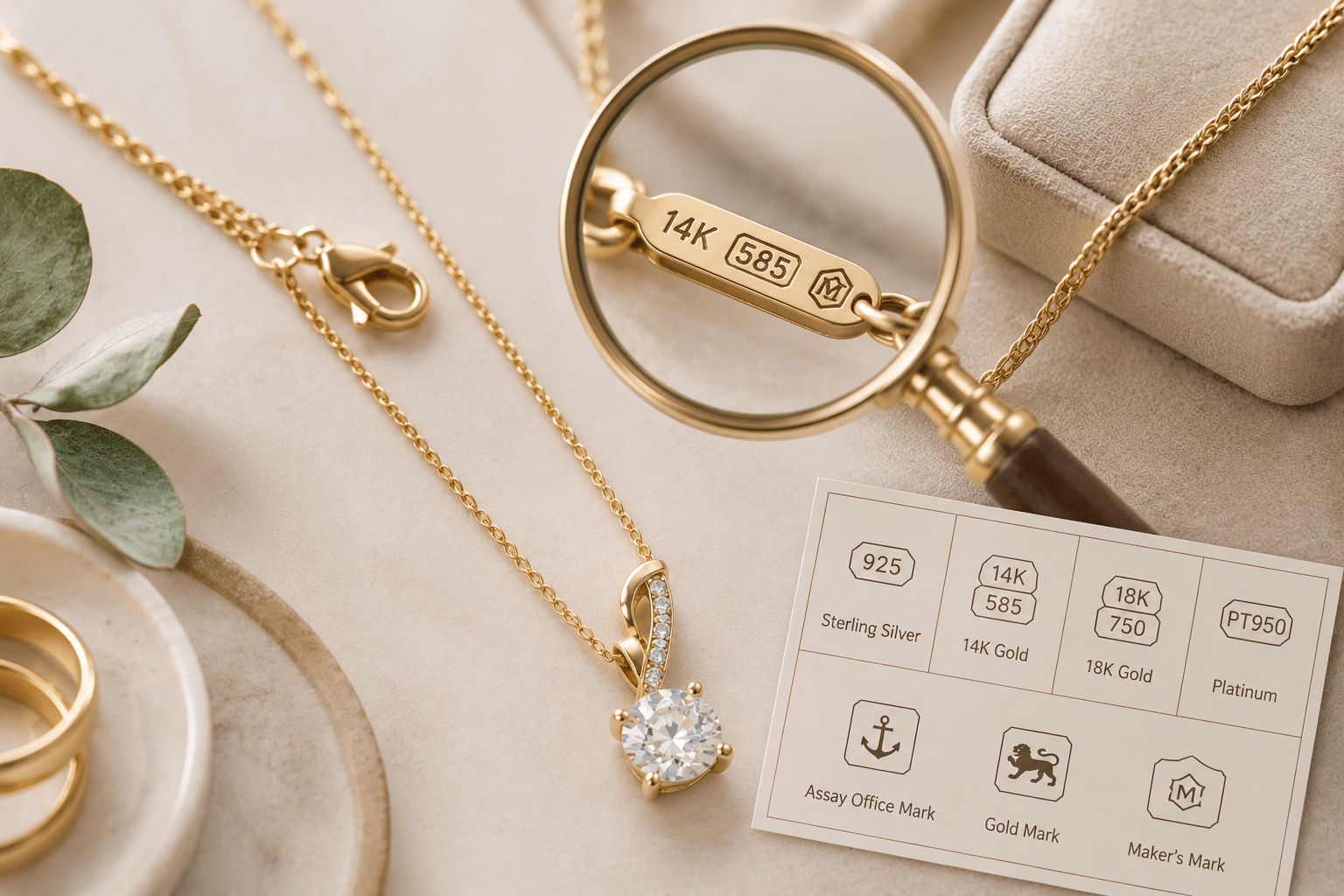
A necklace hallmark is a government-authorized purity mark stamped onto precious metal jewelry by an independent assay office, not by the manufacturer. That distinction matters. A hallmark carries legal weight in many countries because a neutral third party has physically tested the metal and confirmed its composition. A maker’s mark, by contrast, is applied by the manufacturer and carries no independent certification.
The term “hallmark” traces back to Goldsmiths’ Hall in London, where gold and silver were tested and stamped as far back as the 14th century. The practice spread globally and became the foundation of consumer protection in the precious metals trade. Today, a complete hallmark typically includes a purity mark, a maker’s or sponsor’s mark, an assay office mark, and sometimes a date letter indicating the year of testing.
Not every stamp on a necklace is a hallmark. Brand logos, designer initials, and country-of-origin stamps are manufacturer marks. They tell you who made the piece, not what it is made of. Confusing the two is one of the most common mistakes buyers make when evaluating jewelry.
Where are hallmarks located on a necklace?
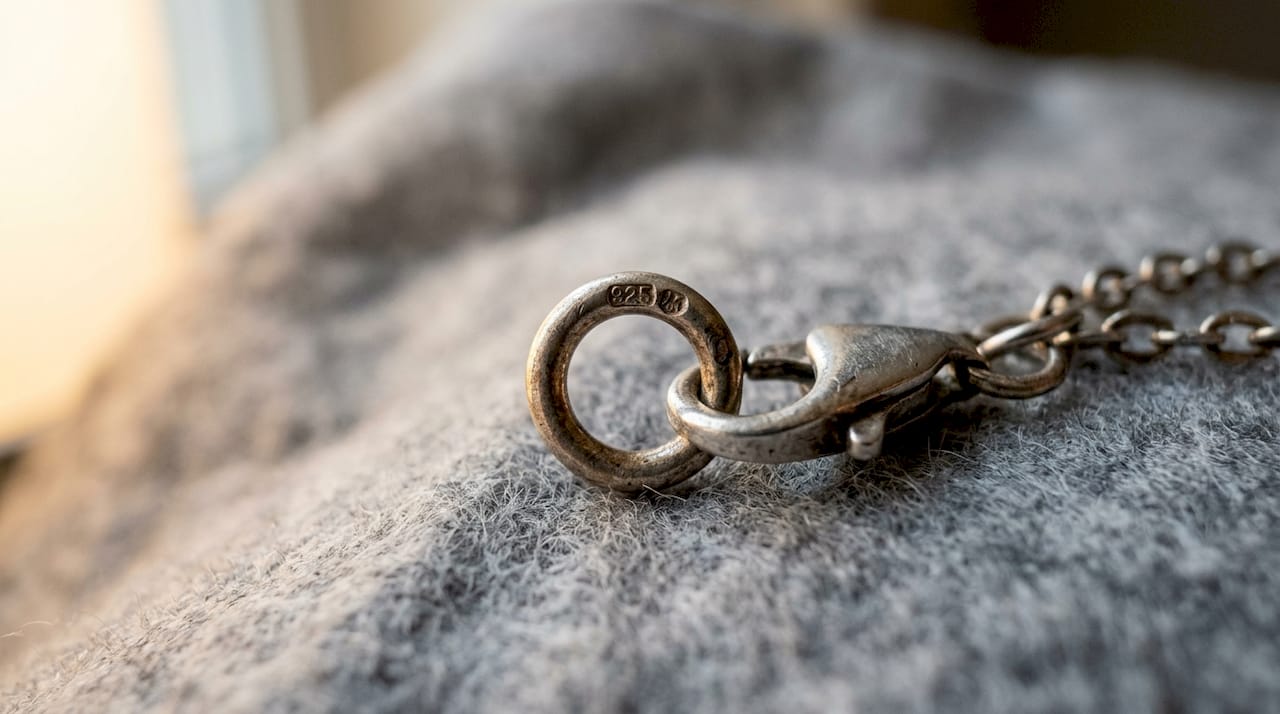
Hallmarks on necklaces appear most often on the clasp mechanism, on a small jump ring near the clasp, or on a tiny tag attached close to the clasp. These locations are chosen because they are structurally stable and accessible to engravers, while staying out of sight during normal wear. You will rarely find a hallmark on the chain itself, since the links are too small and too flexible to hold a legible stamp.
The placement logic is practical. The clasp is the thickest, most rigid part of most necklaces, which makes it the easiest surface to stamp cleanly. Jump rings and small tags serve the same purpose on designs where the clasp is too delicate or decorative to mark directly.
There is a real downside to these locations. Hallmark stamps can wear away over time, especially on clasps and jump rings that experience constant friction. A frequently worn gold chain may have a faint or completely rubbed-off mark after years of use. A missing stamp does not automatically mean the piece is fake. It may simply mean the piece has been worn and loved for a long time.
Pro Tip: Use a 10x jeweler’s loupe and a bright light to examine the clasp and any small rings near it. Angle the light at roughly 45 degrees to the surface so the engraved marks catch the light and become easier to read.
What do necklace purity marks actually mean?
Purity marks are the most important part of any hallmark because they tell you the exact metal content of a necklace. Gold purity marks appear as either karat designations or three-digit numeric codes. Both systems communicate the same information in different formats.
Gold purity marks explained
| Karat | Numeric code | Gold content |
|---|---|---|
| 10K | 417 | 41.7% pure gold |
| 14K | 585 | 58.5% pure gold |
| 18K | 750 | 75.0% pure gold |
| 24K | 999 | 99.9% pure gold |
The numeric codes are the international standard. A stamp reading “585” on a gold necklace means the piece is 14K gold, regardless of where it was made. This system removes language barriers and makes purity verification consistent across borders.
Silver and other metal marks
- 925: Sterling silver, meaning 92.5% pure silver. This is the most common silver standard worldwide.
- 950: Platinum at 95% purity, the standard for fine platinum jewelry.
- GF: Gold-filled, meaning a layer of gold bonded to a base metal. Not solid gold.
- GP: Gold-plated, a thin surface coating. The base metal is not gold.
The difference between GF and GP matters significantly for value and durability. Gold-filled pieces contain far more gold by weight than gold-plated ones and will hold up much longer under daily wear. Neither carries the same value as solid gold, but both are legitimate products when labeled correctly.
Hallmarks versus maker’s marks
A hallmark is third-party certified, meaning an independent assay office tested the metal before applying the stamp. A maker’s mark is applied by the manufacturer and reflects their own claim about the metal. Both can appear on the same piece, but only the hallmark carries independent verification. When you see both on a necklace, the hallmark is the one to trust for purity confirmation.
How to read and verify a necklace hallmark at home
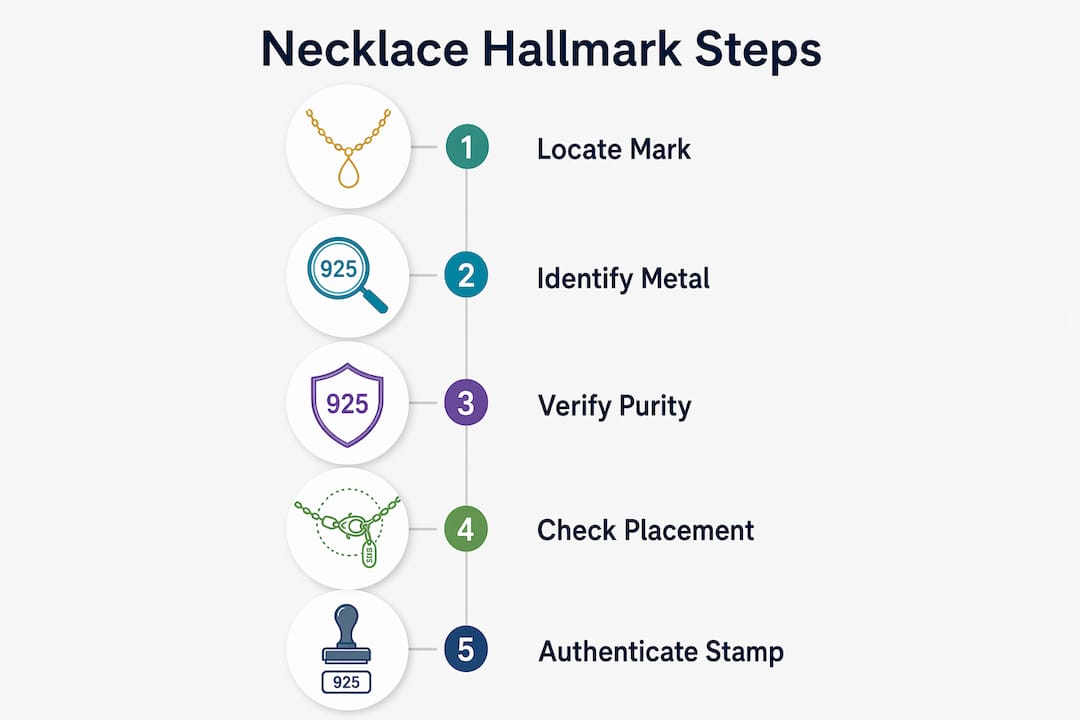
Verifying a hallmark at home takes about five minutes and requires no special equipment beyond a magnifying glass. Follow these steps in order for the most reliable result.
- Locate the stamp. Examine the clasp, jump rings, and any small tags near the clasp under a 10x loupe or a strong magnifying glass. Look for tiny stamped numbers or letters. Natural light or a flashlight held at an angle works best.
- Decode the purity mark. Match what you see to the standard codes: 417, 585, or 750 for gold; 925 for sterling silver; 950 for platinum. If you see “GF” or “GP,” the piece is not solid precious metal.
- Perform the magnet test. Real gold does not react to magnets. Hold a strong neodymium magnet near the clasp. If the necklace pulls toward the magnet, the metal is likely a ferrous base metal with a surface coating. This test rules out obvious fakes quickly.
- Try the vinegar test. Apply a small drop of white vinegar to an inconspicuous spot on the metal. Real gold shows no reaction. A color change or surface discoloration indicates plating or a base metal underneath. This test works best on pieces where you suspect the hallmark has been faked.
- Cross-reference all results. No single test is definitive on its own. A piece that passes the magnet test, shows a legible 585 stamp, and shows no vinegar reaction is almost certainly 14K gold. Conflicting results mean you should take the piece to a professional jeweler for a formal assay.
Pro Tip: Hallmarks can be faked. A stamp reading “750” on a piece that reacts to a magnet is a red flag. Always combine at least two verification methods before drawing a conclusion.
Why necklace hallmarks matter for buyers and collectors
Hallmarks function as consumer protection tools. They give buyers a factual basis for evaluating what they are purchasing, independent of what a seller claims. This matters most in three specific situations: buying pre-owned jewelry, insuring a piece, and reselling.
- Insurance and appraisal. Insurers and appraisers rely on hallmarks to establish metal content and value. A necklace with a clear, legible hallmark is easier to appraise accurately and faster to insure at the correct replacement value.
- Resale value. A hallmarked necklace commands higher confidence from buyers in the secondary market. The mark provides documented proof of metal content without requiring the seller to make verbal claims.
- Provenance and age. A complete hallmark that includes a date letter and assay office mark can place a piece in a specific year and country of testing. For collectors of antique or vintage jewelry, this information is as valuable as the metal itself.
“Hallmarks are not merely purity marks. They act as a historical record and multi-layer verification of quality and origin.” — Charles Nobel Jewellers
One critical fact for American buyers: the United States does not require mandatory government hallmarking on jewelry. American-made pieces often carry only a maker’s mark, which is a manufacturer’s own stamp rather than an independently verified purity certification. The absence of a hallmark on a US-made necklace does not mean the piece is fraudulent. It means you are relying on the manufacturer’s claim rather than a third-party test. This is why buying from reputable retailers with transparent quality standards matters more in the US than in countries with mandatory hallmarking laws.
For buyers evaluating vintage or pre-owned pieces, knowing the difference between official hallmarks and maker’s marks is the single most important skill. A piece with only a maker’s mark may still be genuine, but it requires additional verification steps that a hallmarked piece does not.
Key takeaways
A necklace hallmark is the most reliable single indicator of precious metal purity, but its absence in US-made jewelry means buyers must combine hallmark reading with physical tests and trusted retailers.
| Point | Details |
|---|---|
| Hallmark vs. maker’s mark | Only hallmarks are third-party certified; maker’s marks are manufacturer claims without independent verification. |
| Purity codes to know | 585 means 14K gold; 750 means 18K gold; 925 means sterling silver. |
| Where to look | Check the clasp, jump rings, and small tags near the clasp using a 10x loupe. |
| US hallmarking gap | American jewelry lacks mandatory government hallmarks, so physical tests and reputable retailers fill the verification gap. |
| Worn marks are common | Friction on clasps can erase stamps over time; a missing mark does not automatically mean a piece is fake. |
What years of reading hallmarks actually taught me
Most jewelry guides treat hallmarks as a simple lookup exercise. Find the stamp, match the number, done. That framing misses the most useful part of the skill.
The real value of reading hallmarks comes from knowing what to do when the stamp is missing, faded, or inconsistent with the metal’s behavior. I have handled pieces with crisp 750 stamps that reacted to a magnet, and pieces with no stamp at all that turned out to be solid 18K gold from American makers who never applied a purity mark. Neither result fits the simple lookup model.
The US hallmarking gap catches buyers off guard more than any other single issue. Shoppers who buy European or British jewelry expect a hallmark and know how to read one. Shoppers who buy American-made pieces often do not realize that the absence of a stamp is legally normal here, not a warning sign. That gap creates real confusion when someone tries to insure or resell a piece years later.
My practical advice: treat the hallmark as your starting point, not your final answer. If the stamp is present and consistent with the physical tests, you have strong evidence. If the stamp is absent, ask the retailer for documentation of metal content. Reputable sellers can provide this. If a seller cannot or will not, that tells you something important.
The fashion necklaces market has grown to include a wide range of metal qualities, and not all of them are labeled clearly. Knowing how to read and verify a hallmark puts you in control of that evaluation, regardless of what the price tag says.
— Andrew
Shop verified necklaces at Superjeweler
Knowing how to read a hallmark is most useful when you are shopping from a source that applies those standards consistently. Superjeweler carries a wide selection of gold and silver necklaces with clearly documented metal purity, so you know exactly what you are getting before the piece arrives.

From gemstone necklaces in verified 14K and 18K gold settings to personalized gold necklaces with stamped purity marks, every piece is backed by Superjeweler’s quality standards and return policy. Free worldwide shipping and warranty options make it straightforward to shop with confidence. If you are ready to put your hallmark knowledge to use, browse the full necklace collection at superjeweler.com.
FAQ
What is a necklace hallmark?
A necklace hallmark is an official stamp applied by an independent assay office that certifies the purity and metal content of a precious metal necklace. It is distinct from a maker’s mark, which is applied by the manufacturer without third-party verification.
Where do you find the hallmark on a necklace?
Hallmarks appear most often on the clasp, a jump ring near the clasp, or a small attached tag. These locations offer a stable surface for stamping while keeping the mark out of sight during wear.
What does 925 mean on a necklace?
The stamp 925 means the necklace is made of sterling silver, which is 92.5% pure silver. It is the international standard mark for sterling silver jewelry.
Why does my necklace have no hallmark?
In the United States, government hallmarking is not mandatory, so many American-made necklaces carry only a maker’s mark or no purity stamp at all. A missing hallmark does not mean the piece is fake. It means purity was not independently certified, and you should verify metal content through physical tests or retailer documentation.
Can a hallmark be faked?
Yes, hallmarks can be stamped onto low-quality metals. A piece with a purity stamp that reacts to a magnet or discolors under vinegar is a strong indicator of a faked mark. Always combine hallmark reading with at least one physical test for reliable verification.
Recommended
- What is birthstone jewelry? A 2026 guide to meaning
- Diamond necklace buying tips: quality & value in 2026
- Journey and Three Diamond Necklaces | SuperJeweler
- Two Stone Diamond Necklaces | SuperJeweler
