TL;DR:
- Gold is more abundant, softer, and available in multiple colors, making it popular for jewelry and investments.
- Platinum is rarer, denser, naturally white, and often used in high-end settings and industrial applications.
The difference between gold and platinum comes down to four core factors: rarity, color, durability, and market role. Gold is more abundant, traditionally yellow, and prized for investment and jewelry alike. Platinum is rarer, naturally white, and denser, making it the preferred choice for high-end settings and industrial applications. These distinctions directly affect price, maintenance, and which metal makes sense for your ring, necklace, or portfolio. Understanding both metals clearly helps you spend smarter and choose with confidence.
What is the difference between gold and platinum?
Gold and platinum are both precious metals, but they occupy different positions in the market and on your finger. Gold is a chemical element (symbol Au) that has been used in jewelry and currency for thousands of years. Platinum (symbol Pt) is a naturally white, transition metal discovered in South America in the 18th century and far rarer than gold in the Earth’s crust.
The most practical distinction is this: gold is softer, more malleable, and available in multiple colors, while platinum is denser, heavier, and naturally white. That single physical difference shapes everything from how a ring wears over decades to how a metal performs in a financial crisis. Both metals are genuine stores of value, but they serve different buyers with different priorities.
What are the physical and chemical differences between gold and platinum?
Physical properties set these two metals apart before price or style even enters the conversation.
Density and weight
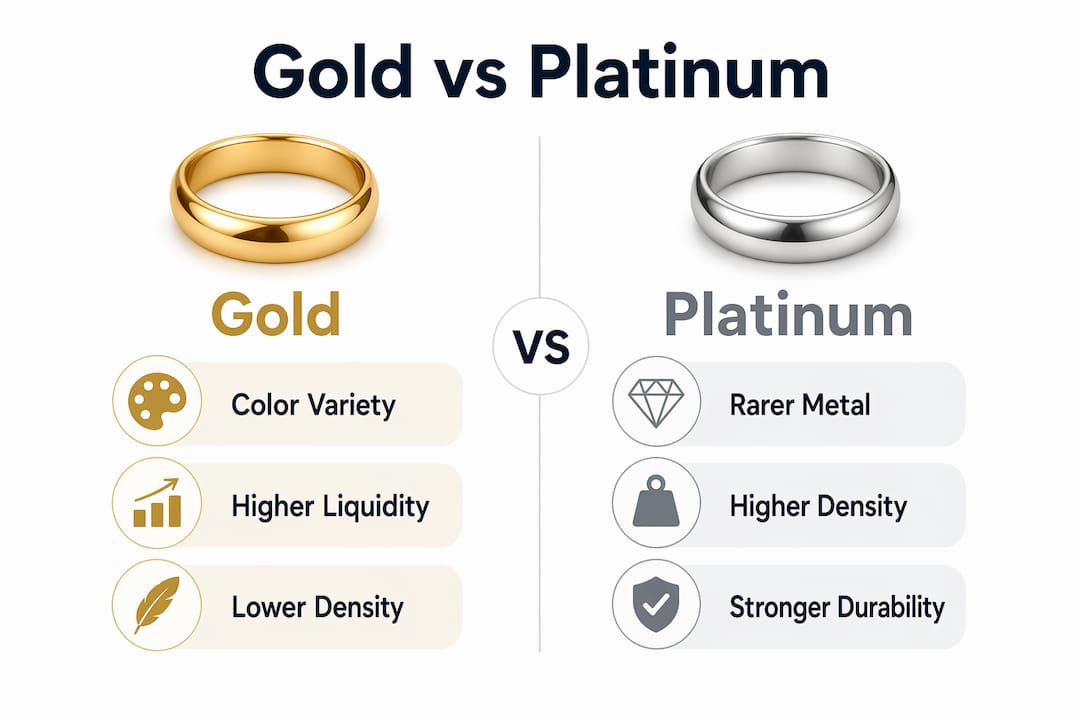
Platinum is significantly denser than gold. A platinum ring of the same size as a gold ring will feel noticeably heavier on the hand. Some buyers love that substantial feel; others find it uncomfortable for daily wear. Weight is a real factor to test before you commit.
Purity standards
Platinum jewelry is commonly sold at 95% purity, labeled as 950 platinum. Gold jewelry uses a karat system: 24 karat is pure gold, 18 karat is 75% gold, and 14 karat is 58.3% gold. The remaining percentage in each case is alloying metals added for strength. Platinum’s higher purity means fewer alloy metals touching your skin, which matters for buyers with metal sensitivities.
Color options
Gold’s natural color is yellow, but jewelers alloy it with other metals to create white gold and rose gold. White gold requires rhodium plating for its bright white finish, and that plating wears off over time. Platinum needs no plating. Its silvery white color is natural and permanent, which is a meaningful maintenance difference over years of wear.
| Property | Gold | Platinum |
|---|---|---|
| Natural color | Yellow | Silvery white |
| Common purity | 14k (58.3%), 18k (75%) | 950 (95%) |
| Density | Lower | Significantly higher |
| Malleability | High | Moderate |
| Hypoallergenic | Varies by alloy | Yes (at 95% purity) |
Pro Tip: If you or your partner has a nickel allergy, platinum is the safer default. White gold alloys often contain nickel, which is a common skin irritant.
How do gold and platinum differ in price and market demand?
Price is where the gold vs platinum comparison surprises most buyers. Historically, platinum traded at a premium to gold. That relationship has reversed sharply. Platinum trades at roughly 44% of gold’s price as of may 2026, with gold near $4,545 per ounce and platinum near $1,992 per ounce. That gap is historically wide and reflects very different demand structures.
What drives each metal’s price
- Gold: Demand is led by investment, central bank purchases, and jewelry. These drivers are relatively stable across economic cycles, which keeps gold’s price steadier.
- Platinum: 40–50% of platinum demand comes from industrial applications, primarily catalytic converters in vehicles. That industrial dependence makes platinum’s price more sensitive to manufacturing cycles and automotive trends.
- Supply concentration: Most of the world’s platinum comes from South Africa and Russia, making supply more geopolitically concentrated than gold.
The practical implication for jewelry buyers: platinum jewelry costs more per piece than gold jewelry of similar weight, because platinum is denser and requires more metal by volume. But the raw metal price is lower than gold right now. For investors, the price gap signals very different risk profiles.
“Gold acts as portfolio insurance during instability; platinum suits experienced investors tolerating volatility linked to industrial growth.” — USA Gold
What practical differences do gold and platinum present for jewelry buyers?
For everyday wear, the differences between gold and platinum show up in durability, maintenance, comfort, and style. Jewelry professionals recommend platinum for settings requiring a stronger metal and a natural white color. Gold suits buyers who want color variety and a lower upfront cost.

Durability and scratching
Platinum is harder to deform than gold, but it does scratch. When platinum scratches, the metal displaces rather than chips away, so the total metal volume stays intact. Gold scratches more easily and loses small amounts of metal with each scratch. Over decades, a platinum ring retains more of its original material.
Maintenance requirements
White gold’s rhodium plating typically needs to be reapplied every one to two years depending on wear. That means periodic trips to a jeweler and added cost over time. Platinum develops a natural patina as it ages, which many buyers find attractive. If you prefer a high-polish look, platinum can be buffed back to bright white without any plating.
Style and color flexibility
Gold offers more style and color options and is generally more affordable upfront than platinum. Yellow gold, white gold, and rose gold each create a distinct look. Platinum offers one color: bright white. If you want a warm-toned ring or a rose gold engagement ring, platinum is not an option.
Pro Tip: For prong settings holding a diamond, platinum’s strength provides a more secure grip over time. For buyers who want a yellow or rose-toned band, 18k gold is the practical choice.
Comfort and weight
Platinum’s higher density means a platinum band weighs more than a gold band of the same width. Buyers who prefer lighter jewelry consistently choose gold. Those who associate weight with quality often prefer platinum.
How do gold and platinum compare as investment metals?
Gold and platinum serve different roles in an investment portfolio. They are not interchangeable.
Gold as a safe-haven asset
Gold is recognized as a strong safe-haven asset with lower price volatility and high liquidity. Central banks hold gold as a reserve asset. During financial crises, gold prices typically rise as investors seek stability. Gold is also easy to buy and sell globally, through coins, bars, ETFs, and futures markets.
Platinum as a cyclical play
Platinum can be a contrarian or cyclical investment due to its industrial demand dependence and its current deep discount to gold. Investors who believe automotive and industrial demand will recover may see platinum’s current price as an opportunity. That thesis carries real risk, however, because electric vehicles use far less platinum than combustion engines.
Side-by-side investment comparison
| Factor | Gold | Platinum |
|---|---|---|
| Price stability | Higher | Lower |
| Liquidity | Very high | Moderate |
| Safe-haven status | Strong | Weak |
| Industrial demand exposure | Low | High (40–50%) |
| Current price (mid-2026) | ~$4,545/oz | ~$1,992/oz |
The clearest takeaway: gold belongs in a portfolio as insurance. Platinum belongs in a portfolio as a speculative position for investors who understand industrial commodity cycles. Most first-time precious metal buyers are better served starting with gold.
Key takeaways
Gold and platinum serve different buyers: gold offers flexibility, liquidity, and color variety, while platinum delivers natural white color, higher purity, and long-term durability for premium jewelry.
| Point | Details |
|---|---|
| Price gap is historically wide | Platinum trades at roughly 44% of gold’s price in mid-2026, a reversal of historical norms. |
| Purity and hypoallergenic properties | Platinum at 95% purity is safer for sensitive skin than most gold alloys. |
| Maintenance differs significantly | White gold needs rhodium replating; platinum’s white color is permanent and requires no plating. |
| Investment roles are not the same | Gold is a safe-haven asset; platinum is a cyclical, industrial-linked commodity. |
| Style flexibility favors gold | Gold comes in yellow, white, and rose; platinum offers only its natural silvery white. |
My take after years of watching buyers choose between these two metals
Most buyers walk in assuming platinum is better because it costs more per piece. That assumption leads to real regret. The honest truth is that more expensive does not always mean better. Gold’s repairability, color variety, and global liquidity make it the smarter choice for a large share of buyers.
Where I’ve seen platinum win consistently: solitaire engagement rings with a single large diamond, buyers with nickel sensitivities, and anyone who refuses to deal with rhodium replating. Platinum’s prong strength genuinely matters for securing a valuable stone over decades of daily wear. That is a real, practical advantage.
Where I’ve seen gold win: buyers on a budget who want a beautiful white metal ring can choose white gold for engagement rings and save significantly upfront. Yellow gold buyers get a timeless look that never goes out of style. Rose gold buyers get something no platinum ring can offer.
The question I always ask buyers is simple: How much maintenance are you willing to do, and what color do you actually want? Answer those two questions honestly, and the right metal becomes obvious. Do not let price alone drive the decision.
— Andrew
Gold and platinum rings at Superjeweler
Superjeweler carries engagement rings in gold and platinum across a wide range of styles and price points, so you can compare both metals side by side before you buy.

For buyers working with a tighter budget, Superjeweler’s affordable diamond engagement rings include real diamonds set in both gold and platinum options under $1,000. Lab-grown diamond settings are also available, giving you the option to put more of your budget toward the metal quality you want. Free worldwide shipping and a solid return policy mean you can shop with confidence from home.
FAQ
What is the main difference between gold and platinum?
Gold is softer, available in multiple colors, and more common, while platinum is rarer, naturally white, and denser. These physical differences affect price, maintenance, and jewelry durability.
Is platinum more expensive than gold right now?
No. As of mid-2026, platinum trades at roughly 44% of gold’s price, with gold near $4,545 per ounce and platinum near $1,992 per ounce. This is a reversal of the historical relationship.
Which metal is better for an engagement ring?
Choosing between platinum and gold jewelry depends on wear frequency, budget, color preference, and maintenance tolerance. Platinum suits buyers who want natural white color and minimal upkeep; gold suits buyers who want color variety or a lower upfront cost.
Does platinum require more maintenance than gold?
Platinum requires less maintenance than white gold. White gold needs rhodium replating every one to two years, while platinum’s white color is natural and permanent.
Is gold or platinum a better investment?
Gold is the stronger safe-haven investment with higher liquidity and lower volatility. Platinum is a more speculative, industrial-linked asset that may appeal to experienced investors seeking diversification.
Recommended
- White Gold vs Platinum: Key Differences for Jewelry Buyers
- Why choose platinum rings: enduring value and elegance
- What Is Gold Plating? A Jewelry Shopper’s Guide
- The Role of Precious Metals in Investment and Jewelry
