TL;DR:
- Cut is the most critical factor influencing a gemstone’s brilliance and sparkle.
- Well-cut diamonds reflect and bounce light perfectly, enhancing their beauty regardless of size.
- Prioritize excellent or ideal cut grades, especially for round diamonds, for maximum visual impact.
When it comes to choosing a diamond, diamond cut brilliance is the single most important factor influencing how much it sparkles. Most shoppers zero in on carat weight when they walk into a jewelry store, assuming bigger always means more beautiful. It’s one of the most persistent myths in fine jewelry.
The truth is that cut is the most critical of the 4Cs for determining how much a gemstone actually sparkles. A perfectly cut one-carat diamond will outshine a two-carat stone with poor proportions every single time. This guide breaks down what cut really means, why it controls everything you see when light hits a stone, and how to use that knowledge to make a smarter, more satisfying jewelry purchase.
Table of Contents
- What does cut mean in gemstones?
- How cut drives brilliance: The science of sparkle
- Cut grading: What makes a cut ‘Excellent’ or ‘Ideal’?
- Beyond round diamonds: Fancy shapes and practical buying tips
- A jeweler’s perspective: Cut is your smartest investment
- Shop brilliance: Find your perfectly cut gemstone ring
- Frequently asked questions
Key Takeaways
| Point | Details |
|---|---|
| Cut is key | The cut of a gemstone is the main factor responsible for its brilliance, fire, and overall sparkle. |
| Top grades shine brightest | An Excellent or Ideal cut outperforms bigger size or flawless clarity for visual impact. |
| Fancy shapes need extra attention | Non-round gemstones require careful inspection since most labs don’t assign an official cut grade. |
| See before you buy | Subtle differences exist even within top cut grades—always compare stones by viewing them in person or video. |
What does cut mean in gemstones?
When most people hear “cut,” they picture shape, like round, oval, or pear. But shape and cut are two completely different things. Cut refers to how a gemstone’s facets, which are the flat, polished surfaces, are arranged and angled relative to each other. It includes the overall proportions of the stone, the precision of each angle, and the quality of its finish. Shape is simply the outline you see from above.
A gemstone has several key parts that affect how light travels through it. The table is the large flat facet on top. The crown is the upper portion above the girdle (the narrow band around the stone’s widest point). The pavilion is the lower portion below the girdle. Every angle in these sections was designed with one goal: to control how light enters, bounces, and exits.
Here’s why proportions matter so much:
- Brilliance is the white light that reflects back to your eye from inside the stone.
- Fire refers to the rainbow-colored flashes you see as the stone moves.
- Scintillation is the sparkling pattern of light and dark you see when the stone or the light source shifts.
All three are directly controlled by the cut. A stone with ideal proportions bounces light from one facet to another, then sends it straight back up through the top. A stone with poor proportions lets light “leak” out the sides or bottom before it can return to your eye.
“Cut is the most critical of the 4Cs for gemstone brilliance, determining how light enters, reflects internally, and returns to create brilliance, fire, and scintillation.” — GIA
Thinking about gemstone cuts explained in this way changes everything. It shifts the conversation from “how big is it” to “how well does it work.” And working well means one thing above all else: getting as much beautiful light as possible back to your eye. GIA’s approach to cut grading was developed over decades for exactly this reason.
How cut drives brilliance: The science of sparkle
Imagine a room lined with mirrors. If the mirrors are angled perfectly, a single beam of light bounces endlessly around the room, reflecting from surface to surface. Tilt one mirror slightly off, and the light shoots straight out a window instead. A gemstone’s facets work exactly the same way.
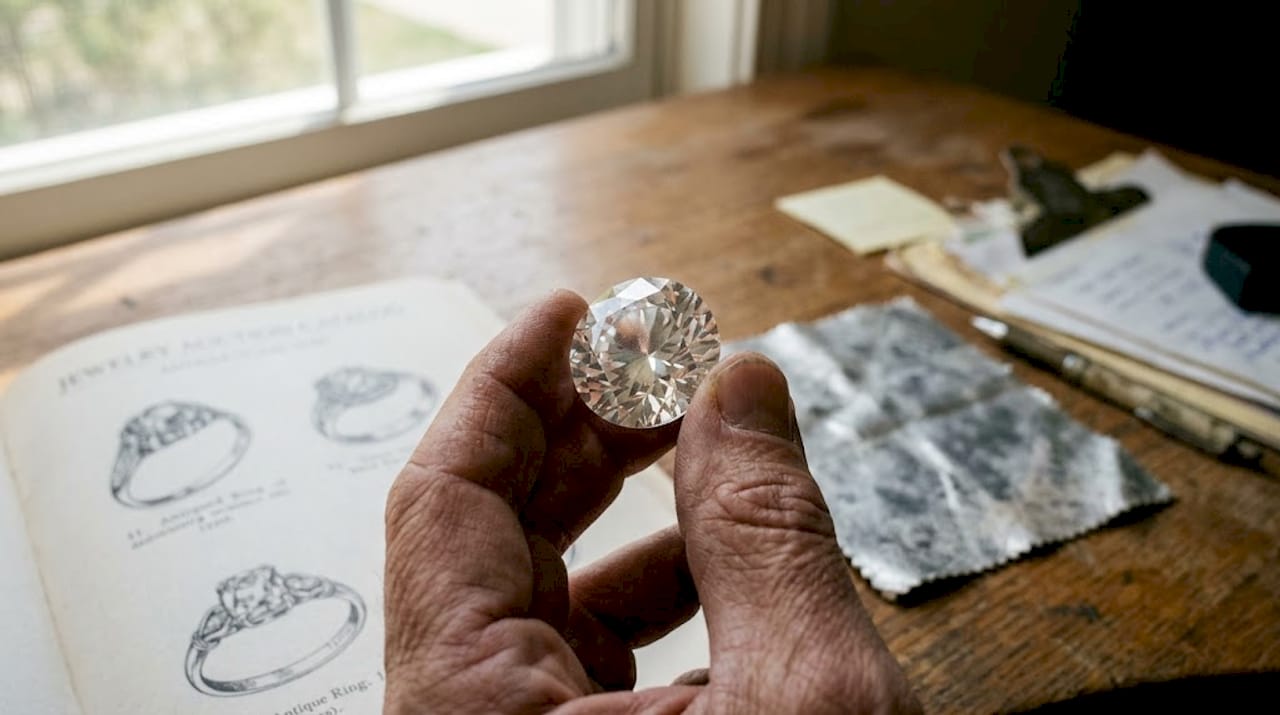
Each facet is a tiny mirror. When a diamond is cut with precise angles, light entering through the table bounces off the pavilion facets at the exact angle needed to reflect back up through the crown. This process is called total internal reflection. When those angles are even slightly off, light exits through the base or sides of the stone, and the diamond looks flat and lifeless.
| Feature | Excellent cut | Poor cut |
|---|---|---|
| Light return | Nearly all light returns to your eye | Light leaks through base or sides |
| Brilliance | Vivid, bright white flashes | Dull, washed-out appearance |
| Fire | Vivid rainbow colors visible | Minimal color dispersion |
| Scintillation | Dynamic sparkle on movement | Static, little movement of light |
| Overall appearance | Larger-looking and lively | Often looks smaller and lifeless |
Here’s the counterintuitive part: a well-cut lower color/clarity diamond actually appears brighter than a poorly cut flawless stone. That means you can spend less on color and clarity and more on cut quality, and end up with a more beautiful ring. Learning to maximize sparkle through cut quality is one of the smartest strategies in fine jewelry buying. IGI’s grading system reinforces this idea, using ray-tracing technology to confirm that precise proportions are the primary driver of a stone’s visual performance.
Pro Tip: Always check the cut grade first on any grading certificate, before you look at carat, color, or clarity. A top cut grade will give you the most visible beauty for your budget.
Cut grading: What makes a cut ‘Excellent’ or ‘Ideal’?
Knowing that cut matters is one thing. Understanding how labs actually measure it is another. Two of the most respected grading organizations in the world, GIA and IGI, each have rigorous methods for evaluating cut, though they approach it slightly differently.
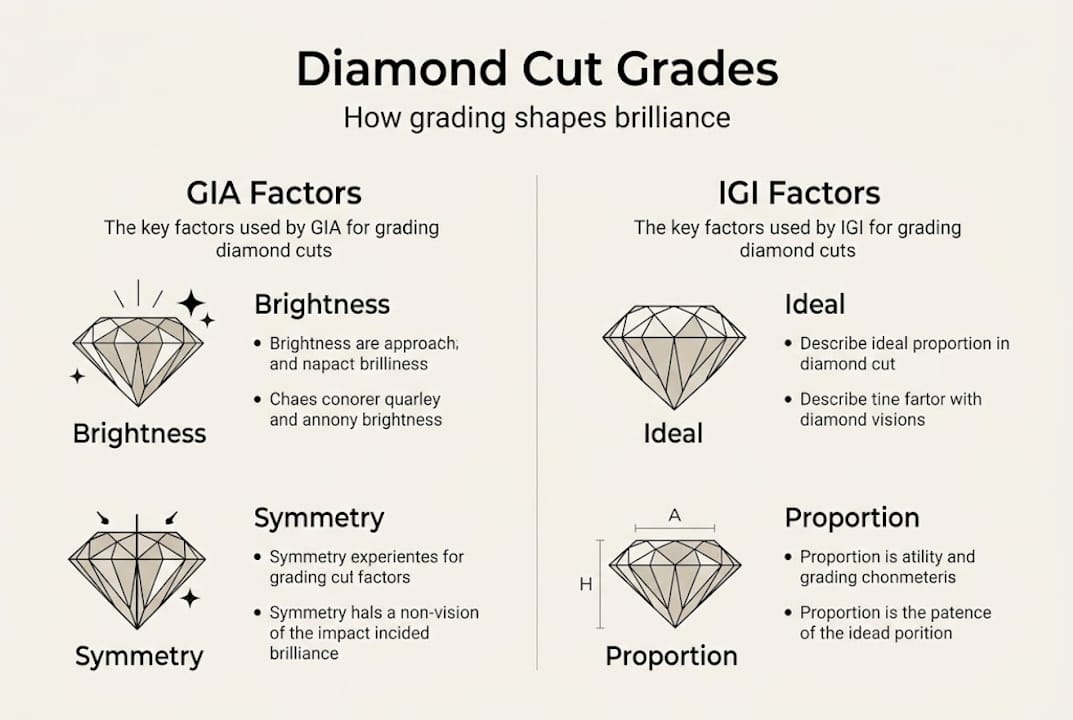
GIA grades round brilliant diamonds on five levels: Poor, Fair, Good, Very Good, and Excellent. The GIA cut grading methodology evaluates seven factors: brightness, fire, scintillation, weight ratio, durability, polish, and symmetry. This system was developed over 15 years using computer modeling of thousands of proportion combinations and more than 70,000 human observations. It’s one of the most thorough grading systems ever built.
| Criteria | GIA | IGI |
|---|---|---|
| Top grade | Excellent | Excellent/Ideal |
| Factors evaluated | 7 (brightness, fire, scintillation, weight ratio, durability, polish, symmetry) | Light Performance (Brightness, Fire, Contrast) via ray-tracing |
| Applies to fancy shapes | No | Limited |
| Technology used | Computer modeling + human observation | Ray-tracing software |
IGI’s methodology uses advanced ray-tracing software to analyze thousands of proportion sets and assess Light Performance across brightness, fire, and contrast. Their top grade for round brilliants is labeled Excellent/Ideal.
Here’s how a lab typically assigns a cut grade:
- Measure the stone’s precise dimensions using optical scanning tools.
- Calculate proportions: table percentage, depth percentage, crown angle, pavilion angle.
- Model how light travels through those proportions using software or human panel review.
- Evaluate polish (surface smoothness) and symmetry (alignment of facets).
- Combine all scores to assign a final grade.
One important nuance: not all Excellent grades look identical. A stone graded Triple Excellent (Excellent cut, Excellent polish, Excellent symmetry) is the gold standard. Some stones within the Excellent range show subtle differences in visual performance. That’s why the visual impact of cut is best judged in person or on video, not just by the certificate alone. Reading diamond grading explained can help you understand all the numbers on a cert. For engagement ring sparkle, always aim for Triple Excellent when your budget allows.
Beyond round diamonds: Fancy shapes and practical buying tips
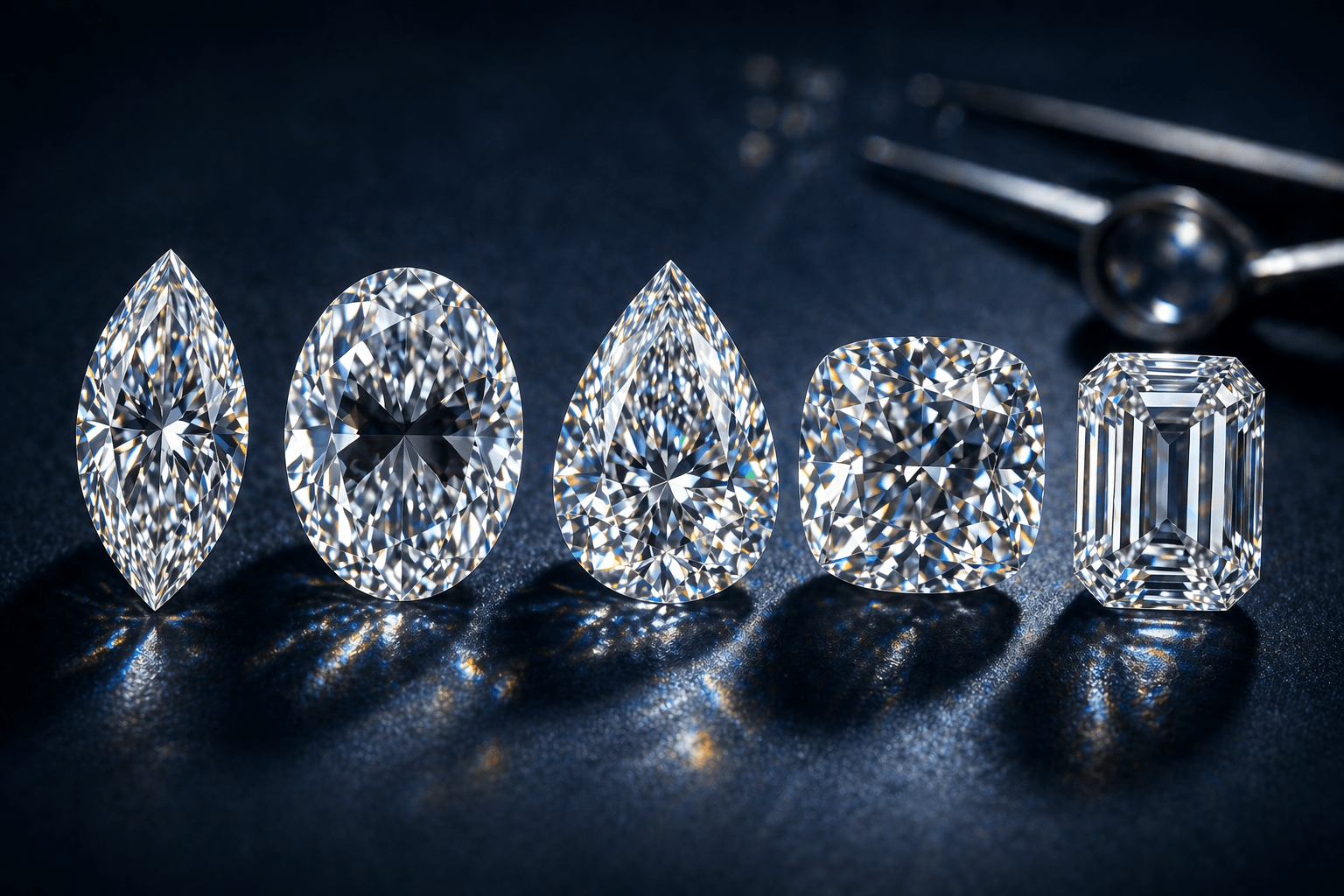
Round brilliant diamonds have the advantage of a standardized cut grading system. Fancy shapes, meaning ovals, cushions, pears, marquises, and emeralds, do not. GIA does not assign a cut grade to fancy shapes, which leaves many buyers without a clear roadmap.
For these stones, fancy shapes lack a GIA cut grade entirely, so you have to rely on other signals: polish and symmetry grades, the stone’s light return as seen in photos and videos, and your own eye. This is where buyers can easily go wrong.
The most common pitfall is the bow-tie effect. This is a dark, bow-tie-shaped shadow that appears across the center of oval, pear, and marquise diamonds when they are poorly proportioned. It’s caused by light leaking rather than reflecting, and it can significantly reduce a stone’s beauty. Subtle proportion variations cause these effects even in stones with otherwise good-looking certificates.
Here’s a practical checklist for shopping fancy shapes:
- Do request high-resolution video showing the stone under different lighting conditions.
- Do ask for Excellent or Very Good polish and symmetry grades on the certificate.
- Do look for even sparkle distribution across the entire stone, with no dead zones.
- Don’t rely on measurements alone. Proportions that look fine on paper can still produce a bow-tie.
- Don’t skip the video inspection, especially when buying online.
- Don’t assume a well-known brand automatically means a well-cut stone.
Understanding the difference between shape and cut is essential before you browse. Once you know what you want visually, it’s much easier to choose perfect diamond shape and evaluate it with confidence.
Pro Tip: For fancy shapes, always ask to see a video before purchasing online. Still images rarely reveal a bow-tie or windowing effect, but video under direct lighting will show it clearly.
A jeweler’s perspective: Cut is your smartest investment
Here’s a truth the industry doesn’t always shout from the rooftops: most buyers leave money on the table by chasing size instead of quality. A 1.2-carat stone with a mediocre cut will look smaller and duller than a 1.0-carat stone with an Excellent cut. The smaller stone will catch every eye in the room. The larger one will leave people wondering why it doesn’t sparkle more.
When you allocate your budget, treat cut as non-negotiable. It’s the one factor you will see and feel every single day. You can always compare gemstone clarity vs cut and find that slight clarity compromises are nearly invisible to the naked eye, while a poor cut is obvious the moment light hits the stone.
Even the major grading bodies, GIA, IGI, and AGS, all agree that cut is the most powerful driver of a diamond’s visual appeal. That rare industry-wide consensus should tell you something. Buy the best cut you can afford, view the stone on video if you can’t see it in person, and prioritize Triple Excellent for rounds. Your everyday joy from that ring will reflect it.
Shop brilliance: Find your perfectly cut gemstone ring
Ready to put this knowledge to work for your next statement piece or engagement ring? Now that you understand how cut controls every flash of light and color in a stone, you can shop with real confidence instead of guessing.

At SuperJeweler, we’ve curated a selection of affordable engagement rings that prioritize brilliance without sacrificing your budget. Whether you’re drawn to a classic round brilliant or a show-stopping fancy shape, our all engagement ring styles collection gives you the variety and quality to find the one that truly dazzles. Shop with free shipping worldwide and our satisfaction guarantee, knowing you’re choosing cut-first beauty at every price point.
Frequently asked questions
Why does cut matter more than carat or clarity for sparkle?
Cut determines how effectively a gemstone reflects light back to your eye. A well-cut diamond appears brighter than a poorly cut flawless one, making cut the single biggest driver of visible sparkle.
How can I tell if a fancy-shaped diamond is well-cut?
Check for Excellent or Very Good polish and symmetry grades, look for even sparkle with no dark center band, and always request video. Fancy shapes rely on polish/symmetry since GIA does not assign a formal cut grade for these stones.
What are the signs of a poorly cut gemstone?
A poorly cut stone looks dull, shows uneven light distribution, and often has a dark center or edges. The bow-tie effect in fancy shapes is one of the clearest signs of a stone that leaks light instead of reflecting it.
Is there a universal ‘best’ cut for brilliance?
The round brilliant with an Excellent or Ideal grade delivers the most consistent maximum sparkle. That said, subtle proportion variations within Excellent grade stones mean viewing in person or on video is always the best final step.
Recommended
- Understand gemstone cuts: Unlock sparkle, value & style
- Diamond Cut in Engagement Rings: Maximizing Sparkle
- Blue Gemstones: Ocean-Inspired Beauty
- Role of cut in diamond quality: maximize sparkle in 2026
