If you have the cash, pay cash. If you need a short runway and can clear the balance fast, a true 0% promo works. Mid-size purchases fit BNPL, long-term predictable payments favor a personal loan, and lease-to-own fills the gap for buyers without established credit, though it costs more over time. The trap to watch: deferred-interest store cards that charge you retroactively if you miss the payoff window. An increasing number of online jewelry retailers offer flexible payment choices at checkout for shoppers who want a direct, no-hassle path to owning the ring or piece they want.
TL;DR:
- Personal loans generally offer lower and more predictable interest rates than store credit cards or deferred-interest plans, especially for purchases above $3,000.
- Deferred-interest store cards can trigger retroactive interest charges if payments are late or the deadline is missed, often making them the most expensive option.
- BNPL plans typically do not affect credit scores at application, but some now report ongoing payments, and high credit utilization can harm your credit health.
- When comparing financing options, it is crucial to calculate the total cost by considering interest rates, fees, and the risk of retroactive charges rather than relying solely on monthly payments.
- For purchases under $1,000, pay-in-4 or layaway often provide the most cost-effective and straightforward financing, while fixed personal loans are better suited for higher budgets with good credit.
Table of Contents
- What are the main jewelry financing options at checkout?
- How do you compare total cost across financing plans?
- Does jewelry financing affect your credit score?
- How do you choose the right financing plan for your budget?
- What happens after you apply: approval, funding, and returns
- How SuperJeweler supports flexible payments and buyer protections
- The financing advice most guides get backwards
- Shop flexible payment options built for every ring budget
- Sources
- FAQ
What are the main jewelry financing options at checkout?
Every major jeweler offers some version of the same five financing families, and each one solves a different problem. Knowing which bucket you’re in before you get to the register saves you from a sales pitch that doesn’t fit your situation.
- Store credit cards and promotional retail plans: These often advertise “0% for 12 months” or similar. They save you real money only if you pay off the full balance before the promo ends. Miss that date by even a few dollars, and many of these plans charge interest retroactively from the original purchase date.
- BNPL and installment apps: Pay-in-4 apps split a purchase into four payments over six weeks, ideal for smaller pieces like earrings or a modest ring a modest price range. Longer installment loans through the same providers stretch payments out further and suit mid-range purchases.
- Personal loans: Fixed monthly payments, a set end date, and no revolving balance to manage. According to Credible, repayment terms on these loans commonly range from several months to several years, which gives you room to match the loan length to your paycheck cycle.
- Lease-to-own and alternative approval programs: These approve buyers with thin or damaged credit files, but the tradeoff is real. Gerald’s financing breakdown notes total costs can run 50 to 100 percent higher than the sticker price over the life of the payments.
- Layaway and saving up: No interest, no credit check, no risk. You wait longer to wear the piece, but you never pay a cent beyond the price tag.
How do you compare total cost across financing plans?
The monthly payment on a financing offer tells you almost nothing about what you’ll actually pay. Two plans can advertise the same $150 monthly figure and differ by hundreds of dollars in total cost, depending on the APR and how interest gets calculated.
Start with a simple formula: total cost equals principal plus interest plus any fees. Run that math before you sign anything.
A mid-priced ring, two ways: On a two-year personal loan at a typical rate, you’d pay a predictable amount in interest over a typical multi-year term with no surprises, since lenders must disclose the APR and finance charges under Truth in Lending rules, per Credible. On a deferred-interest store card promising “0% for a typical multi-year term,” paying it off one month late can trigger interest calculated from the original purchase date, not from when you missed the deadline. That single mistake can turn the cheaper-looking option into the most expensive one, according to LegalClarity’s analysis of jewelry financing.
NerdWallet’s data on rate comparisons shows two-year personal loans routinely carry lower average interest rates than general credit cards, which makes loans the more transparent option for anyone who isn’t fully confident they’ll hit a promo deadline.
Watch for three specific traps before you commit:
- Retroactive interest: The single biggest cost risk in store financing. Confirm exactly what date interest starts accruing if you don’t pay in full.
- Late fees: Even a one-time miss can add $25 to $40 on top of everything else.
- Return-policy conflicts: Some financed purchases process refunds differently than cash purchases, so ask how a return affects your loan or card balance before you buy.
Does jewelry financing affect your credit score?
It depends heavily on which type of financing you choose, and the difference matters more than most shoppers realize.
Store credit cards typically require a hard credit pull, which temporarily dings your score by a few points and shows up on your credit report. Most BNPL apps use a soft pull instead, which doesn’t affect your score at the application stage, according to Firstcard’s review of BNPL jewelry financing. That said, the same source notes a growing number of BNPL providers now report ongoing payment activity to credit bureaus, so the “no impact” reputation BNPL built its name on is shifting.
Credit utilization is the other lever that catches jewelry shoppers off guard. Charging a mid-priced ring to a card with a $10,000 limit pushes utilization to 50 percent, well above the 30 percent threshold that credit scoring models treat as healthy, per NerdWallet. A personal loan doesn’t touch card utilization at all, since it’s an installment account rather than revolving credit.
- Ask any BNPL provider directly whether they report to Equifax, Experian, and TransUnion before you apply, especially if building credit history matters to you.
- Set up autopay the day your loan or plan is approved. A missed payment costs you far more than the convenience is worth.
- If a card is your only option, ask the issuer for a credit limit increase before the purchase to keep utilization under 30 percent.
Pro Tip: If you’re planning to apply for a mortgage or auto loan within the next six months, avoid opening a new store credit card for your jewelry purchase. The hard inquiry and fresh revolving balance can both work against you during underwriting.
Red flags during application include any plan that won’t disclose its post-promo APR upfront, a salesperson who rushes you past the fine print, or an approval process that never mentions a specific interest rate at all.
How do you choose the right financing plan for your budget?
Run through this checklist before you sign anything at the counter or click “approve” on a payment screen.
- Ask what the total cost will be if you pay on schedule versus if you’re one payment late. A trustworthy plan can answer this in one sentence.
- Confirm what date interest starts accruing. For deferred-interest offers, this is almost always the original purchase date, not the missed deadline.
- Get the exact late-fee amount in writing or in the disclosure screen, not a vague “fees may apply.”
- Ask whether the plan reports to credit bureaus. If building credit is part of your goal, this answer changes which plan you pick.
- Check the minimum payment and what happens if you only pay that amount. Minimums on revolving plans can stretch payoff for years.
- Ask how returns and exchanges are handled financially, especially with a resized ring or a piece bought before an engagement.
Your budget size should drive the decision more than any single plan’s marketing:
- Under $1,000: Pay-in-4 BNPL or layaway usually make the most sense. Interest costs on a loan this small rarely justify the paperwork.
- $1,000 to $3,000: This is where 0% promotional plans and short personal loans compete most directly. Compare the deferred-interest fine print against a loan’s disclosed APR side by side before deciding.
- $3,000 and up: A fixed personal loan usually wins here, since Finder’s guide to jewelry financing confirms that buyers with strong credit typically get the lowest total cost from loans or genuinely interest-free cards, while thinner credit files may need to weigh a store plan or lease-to-own against the higher long-term cost that comes with it. Matching the loan term to how fast you can realistically pay it off, rather than to the lowest monthly number, keeps the total cost down.
If you’re mapping this against an actual ring budget, our engagement ring budgeting workflow walks through setting a target price before you ever look at financing terms.
What happens after you apply: approval, funding, and returns
The timeline from application to first payment varies a lot by financing type, and knowing what to expect keeps you from second-guessing a normal delay.
- BNPL approval typically happens in seconds at checkout, with funding applied instantly to your order.
- Store credit card approval usually takes a few minutes to an hour online, though in-store applications can be instant.
- Personal loan approval ranges from same-day to a few business days, depending on whether the lender needs income verification.
- Prequalification for any of these, when offered, uses a soft pull and shows you likely rates without affecting your score. Only the final application triggers a hard pull.
- Returns and refunds on financed jewelry can get complicated. If you return a financed piece, confirm in writing whether the refund goes back to your loan balance or arrives as a separate payment, and keep every receipt and confirmation email until the transaction fully settles.
If you’re timing a purchase around a proposal date, our engagement ring shopping timeline lines up when to start the financing conversation relative to the big day.
How SuperJeweler supports flexible payments and buyer protections
Superjeweler builds its checkout around the same buyer profiles this guide walks through, from someone financing a $600 promise ring to a couple planning a $5,000 centerpiece stone.
- A wide product range spanning engagement rings, wedding bands, and lab-grown diamonds gives you room to shop within whatever payment plan fits your budget.
- Warranty options and a clear return policy protect you if a financed purchase needs to be resized, exchanged, or refunded.
- Free worldwide shipping means the price you finance is the price you pay, with no surprise shipping costs added at the end.
- Shoppers working with a tighter budget can start with the cheap engagement rings under $1,000 category, while buyers ready for a larger centerpiece stone can browse the full engagement ring selection and apply the payment plan that matches their checklist from this guide.
The financing advice most guides get backwards
Most jewelry financing articles rank plans by interest rate alone. That’s the wrong first filter. The right first question is: how confident are you, honestly, that you’ll pay this off inside the promo window? In practice, it’s the plan most likely to blindside you, because the entire cost structure flips the moment you miss a single date.
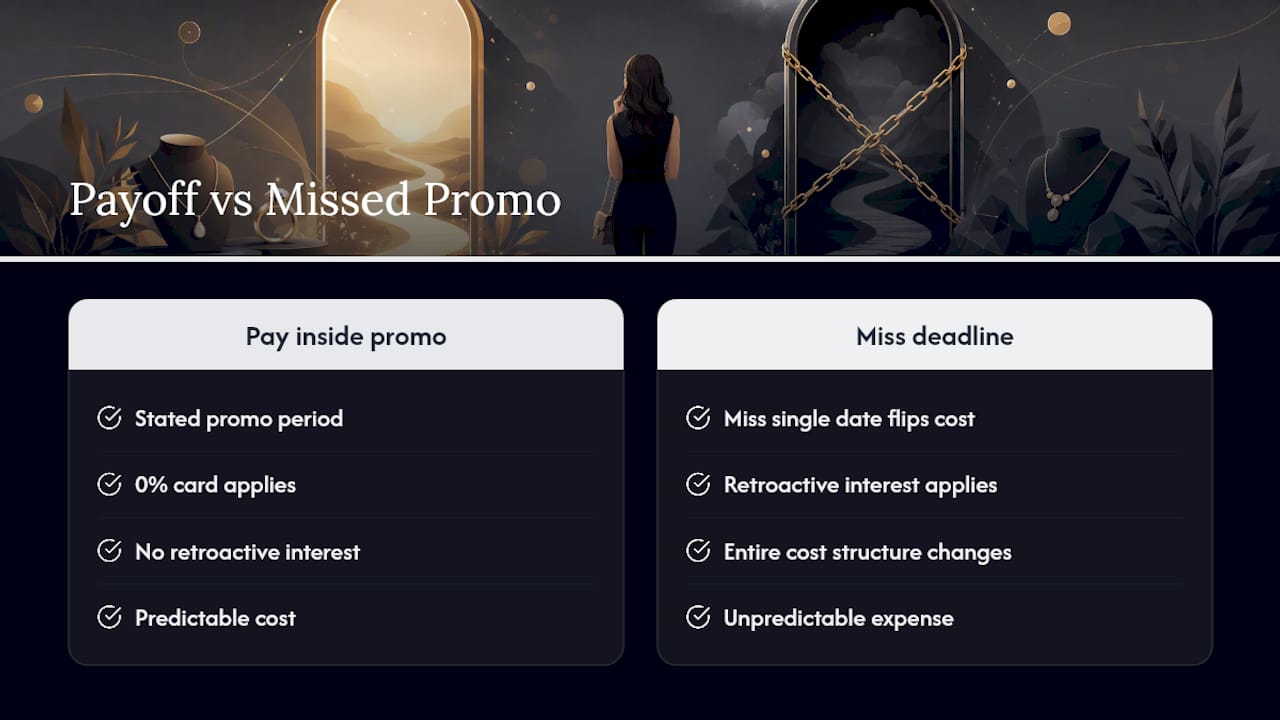
I’d rather see a buyer choose a personal loan with a disclosed 12 percent APR they understand completely than a 0% card they’re only 80 percent sure they’ll pay off on time. Predictability has value that doesn’t show up in the interest rate.
The other overlooked piece: financing decisions and credit-building goals often pull in different directions, and most shoppers never notice until the statement arrives. If you want this purchase to help your credit file, that changes which plan wins, not just whether you can afford the payment. Ask about bureau reporting before you ask about the rate.
— Andrew
Shop flexible payment options built for every ring budget
Superjeweler gives you a direct path to the ring or piece you want without forcing you through a single rigid payment structure. Whether you’re working with a tight budget or ready to finance a larger centerpiece stone, the checkout is built to match the buyer profiles covered throughout this guide.

If a budget-friendly starting point makes sense for you, the engagement rings under $1,000 collection pairs real diamonds with prices that fit a pay-in-4 or short-term plan comfortably. Buyers planning a bigger purchase and comparing a personal loan against a promotional plan can browse the complete engagement ring collection and apply the checklist from this guide directly at checkout: ask about the total cost, confirm when interest starts, and know your minimum payment before you commit. Start browsing rings now and bring your financing questions straight to the payment screen, where the terms should be just as clear as the diamond itself.
This article is general information, not a substitute for advice from a qualified financial advisor. Consult a qualified financial professional about your own circumstances before acting on anything here.
Sources
- Finder — Jewelry financing guide
- Credible — How to finance an engagement ring
- LegalClarity — Can you finance jewelry?
- NerdWallet — How to finance an engagement ring
FAQ
What jewelry store has the best financing?
The best option depends on your credit profile rather than any single retailer. According to Finder, buyers with strong credit typically find personal loans or genuinely interest-free cards the cheapest route, while those with thinner credit files may need to weigh a store plan against its higher long-term cost.
What is the 2:1:1 rule in jewelry?
The “2:1:1” idea circulating online generally refers to a rough budgeting split for a ring purchase across savings, financing, and a trade-in or resale value, but there’s no standardized, universally recognized definition of this rule in the financing industry. Treat any version you see as a loose guideline, not a fixed formula.
Can you do payment plans at jewelry stores?
Yes. Most jewelers offer some combination of store credit cards, BNPL installment apps, layaway, or in-house payment plans, and Superjeweler’s checkout supports flexible payment options for shoppers who want to spread out a purchase.
What is the easiest jewelry store credit card to get?
Store credit cards generally have looser approval standards than personal loans since they’re tied to a specific retailer, but approval still depends on your credit profile and the issuing bank’s requirements. Confirm the post-promo APR and whether the card uses deferred interest before applying, since LegalClarity’s research shows these can jump sharply once the promotional period ends.
Does BNPL financing hurt your credit score?
Most BNPL providers use a soft credit check that doesn’t affect your score at application, but Firstcard’s research notes that a growing number of providers now report ongoing payment activity to credit bureaus, so missed payments can still show up on your credit file.
Recommended
- Affordable Jewelry Shopping Guide for Quality Finds
- Step by Step Jewelry Buying: Your Complete 2026 Guide
- 7 Affordable Jewelry Gift Ideas for Stylish Occasions
